Industry Solutions · Manufacturing
uEngine MES
A manufacturing execution system that records every change as an event — it calculates the impact when equipment stops, keeps the grounds for each judgment and action, and has AI agents respond under human approval
This is a demonstration reference implementation. The source is not public, and the companies, products and figures on screen are all synthetic. Contact us for a demo environment.
From an MES That Records to an MES That Judges and Responds
If you store only the current state, the reason it got there is lost. uEngine MES stores every change as an event. When equipment stops, it calculates which work orders, sales orders and due dates are affected, and the person's judgment and the result of the action continue in the same history.
On top of that sit Process GPT agents and a semantic layer. Agents gather evidence from several systems and propose options; once a person decides, they execute and read the source again to confirm. A decision the person marks "apply from now on" becomes a new version of the rule, so the same failure is handled without a decision next time.
From Floor Response to AI
Every screen was captured from an actual run. Click a screen to play that chapter's video (Korean narration).
FLOOR RESPONSE
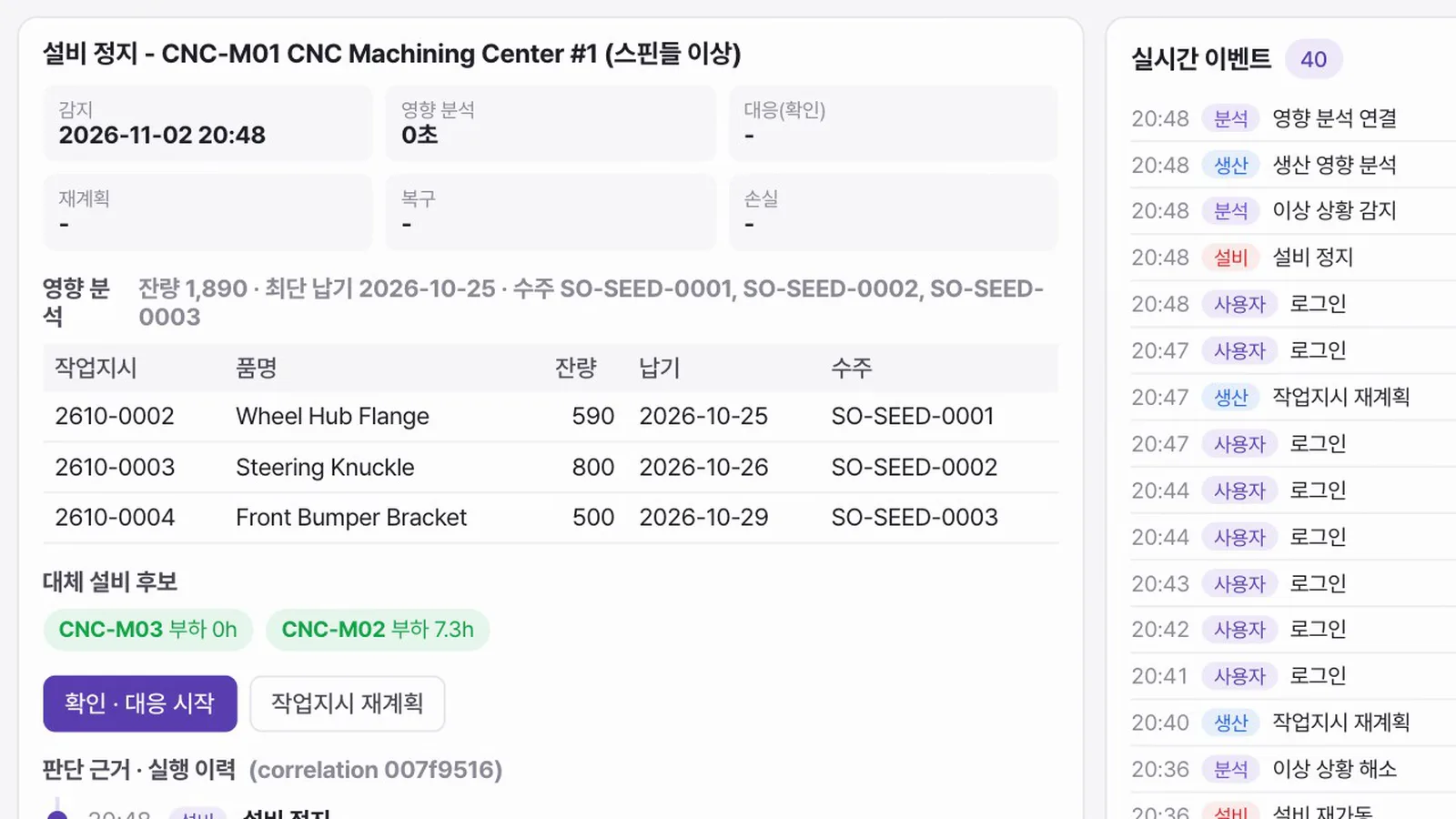
When Equipment Stops, Impact Comes First
Registering a stop opens an anomaly case, with the impact and alternative equipment candidates right away.
- Impact analysisFollows the links from equipment to work orders, sales orders and due dates to calculate remaining quantity and the nearest due date.
- A response people chooseHolds and replanning to alternative equipment run with a reason and an approver.
- Response metricsImpact analysis, response, replanning and recovery times and lost quantity are calculated from event timestamps.
HISTORY AND TRACING
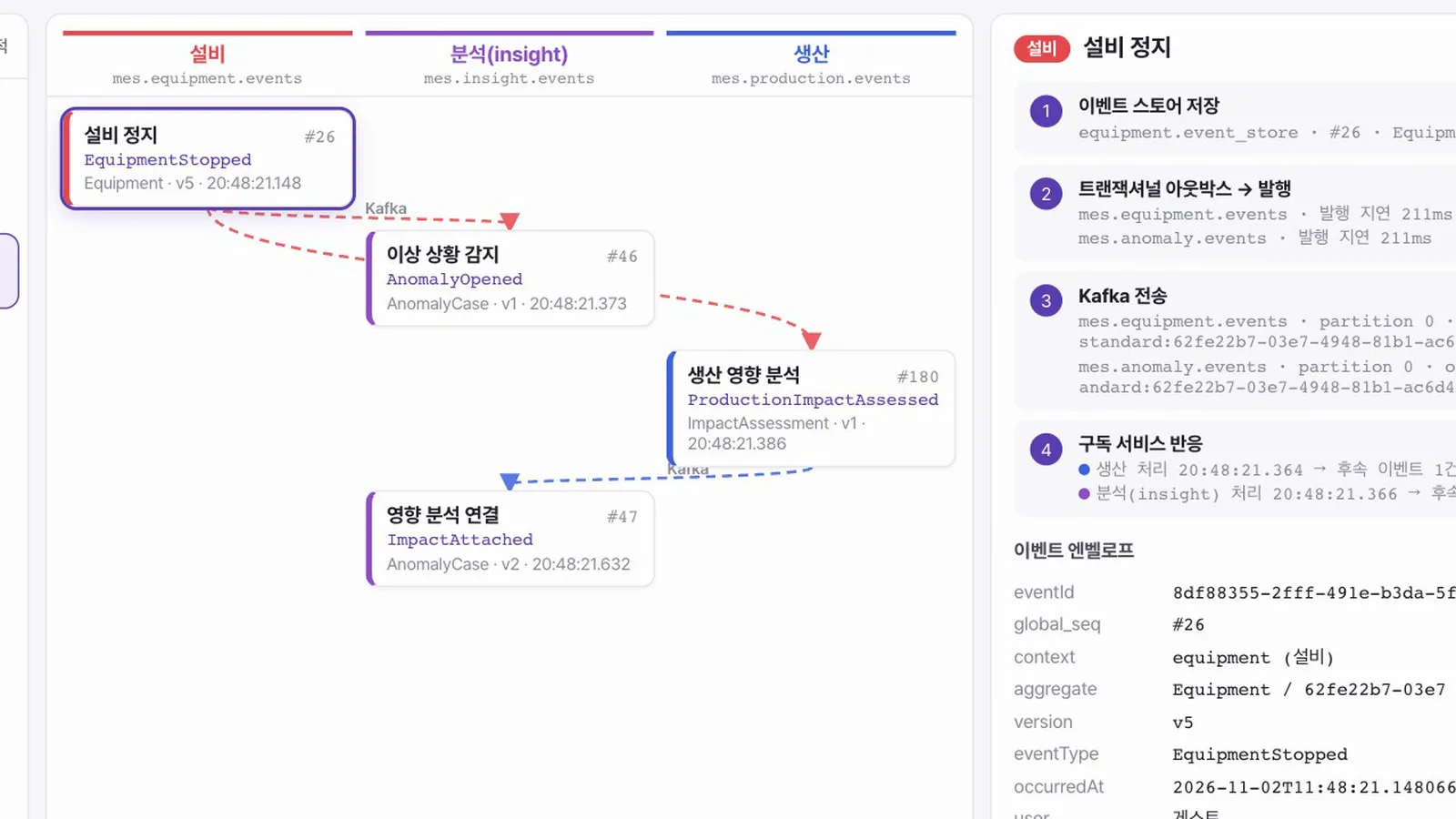
Trace Why It Happened, Through Events
Cause and effect across services stay on record, and you can see the factory as it was at that moment.
- Change historyEvery screen shows field-level before and after, the reason and the approver.
- Process traceEvents tied by a correlation ID are laid out in service lanes with causal arrows.
- Point-in-time view and rebuildReplays events to restore equipment state at that time, and rebuilds read models from events.
AI
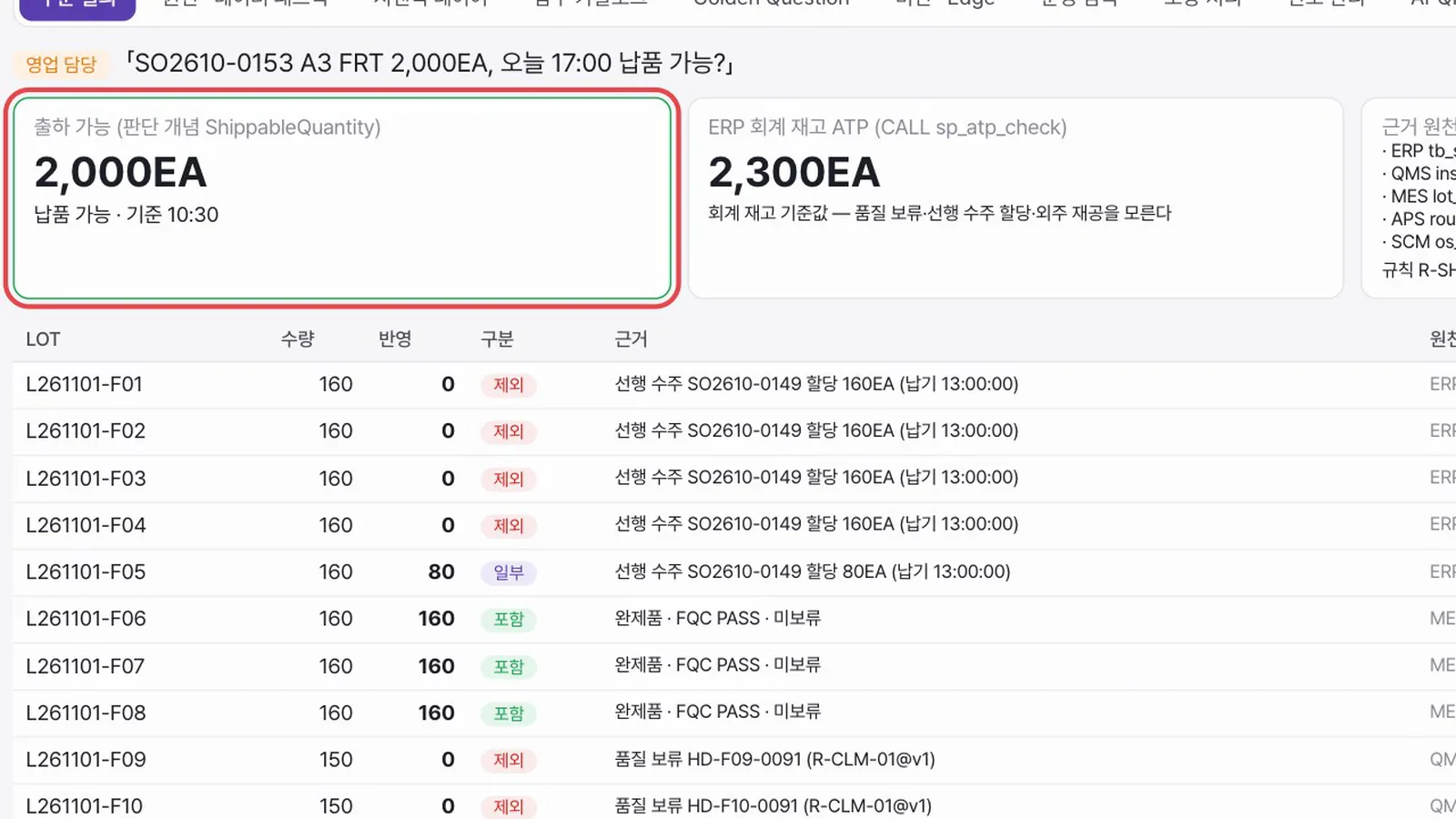
Tie Scattered Systems into One Judgment
Questions no single system can answer, such as "Can we deliver 2,000 by 17:00 today?", get an answer with lot-by-lot evidence.
- Sources stay in placeSeven sources (ERP, SCM, APS, MMS, QMS, MES, Edge) are read at query time without copying.
- Judgment conceptsConcepts no system holds, such as shippable quantity, are defined together with their rules.
- Functions and regressionExisting procedures and services are promoted to read·plan·exec functions and rechecked with Golden Questions.
AI
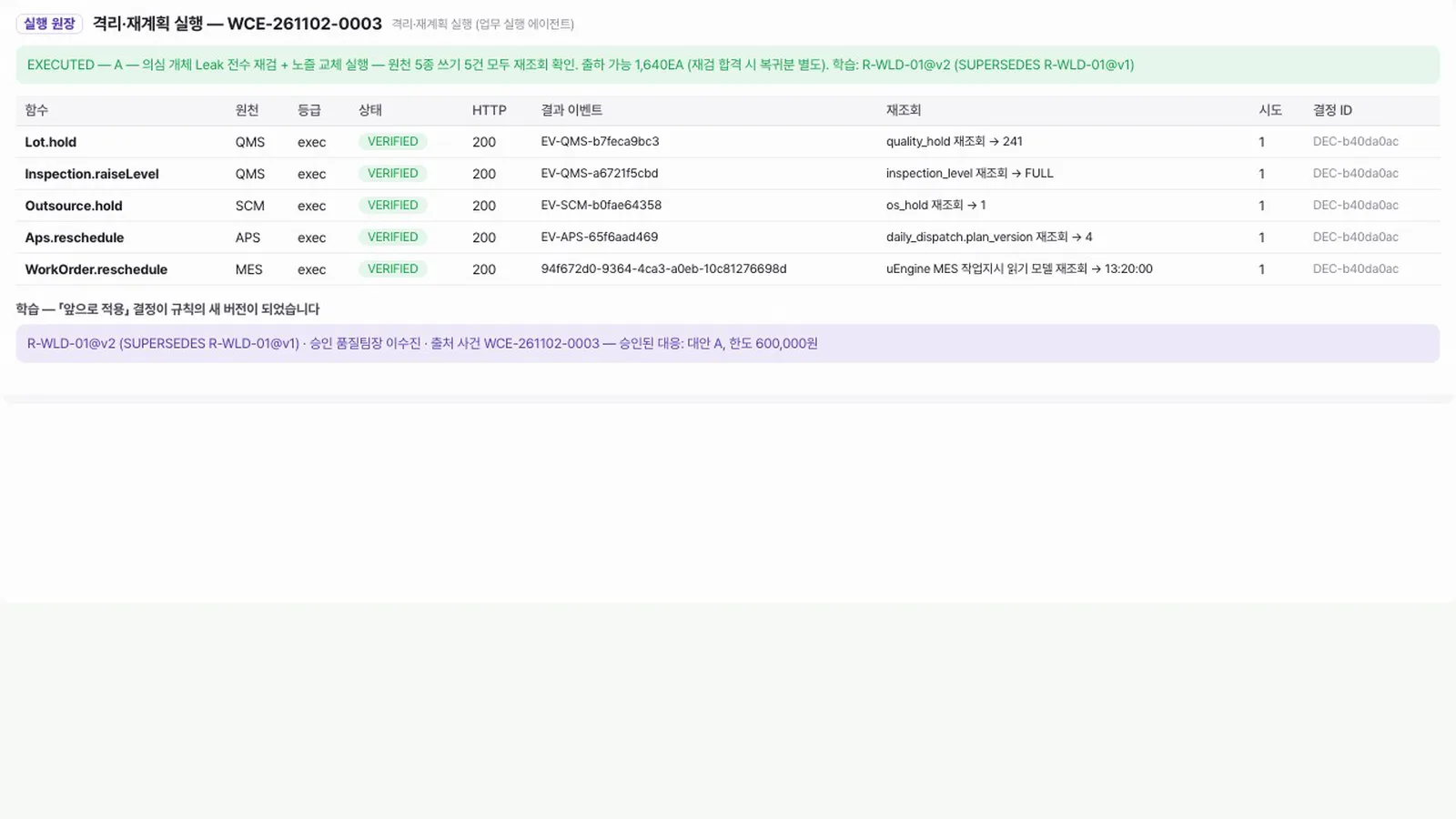
Agents Propose, People Decide, Rules Learn
Departmental agents pass along one welding anomaly and work it through. The person only chooses on a decision card.
- Departmental agentsThey take on risk assessment, suspect lot tracing, delivery impact and option simulation in turn.
- Execution and re-readThey execute only on an approved decision and read the source again after every write.
- Automatic handling on recurrenceA decision marked "apply from now on" becomes a new rule version, so the next case is checked against conditions and executed automatically.
What It Is and Where It Stands
What is done and what is not, stated plainly.
| Category | Description |
|---|---|
| Backend | 10 business services and a gateway. Java 17, Spring Boot, Kafka, PostgreSQL |
| UI | Vue 3. 9 top menus, 60 mid menus, 145 screens. Most are generic grid screens; core screens for production, equipment, quality and warehouse are purpose-built |
| Event sourcing | Append-only event store, outbox, correlation and causation IDs, point-in-time views, projection rebuild |
| AI | Process GPT processes and agents, semantic layer, read·plan·exec functions, human decision cards |
| Not yet | Generic screens have no domain rules. Permission data is not yet enforced on menus or APIs. There are no container images. The semantic layer and data fabric are lightweight demo implementations, and vision inference is imitated with pixel rules rather than a trained model |
Watch the Videos
Recorded while actually running on synthetic data, with Korean narration and subtitles. Click a thumbnail to play.
Product Demo
Product Demo
Equipment stop response, event tracing, the semantic layer and agents in one video.
Tutorial (Korean)
Chapter 0: Getting Started
A tour of the layout, menus, grids and change history.
Chapter 1: Responding to an Equipment Stop
From an equipment stop through impact analysis, replanning, restart and resolution.
Chapter 2: Event Tracing
Causal tracing, the event store, stream replay, point-in-time views and projection rebuild.
Chapter 3: The Semantic Layer
One delivery question leads through sources, the ontology, functions and the regression set.
Chapter 4: Agent Collaboration and Human Decisions
A real run of detection, agents, a human decision, execution, learning and automatic handling on recurrence.
Start with a Look at the Demo
Go through the demo environment together, then find which work should go to agents in an Agent Storming Workshop.
Have more questions?
Want to know more about uEngine MES or have a question? Get in touch anytime.