The Story Behind the Records
Opening Up Technology,
Building Together Over Time
From a small engine that expressed the flow of work as software, to the cloud and AI. Running through uEngine's journey is one belief: customers should be able to understand the technology and evolve it themselves.
uEngine BPM
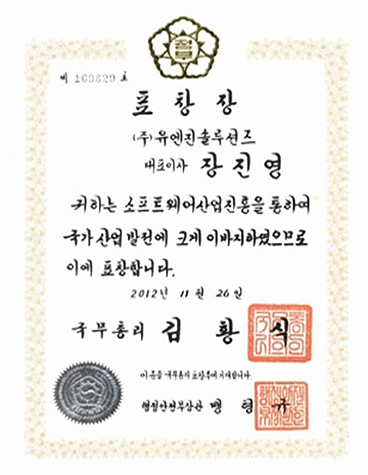
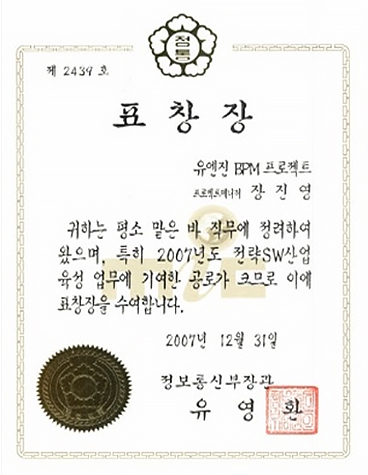
Download ranking achieved in the Enterprise category
uEngine BPM selected among
Enterprise Open Source Applications
The decision to open-source an engine we built ourselves came back to us as the attention of developers around the world.
2001–2006 · Beginnings and Going Open
So Everyone Could Use the Engine We Built
In 2001, uEngine began R&D on a BPM engine that expresses and executes business processes as software. The starting point was to turn recurring work flows into visible models and to build an engine that could be adapted to the way each company works.
In 2003, we released uEngine BPMS on SourceForge. We opened up even the internal structure so developers could read, modify and evolve the code together. It was a deliberate choice: the companies using the product should keep people who understand it.
2006–2011 · Into the Enterprise
The Responsibility That Comes After Open Source
Founded as a sole proprietorship in 2006 and incorporated in 2007, the open engine began taking on real enterprise work. It connected work flows across very different settings: quality management in automotive, underwriting and approvals in finance, and operations in manufacturing and logistics. Through Process Codi, we also extended the reach of BPM into human collaboration.
Being open source did not automatically solve the challenges of adoption and operations. uEngine chose to share the customer's operational burden through architecture consulting, technical support and training. Building the system and equipping customers to run it themselves have always gone hand in hand.
2012–2016 · Open Cloud Engine
Bringing Individual Technologies Together into One Platform
Our focus widened from tools for designing work to environments for developing and deploying it. uEngine Cloud Edition and a web-based IDE were attempts to let developers write code in the browser and connect all the way to the runtime environment.
In 2013, the Open Cloud Engine (OCE) alliance was formed. uEngine, uEngine Cloud, CUBRID, Cloudine, Enkisoft, MHR and WebSquared pooled their technologies in workflow, databases, WAS, big data and operations. Rather than merely extending one company's product, we built an open-source platform that connected each other's expertise.
The shared cloud pool and application-sharing environment for public R&D institutions such as the Korea Institute for Advancement of Technology (KIAT) is one example of this collaboration reaching the field. The idea of connecting analysis, design, development, deployment and operations lives on today in uEngine Cloud.
2017–2022 · Cloud Native
From Moving Servers to Understanding the Work
Even with a cloud environment in place, how to break up a large system remained a hard problem. uEngine focused on domain-driven design (DDD) and EventStorming so that business and developers could understand the work together and design services along those boundaries.
That experience led to MSA Easy's modeling and code generation and Kubernetes-based deployment and operations. We wanted to create a flow in which a model describing the work leads to implementation, and the implemented services run in a real environment. It carried the original BPM idea of 'connecting work and software' into the cloud-native world.
Community and Education · Building Capability Together
Leaving Behind People Who Understand, Along with the Tools
Opening our source code led to sharing knowledge and experience. Through open-source community activities, participation in the eGovFrame Open Community, the Open Cloud Engine Conference and technical lectures, we have shared what we learned in the field.
MSA School has taught everything from domain design to cloud-native implementation. As of 2024, its record of 325 courses, 9,655 participants and 17,864 cumulative hours holds the time of developers who learned a new architecture first-hand to apply it in the field.
Cloud-native consulting and training case studiesTime with Customers · Accumulation and Change
Relationships That Prepare for the Next Change Together
Hanwha Group's early adoption of our groupware engine and our participation in its 2010 enterprise-wide system rebuild led to MSA transition consulting for Hanwha Systems in 2021, implementation training in 2022, and the Hanwha Life BPM build awarded in 2025. It is a history of solving the same customer's new challenges with different technologies.
LG's MSA development methodology and manufacturing BPM, KB Wallet's MSA implementation consulting, POSCO's logistics platform and AI transformation, and Gov24's cloud-native consulting. Industries and systems differ, but the process of understanding the work, establishing the design and helping it run in the field has continued.
BPM case studies2023–Present · Continuing the Journey with AI
Back to the Starting Point: Technology That Understands the Work
Even in an era when AI writes the code, explaining what to build and how it should behave still matters. Robo Architect, which evolved from MSA Easy, connects design specifications to implementation, and Robo Modernizer helps understand and transform existing systems. Robo Architect's outputs are deployed to uEngine Cloud and carried into operations.
uEngine6 BPM and Process GPT are moving toward executing accumulated business processes together with AI. Process-GPT's GS Certification Grade 1 and registration on the Public Procurement Service Digital Service Mall in 2026, along with process asset creation and agentic automation in the SKT OSS domain, are all part of that continuum.
The names of the technologies change, but our commitment to helping enterprises understand their own work and software and change it themselves stays the same. uEngine continues that work together with open source.