AI-Native Enterprise: Redesigning Management Around Impact and an Execution Strategy
For the past few years, the hot topic for every company, at home and abroad, has been 'AI adoption.' Bolting on a chatbot, handing out copilots, and building an in-house LLM platform passed for 'innovation.' But as of 2026, the leaders of forward-thinking companies have begun asking a slightly different question: "Can AI itself become a weapon of ours that no one else can imitate?"
The answer is mostly 'no.' OpenAI's models and Palantir's platform can be bought just the same by any competitor with the money. So where does real competitiveness lie? The 'AI-Native Enterprise' framework that uEngine Solutions has put together contains the answer to that question. In this article we will walk through, in order, how executives' questions are changing, why 'management redesign' rather than 'AI adoption' is what separates results, and what it takes to make that redesign actually work inside a real organization.
1. AI is a means — real competitiveness lies in becoming an 'AI-Native Enterprise'
Let us start with the conclusion. AI is a means, not an end. Foundation technologies from OpenAI, Anthropic, and Palantir are open to every company in the world on identical terms at this very moment. A technology anyone can buy with capital alone can never be a sustainable competitive advantage.
In fact, the performance gap between companies that delegated AI innovation to an operational function such as a CAIO and companies whose CEO took personal charge and drove aggressive investment is widening over time. The former remain stuck in incremental, department-level optimization, while the latter are reshaping their productivity and revenue structures and building a winner-takes-all position.
The essence of this gap is not 'who is in charge of AI projects,' but how fundamentally decision logic and business processes have been redesigned on the premise that AI exists. We call a company whose entire organization has been redesigned to be AI-native in this way an 'AI-Native Enterprise', and it is the theme running through this entire article.
2. The question is changing: from 'what' to 'how'
In 2022–2023 we passed through the 'age of exploration.' Back then, the central question for executives was "What on earth is AI? Why should we adopt it?" Curiosity-driven early adopters brought in tools sporadically, and the results were fragmented.
As of 2026, we have entered the 'age of application and proof' (Applied AI). The question has now shifted entirely to "How do we structurally embed AI into our business environment?" The agenda has moved from curiosity to creating tangible impact, and on to a fundamental redefinition of corporate competitiveness.
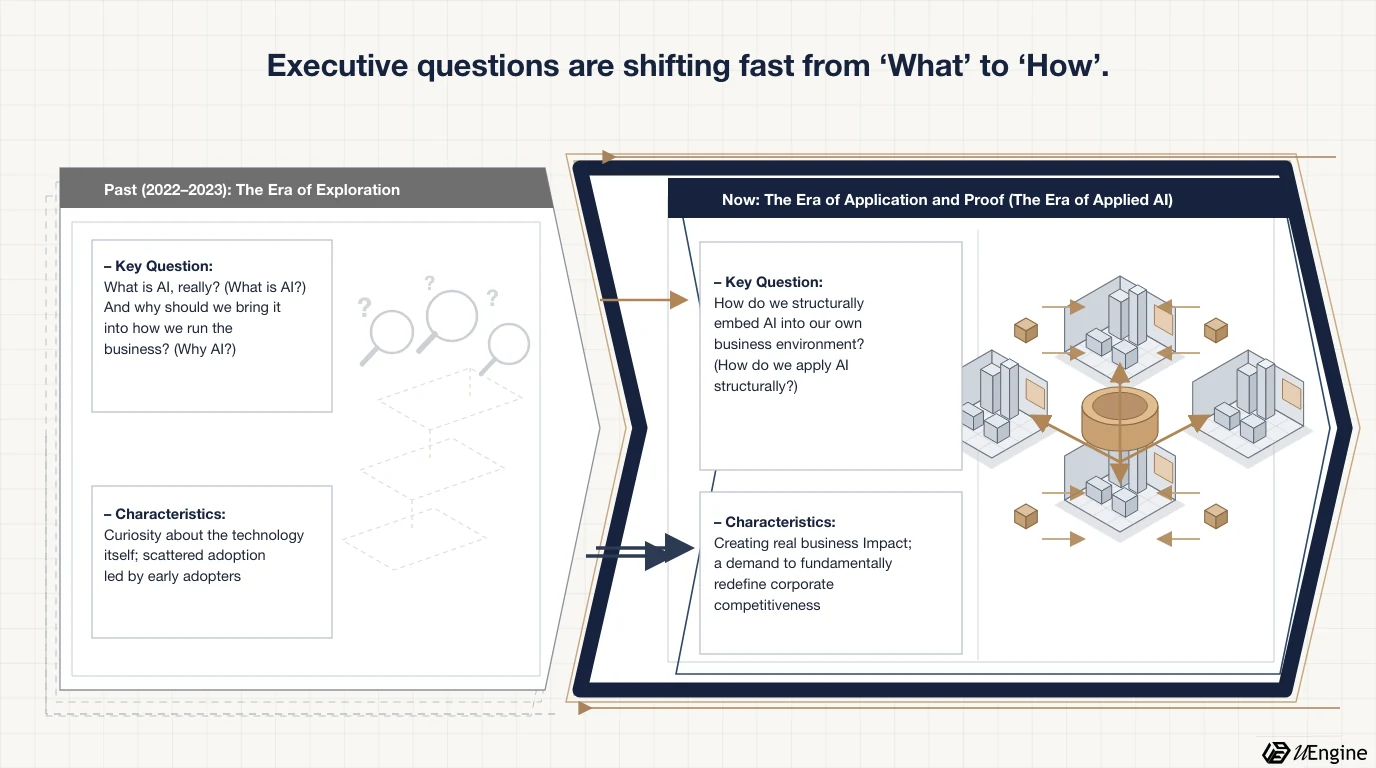
Executives' questions are shifting rapidly from 'What' to 'How'
There is a very common trap in this transition: 'The Illusion of Deployment.' A company hands out ChatGPT or Claude accounts to every employee and pours in budget for over a year, yet when you look closely, it is often hard to explain what has fundamentally changed at the company level. That is because the 'bottom-up adoption' visible above the surface accounts for only 30% of the whole.
The remaining 70% that actually decides the game lies below the surface: 'structural reshaping' that completely redefines the company's basic sources of competitive advantage around AI — in other words, a fundamental, top-down change of the rules.
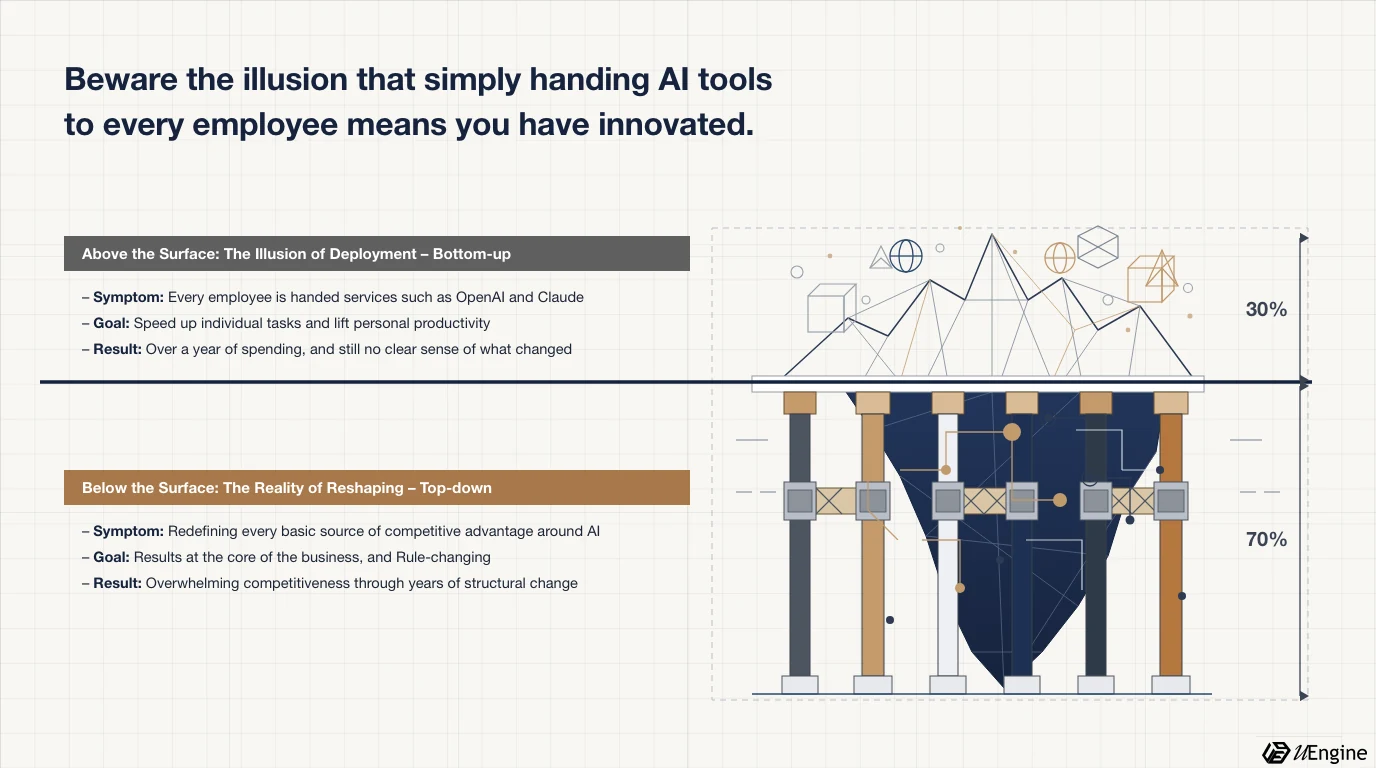
The 'illusion of deployment' above the surface (30%) versus 'structural reshaping' below it (70%) — the real game is decided where it cannot be seen
Deploy vs. Redesign
| Category | Deploy (simple adoption) |
Redesign (full rebuild) |
|---|---|---|
| Approach | Bottom-up, individual use of tools | Top-down, enterprise-wide structural innovation |
| Application to work | Keeps the existing way of working and loosely slots AI in somewhere in the middle | Completely reinvents the sequence and method of work on the premise that AI exists |
| Who leads | Practitioners and technology executives (CAIO) | The CEO and the strategy organization |
| Expected effect | Incremental speed | Exponential impact on the core of the business |
There is one key takeaway from this table. If you leave the existing sequence of work untouched and simply insert AI somewhere in the middle, it is hard to get anything beyond incremental speed gains, no matter how good the model. To change the magnitude of the outcome itself, the sequence of work and the division of roles must be redrawn on the premise that AI exists. How much of a difference that redesign actually makes is covered with concrete examples in Chapter 4.
3. AI-Native Enterprise — a winning formula of our own that money cannot buy
So what is the asset unique to our company — the thing others cannot buy — that becomes the subject of this redesign? Here we need to address one common misconception: the belief that "AI technology itself, such as OpenAI or Palantir, is the competitive edge."
Reality is different. These technologies are merely fast, capable means of execution, and anyone outside can buy them for the same price. Real competitiveness lies in the logic that decides where and why that AI should move, and in how that judgment is carried into actual business processes — in other words, a state in which the entire organization has been redesigned on the premise that AI exists. We call an organization that has reached this state an 'AI-Native Enterprise'.
What is an AI-Native Enterprise?
- 🧭 Definition: A company that has redesigned its decision logic and business processes from scratch on the premise that AI exists, so that AI has become the organization's basic unit of execution.
- 🏆 Core value: Whether our own way of winning — the essence of what makes a new product succeed — is infused into both the decision logic and the execution processes.
- 🔒 Condition: It cannot be built for you by an outside party; it must be internalized by the company itself.
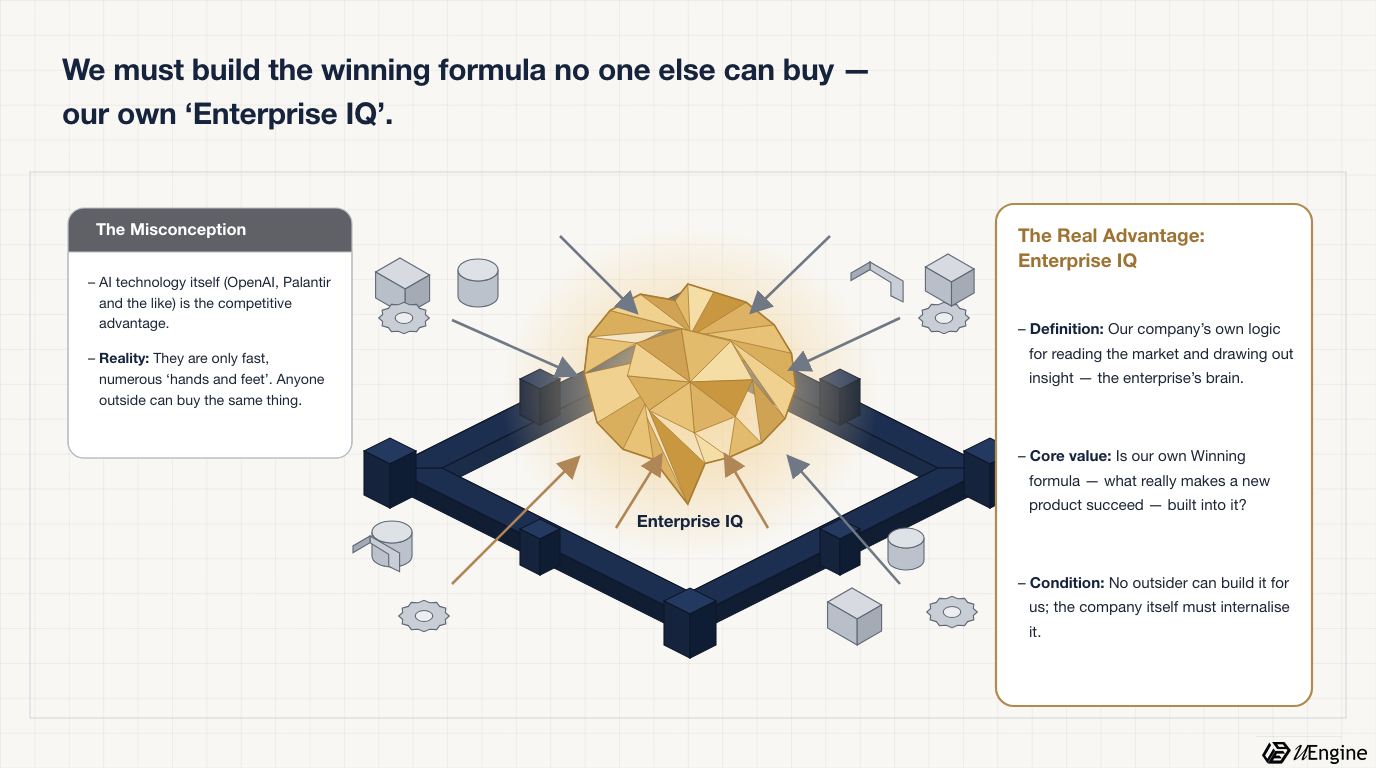
The core asset of an AI-Native Enterprise — proprietary decision logic internalized within the company, which others cannot buy with money
Hearing this idea of 'internalizing decision logic,' a natural question arises: So how do you actually build this decision logic, and where do you keep it? The starting point is usually already inside the company: scattered databases, decades-old legacy code, operating manuals, and the tacit knowledge in the heads of the people in charge. The problem is that these exist only as 'data' and 'experience'; the causal relationships among KPIs, metrics, processes, and resources — that is, 'what affects what in our company' — are not spelled out anywhere. Building a judgment asset ultimately means extracting these causal relationships from people's heads and putting them into a form the organization can share and machines can read.
4. How redesign produces overwhelming results
The theory sounds plausible, but is there evidence that redesign actually outperforms deployment? The new product development (NPD) process is a good example.
The old approach was a linear structure: write a single proposal (with AI merely speeding up parts of the research), then push it through review and approval, taking 6–12 months. AI remained an auxiliary tool tacked onto the existing process.
The redesign approach is different. AI scans market opportunity areas and generates 'multiple' draft new-product proposals simultaneously, then rapidly narrows them down to the ones with the highest probability of success — a 'multi-hypothesis validation funnel' that reorders the work itself to be AI-friendly. As a result, the time required shrinks to 1–2 months.
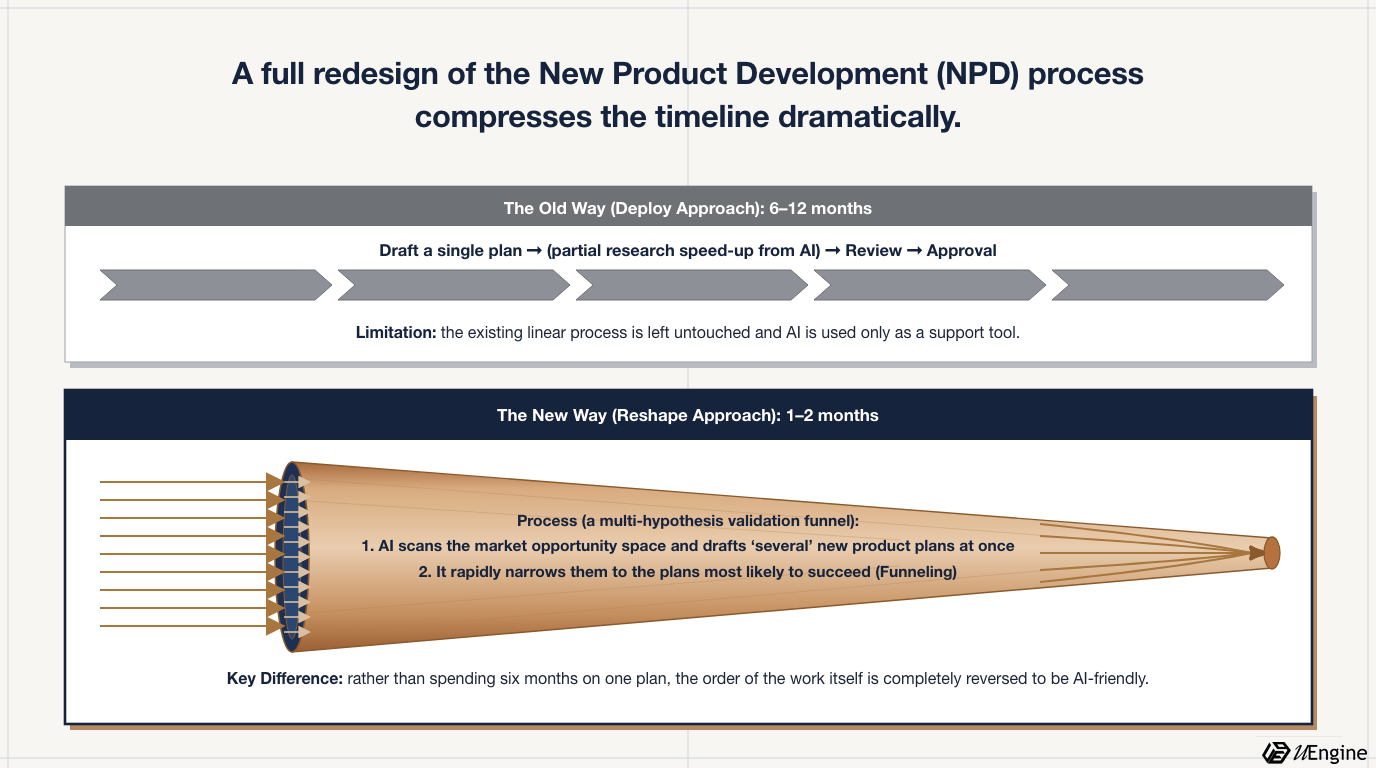
The multi-hypothesis validation funnel — instead of spending six months on one proposal, validate several alternatives simultaneously and narrow down quickly
The Goldman Sachs lesson: 5 core changes beat 100 PoCs
The Goldman Sachs case teaches the lesson from the opposite direction. Before 2024, Goldman Sachs had sporadically attempted some 100 fragmented PoCs (proofs of concept), almost as if pushed into them. CEO David Solomon later reflected: "We acknowledge our failure. We did not manage to produce a proper success story."
After 2024, Goldman Sachs changed its philosophy, shifting to concentrate its AI transformation resources on just five or six core areas that touch what matters most. Scattered adoption only adds fatigue. All resources must be concentrated on the few structural changes capable of delivering enterprise-wide impact.
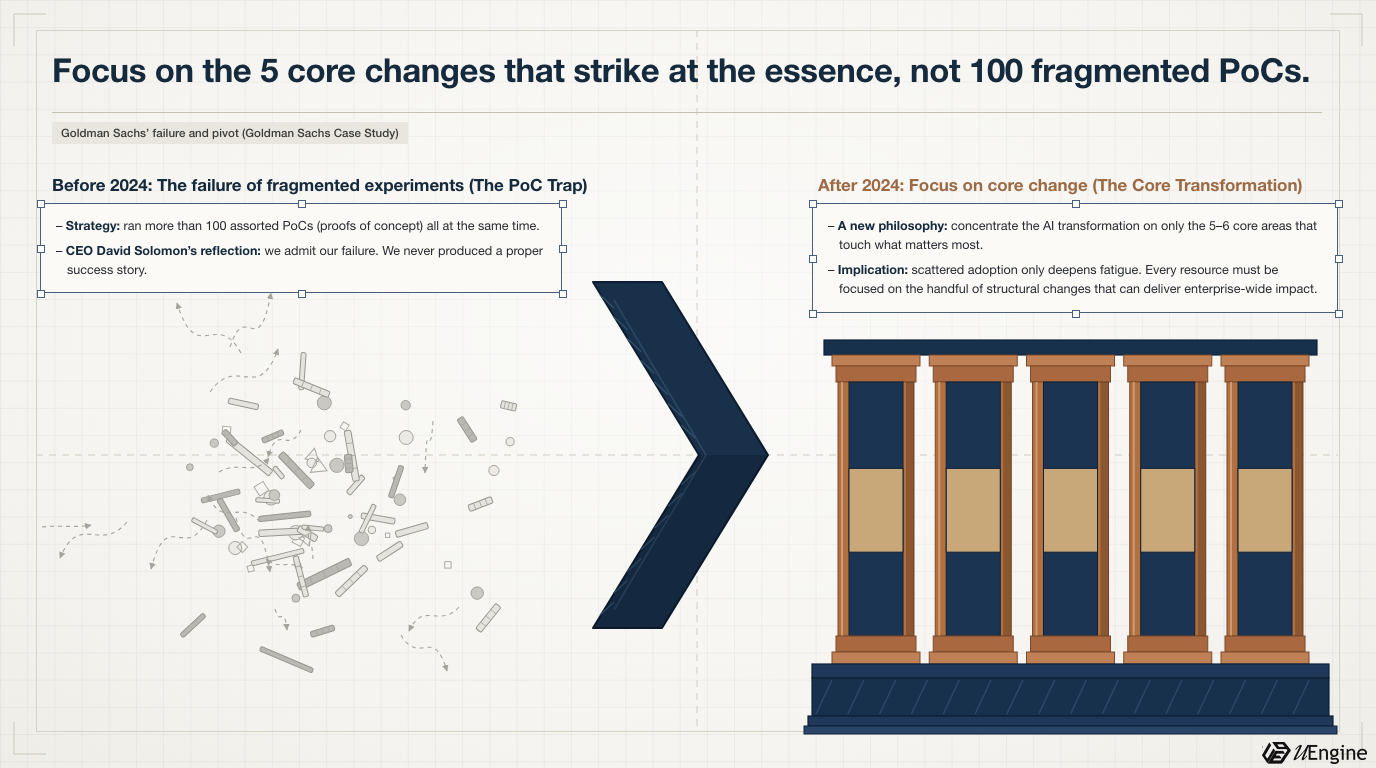
100 fragmented PoCs (Goldman Sachs, before 2024) → 5 core changes that strike at the essence (after 2024)
To sum up, this chapter offers two lessons. First, instead of changing tools, redesign the sequence of work itself to be AI-friendly. Second, instead of spreading thinly, concentrate resources on the few core areas that strike at the essence. Fail to honor both, and even an initiative called 'redesign' will ultimately scatter into 100 PoCs.
5. 70% of success or failure lies in people and organization
No matter how sophisticated the redesign strategy, 70% of a successful AI transformation is decided not by technology but by 'people' and 'organization.'
At the top of the pyramid (the illusion of technology, 30%) sit technology-adoption tasks such as AI strategy formulation, platform construction, and data-driven design. But no matter how excellent the AI platform you build, that alone will never produce results.
The real center of gravity is at the bottom of the pyramid (the reality of execution, 70%): changing how frontline organizations work (processes), overhauling the organizational structure where needed, and strong change management grounded in a deep understanding of, and close engagement with, the organization.
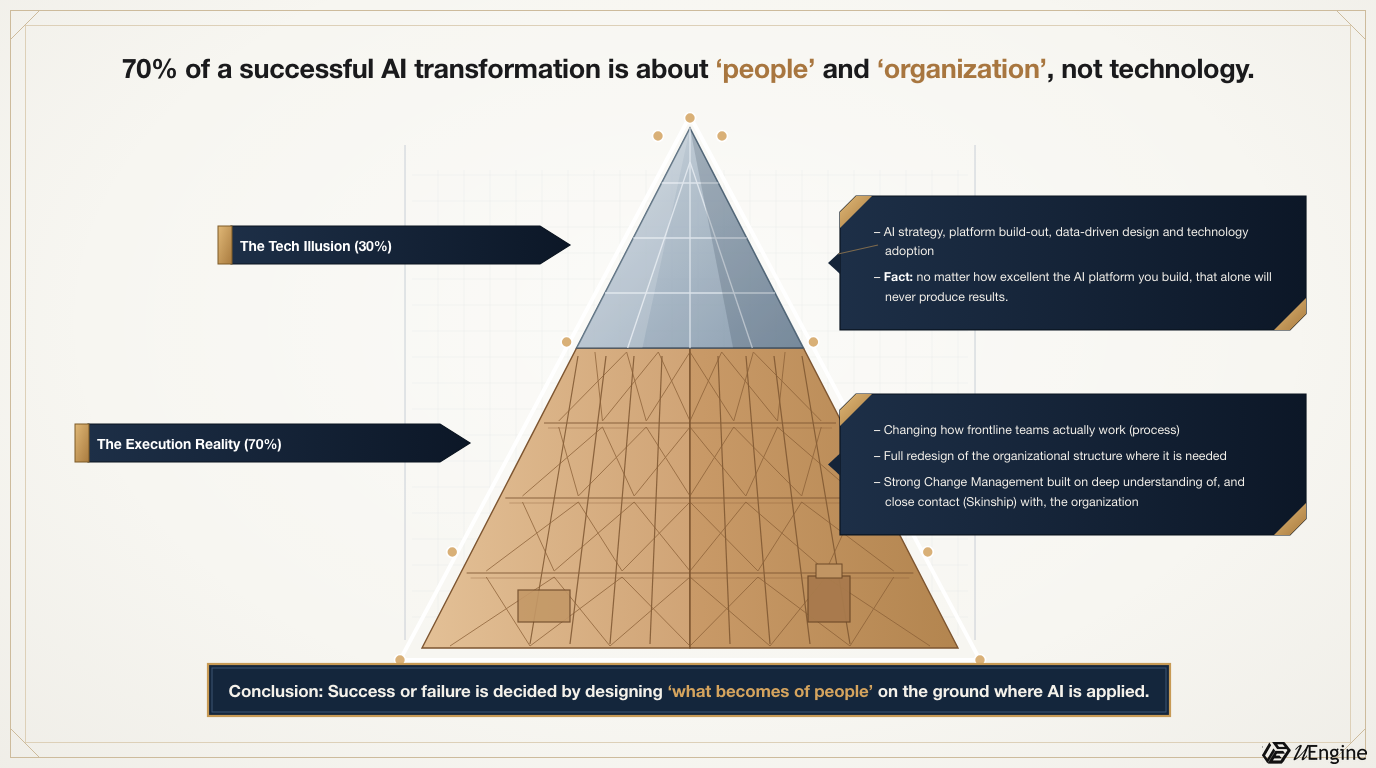
70% of a successful AI transformation is a matter of 'people' and 'organization,' not technology
The conclusion is clear. Designing 'how people will run' in AI-enabled workplaces is what determines success or failure.
One thing should be added here. If change management is left as a one-off project owned by a particular department, its effect disappears when the project ends. Feedback from the field must accumulate day by day in business rules and processes, rather than piling up only as the know-how of a few individuals, and the history of those changes must be recorded so it can be revisited at any time. In other words, the design of 'how people will run' must become a standing operating principle of the organization, not a one-time campaign.
6. Integrated talent will lead the future — and the opportunity for Korean companies
If the role of people becomes this important, what kind of talent can lead the change? In the AI era, reasoning ability, logical thinking, and access to knowledge are universally available to everyone, and roles built on pure technical expertise alone are losing ground.
Instead, 'integrated talent' (the Integrated Builder-Thinker), equipped with all three of the following capabilities, will lead the future.
- 🧩 Structuring and questioning (Thinker): The ability to define and structure problems precisely, driven by deep curiosity (the essence of prompt engineering)
- 🛠️ Tool use and execution (Builder): The ability to use AI tools proficiently and build solutions directly
- 🤝 Empathy and persuasion (Persuader): The ability to communicate solved problems to others with empathy and drive real organizational change
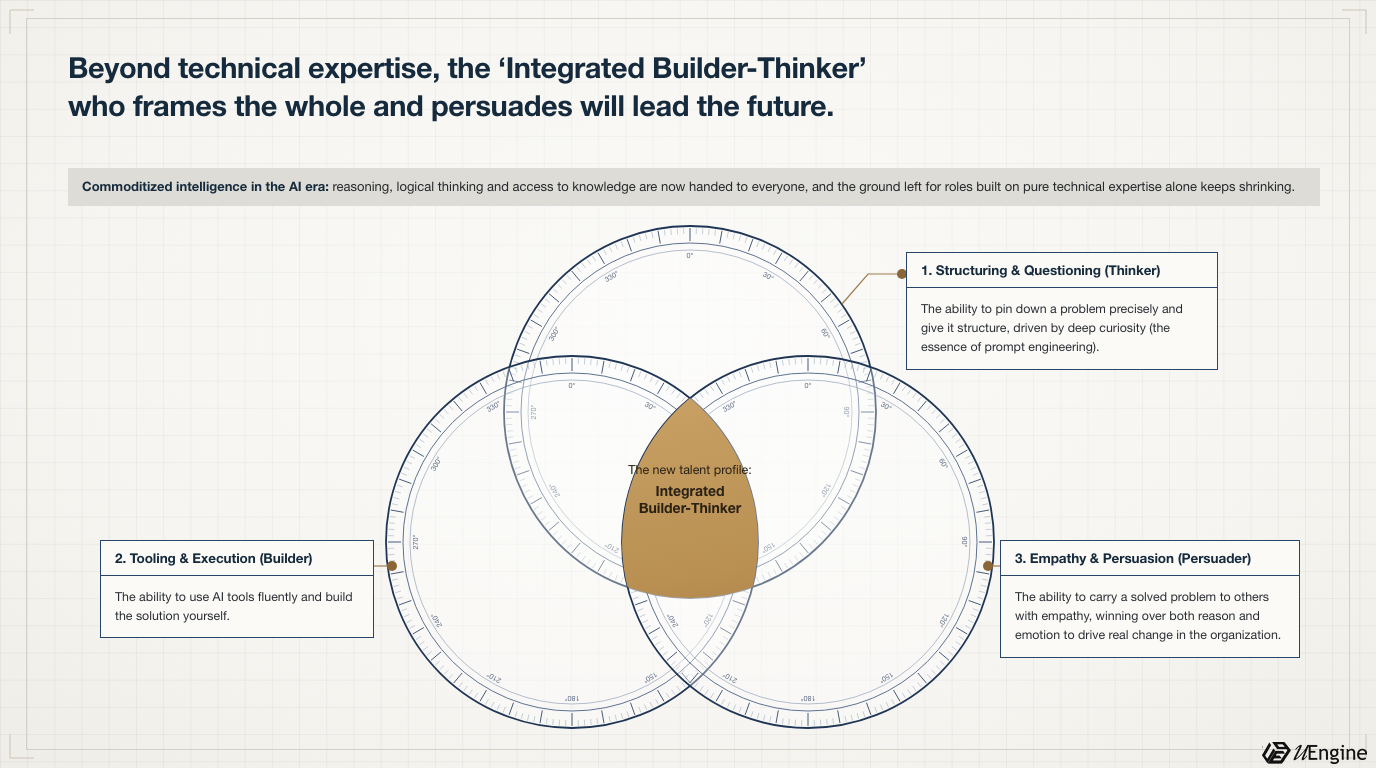
'Integrated talent' that goes beyond technical expertise to plan the whole and persuade others will lead the future
Interestingly, the rules of this new game may work in favor of Korean companies. The US leads in foundation models, but the winners of the 'Applied AI' era — where AI is brought into the field to change the rules — may be different. Massive operational scale in industries such as automotive, shipbuilding, and cosmetics, where AI leverage is maximized; an environment where AI now makes high-efficiency execution possible without enormous capital; and an execution culture in which the whole organization moves decisively behind top-down drive from senior leadership — these three are the structural strengths of Korean companies.
That said, there is a question that must be raised alongside any discussion of 'integrated talent': Does this person really need to know how to write code? No. Someone who can structure a problem and persuade the organization should be able to turn their ideas directly into executable workflows without being held hostage to the development team's schedule. If the integrated-talent thesis is to be more than a slogan, it must come with an environment that closes the distance between planning and execution.
7. The evolution of solutions — the impact engine, and the pioneer's mindset
All of these changes are also redefining what a software solution is. Solutions of the past (Tool Providers) fulfilled their role by focusing on reliably delivering a fixed set of features.
Solutions in the AI era evolve beyond tools that merely provide features into 'Impact Engines' that generate tangible results on their own. They fuse strategy and technology into a single execution logic; they root themselves directly in the customer's data and business processes to deeply understand and resolve problems through end-to-end automation; and from judgment (ontology) to execution (process automation), and on to the loop that learns from execution results and improves itself — a single product runs through the entire chain to directly produce 'impact.'
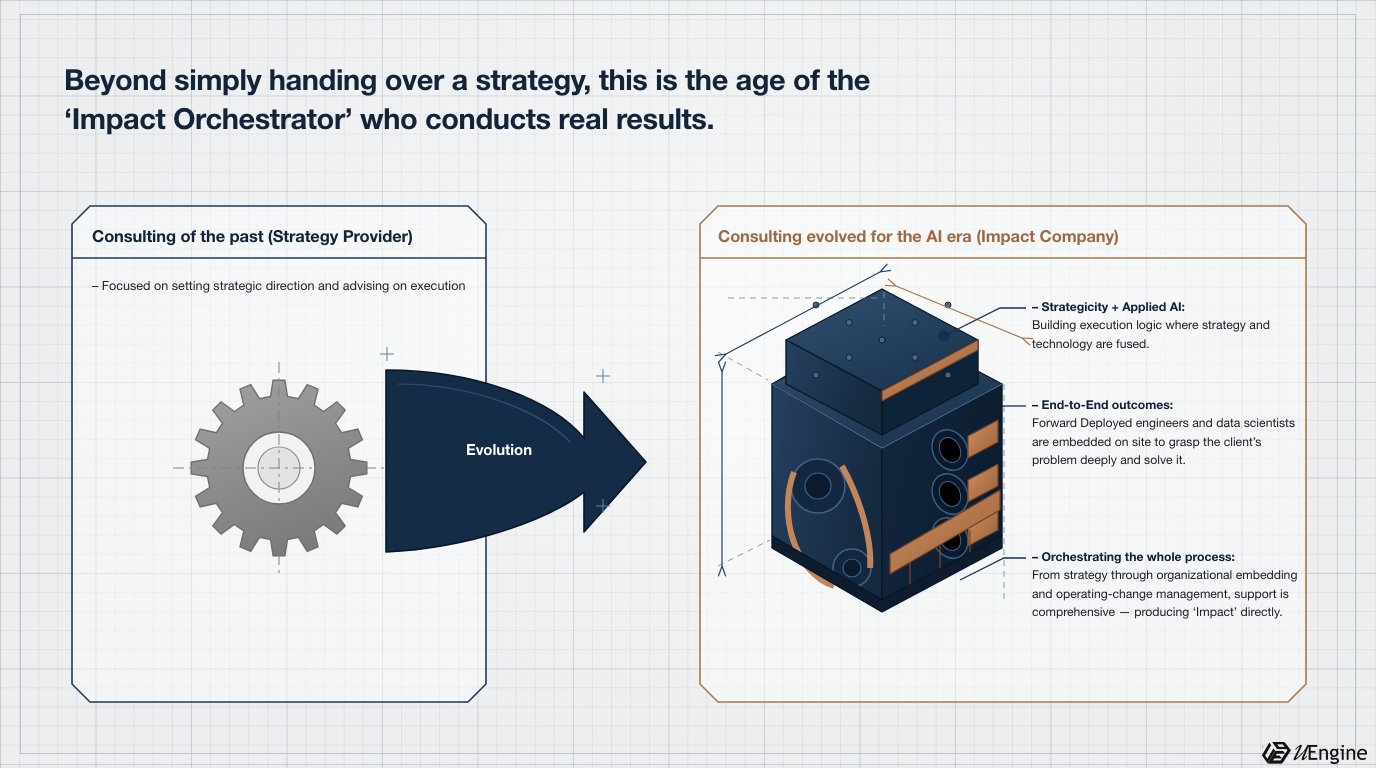
The era of the 'impact engine' that generates tangible results on its own, going beyond simple tool provision
And here is the final psychological barrier that leaders must overcome. We are in an unprecedented era in which no company holds the perfect answer to AI transformation and no global best practice is definitively ahead. A 'fast-follower' strategy that waits for someone else's success story is actually dangerous in this phase. What is needed is the resolve that says "I will be the first mover; I will create the global success story." Only companies that take the first step, experiment even at the risk of failure, and accumulate learning (continuous learning) can break through the current turbulence.
8. Three imperatives for senior leadership
The discussion so far can be distilled into three imperatives that senior leadership can act on right now.
9. Where all the pieces come together: Ontologic + Process GPT
If you have read this far, one natural question remains: "So where can I actually see this whole 'AI-Native Enterprise' picture realized today?"
In fact, the pieces we have covered in this article — the shift in the question, redesign, building judgment assets, rebuilding processes, people and organization, integrated talent, the impact engine — are not scattered theories. Building on some 20 years of accumulated BPM and MSA technology experience, uEngine Solutions has turned these pieces into two products.
If Ontologic Platform builds the 'judgment' axis of the AI-Native Enterprise — the knowledge graph that holds the company's unique decision logic and causal relationships — then Process GPT is the 'execution' axis that redesigns that judgment into real business processes and runs them autonomously. Only with both together is the transition complete: from 'an organization that handed out AI tools' to 'an AI-Native Enterprise with its own winning formula internalized.'
The two products are not tools that run separately; they interlock as a single stack. At the bottom, data integration connects in-house databases, documents, and external APIs through standard interfaces; on top of that sits the knowledge graph / ontology (Ontologic Platform), which structures execution results as entities and relationships and accumulates them; above that, multi-agents collaborating via MCP and A2A do the actual work; and at the very top, agentic business process management (Process GPT) breaks goals down into tasks and branches and orchestrates the whole.
AI-Native Enterprise concepts → uEngine product features
| Challenge from the AI-Native Enterprise perspective | uEngine's answer (product feature) |
|---|---|
| Scattered data, legacy systems, and documents → an integrated knowledge asset |
Ontologic Platform · Data integration Register data sources with 100+ connectors, and even analyze legacy code with an LLM for ingestion. ↗ See it on the product page |
| Our company's unique logic (judgment asset) |
Ontologic Platform · Domain layer Spell out your company's own causal relationships in the semantic layer, including domain schemas, ObjectTypes (semantic objects), and ontology management. ↗ See it on the product page |
| Insight logic (root-cause analysis and prediction) |
Ontologic Platform · Analysis & prediction Map real data onto the ontology to run root-cause analysis (VAR/Granger) and what-if simulations. ↗ See it on the product page |
| Detect anomalies autonomously and act preemptively |
Ontologic Platform · Automation A monitoring agent continuously evaluates conditions and automatically launches a preemptive action process when a threshold is crossed. ↗ See it on the product page |
| Go beyond Deploy and redesign the business process itself from a blank sheet |
Process GPT · No coding knowledge required Enter a goal in natural language, with no programming concepts, and AI defines a BPMN-based process from scratch. ↗ See it on the product page |
| Try multiple alternatives at once and narrow down quickly in a multi-hypothesis funnel |
Process GPT · Automated agent placement Automatically identifies the agents a process needs, maps them to BPMN swimlanes, and runs them in parallel. ↗ See it on the product page |
| Turn core work into standardized assets instead of fragmented experiments (the Goldman Sachs lesson) |
Process GPT · Reverse-engineering policy documents Automatically identifies the tacit knowledge in unstructured documents such as PDFs and images and converts it into executable BPMN process assets. ↗ See it on the product page |
| Embed change management for people and organization into the system |
Process GPT · Self-learning and improvement Field feedback automatically accumulates as agent skills and business rules (DMN), and the history is version-controlled. ↗ See it on the product page |
| Deliver trustworthy results without unfounded judgments (hallucinations) |
Process GPT · Ontology-based knowledge graph Agents use the knowledge graph built with Ontologic as their 'knowledge map,' navigating it via MCP to make well-grounded decisions. ↗ See it on the product page |
Returning to the question this article started with, the answer becomes clear. AI technology itself can be bought with money, but the decision logic that knows what that technology should do and how, and the redesigned processes that carry that judgment into execution, cannot. When Ontologic builds that judgment asset and Process GPT carries that judgment into execution in the field, an AI-Native Enterprise that no one else can imitate is finally complete.
Explore the demos of each feature right now on the Ontologic Platform and Process GPT product pages, or Contact Us to discuss an AI-Native Enterprise transformation roadmap tailored to your organization.