Our Services
Cloud-Native Application Transformation Consulting Service
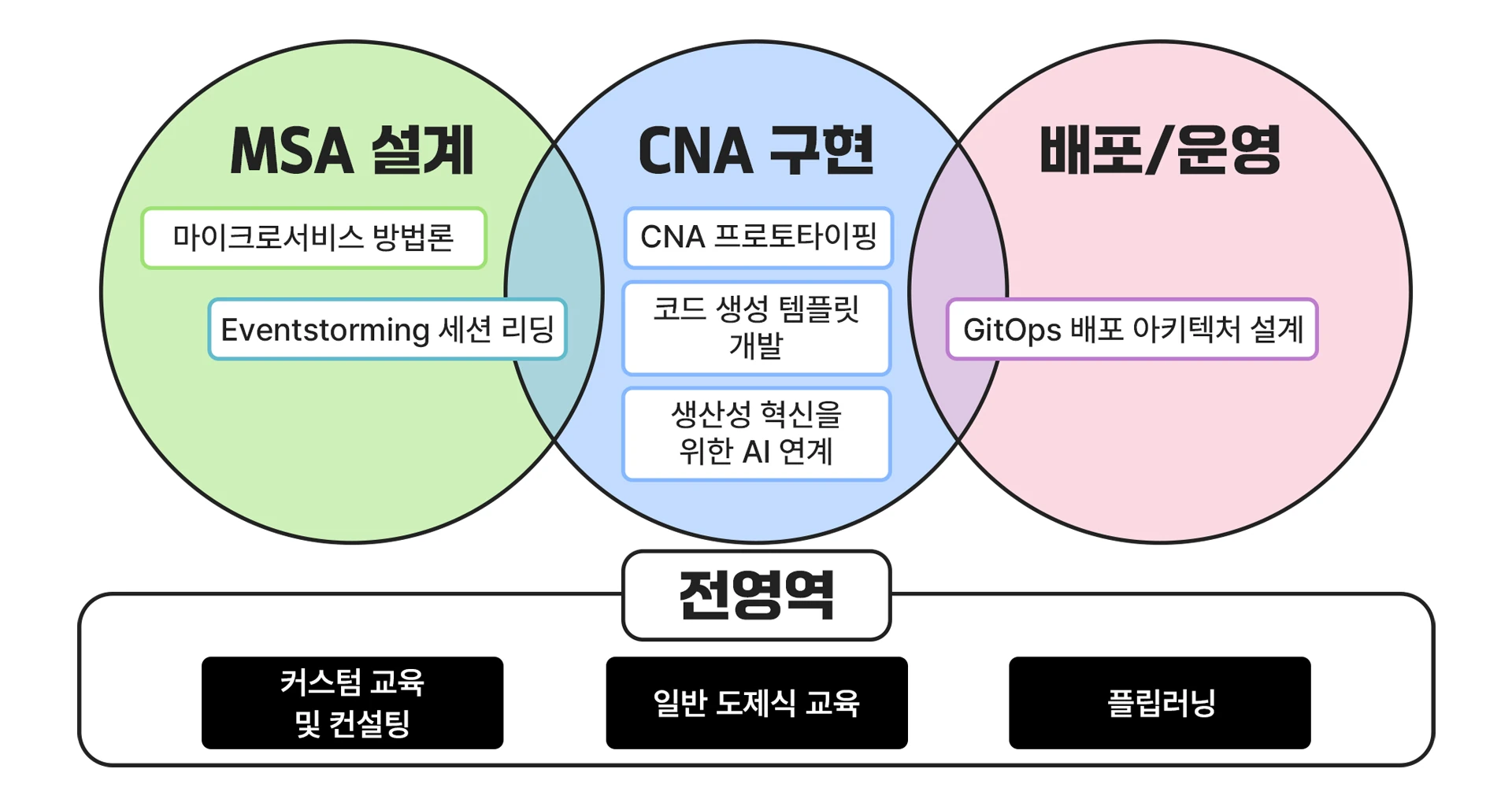
MSA (Microservices Architecture) Consulting
• Full BizDevOps lifecycle support:
End-to-end learning spanning business modeling, implementation, and deployment
• Core DDD and EDA-based frameworks:
Applying the latest event-driven microservice frameworks (Axon, Eventuate, Kafka) and architectures
• Install-free learning tools:
Online EventStorming tool and cloud IDE with no software to install
Consulting Areas
| Area | Stage | What We Cover | |||
|---|---|---|---|---|---|
| Microservices Methodology | MSA Design | Based on the DDD Starter Modelling Process (Domain-Driven Design starter modelling process), this service covers the full spectrum: architecture design, service decomposition through domain-driven design, data management and synchronization strategies, data projection techniques, event-driven communication, monitoring and logging systems, security and authentication management, operations and deployment strategies, and efficient DevOps operations through SRE. | |||
| EventStorming Session Facilitation | MSA Design | EventStorming is a standardized microservice design technique, but when misapplied, teams struggle to carry the analysis results into an actual system implementation, and flawed EventStorming results can lead to inefficient, overly complex microservices. This service focuses on guiding the feasibility of your design so that the core concepts of EventStorming are applied correctly. | |||
| CNA Prototyping | CNA Implementation | This consulting service supports the initial design of cloud-native applications and generates prototype code tailored to your domain topic. Using domain-driven design (DDD), it clearly analyzes business requirements and designs a microservices architecture on that basis. It then auto-generates prototype code optimized for the domain requirements and the cloud environment, so you can experiment and validate quickly. | |||
| Code Generation Template Development | CNA Implementation | This service thoroughly analyzes your company's domain model and business processes, then designs code templates optimized for them. Development teams can automate repetitive coding work, keep code quality consistent, and shorten development time. It is especially valuable for companies that want an efficient, standardized development environment reflecting specific business needs. | |||
| AI Integration for Productivity Innovation | CNA Implementation | We provide AI techniques for productivity innovation, including application code generation based on new technologies, screen design for legacy system migration, and log-based application modernization. We also offer end-to-end consulting for building AI infrastructure, from LLM installation to optimal AI infrastructure cost estimation and hardware specification. | |||
| GitOps Deployment Architecture Design | Deployment / Operations | This service helps your organization adopt GitOps for efficient, consistent application deployment. We design infrastructure and application deployment architecture according to GitOps principles and guide you through building an automated, Git-repository-centered deployment pipeline. The result is smooth management of real-time code changes and deployments, greater transparency and stability in the deployment process, and fast rollbacks and administration. | |||
| Custom Training & Consulting | All areas | We provide training and consulting tailored to your specific organization, company, or site. Because the content is structured around your concrete requirements, operating environment, and goals, it goes beyond theory to hands-on practice and case studies, so you can apply it to real work immediately. | |||
| General Apprenticeship-Style Training | All areas | Instructor-led classes held at a designated training center covering the full BizDevOps spectrum. Hands-on, practice-oriented learning that blends the instructor's field experience with real-time feedback from participants, so you walk away with cloud-native skills you can apply on the job immediately. | |||
| Flipped Learning | All areas | Study the pre-provided videos and materials at home first, then join in-person sessions where a dedicated hands-on instructor leads practice-focused, in-depth learning built on that material. Because each participant can learn at their own pace, they can spend extra time on the areas they find hardest, and the format also eases the financial burden of training fees. | |||
| MSA Design - Microservices Methodology |
| Based on the DDD Starter Modelling Process (Domain-Driven Design starter modelling process), this service covers the full spectrum: architecture design, service decomposition through domain-driven design, data management and synchronization strategies, data projection techniques, event-driven communication, monitoring and logging systems, security and authentication management, operations and deployment strategies, and efficient DevOps operations through SRE. |
| MSA Design - Leading EventStorming Sessions |
| EventStorming is a standardized microservice design technique, but when misapplied, teams struggle to carry the analysis results into an actual system implementation, and flawed EventStorming results can lead to inefficient, overly complex microservices. This service focuses on guiding the feasibility of your design so that the core concepts of EventStorming are applied correctly. |
| CNA Implementation - CNA Prototyping |
| This consulting service supports the initial design of cloud-native applications and generates prototype code tailored to your domain topic. Using domain-driven design (DDD), it clearly analyzes business requirements and designs a microservices architecture on that basis. It then auto-generates prototype code optimized for the domain requirements and the cloud environment, so you can experiment and validate quickly. |
| CNA Implementation - Code Generation Template Development |
| This service thoroughly analyzes your company's domain model and business processes, then designs code templates optimized for them. Development teams can automate repetitive coding work, keep code quality consistent, and shorten development time. It is especially valuable for companies that want an efficient, standardized development environment reflecting specific business needs. |
| CNA Implementation - AI Integration for Productivity Innovation |
| We provide AI techniques for productivity innovation, including application code generation based on new technologies, screen design for legacy system migration, and log-based application modernization. We also offer end-to-end consulting for building AI infrastructure, from LLM installation to optimal AI infrastructure cost estimation and hardware specification. |
| Deployment/Operations - GitOps Deployment Architecture Design |
| This service helps your organization adopt GitOps for efficient, consistent application deployment. We design infrastructure and application deployment architecture according to GitOps principles and guide you through building an automated, Git-repository-centered deployment pipeline. The result is smooth management of real-time code changes and deployments, greater transparency and stability in the deployment process, and fast rollbacks and administration. |
| All Areas - Custom Training and Consulting |
| We provide training and consulting tailored to your specific organization, company, or site. Because the content is structured around your concrete requirements, operating environment, and goals, it goes beyond theory to hands-on practice and case studies, so you can apply it to real work immediately. |
| All Areas - General Apprenticeship Training |
| Instructor-led classes held at a designated training center covering the full BizDevOps spectrum. Hands-on, practice-oriented learning that blends the instructor's field experience with real-time feedback from participants, so you walk away with cloud-native skills you can apply on the job immediately. |
| All Areas - Flipped Learning |
| Study the pre-provided videos and materials at home first, then join in-person sessions where a dedicated hands-on instructor leads practice-focused, in-depth learning built on that material. Because each participant can learn at their own pace, they can spend extra time on the areas they find hardest, and the format also eases the financial burden of training fees. |
MSA School Track Record and Key Client Companies
*As of 2024
Total Sessions
Total Trainees
Total Training Hours
Average Rating











MSA School
produces cloud-native experts who will lead the microservices market, with the best specialized MSA content in the field.
MSA School provides an environment for end-to-end learning and hands-on practice, with training toolkits and a specialized curriculum that cover the entire microservices lifecycle from analysis and design to implementation and deployment.
MSA School keeps evolving, with the latest cloud-native content as well as lab code that reflects the dedicated frameworks essential for event-driven microservices (Eventuate, Axon, and more) and the newest MSA technologies.
Every CNA course can be taken in a web browser with no local software installation. Domain models designed in the browser with EventStorming, the Domain-Driven Design (DDD) analysis and design tool, are turned into CNA code in a variety of languages (Axon, Eventuate, Go, Node.js, Python, Spring Boot, Custom Language) and automatically linked to GitPod, the cloud IDE.
Thanks to the accumulated cloud expertise, hands-on microservices experience, and highly rated training delivered by MSA School, many leading companies planning to adopt microservices learn CNA through MSA School every year, and they keep coming back.
- What is Cloud Native?
-
Cloud native is an approach to designing and operating applications more effectively in cloud environments than on traditional on-premises infrastructure. It relies on the scalable resources provided by cloud service providers.
Cloud-native applications share the following characteristics.- Microservices architecture: Applications are split into small, independent services that are developed and deployed separately. This makes applications far more flexible to scale and manage.
- Container technology: Containers provide a lightweight environment for running applications. Tools such as Docker and Kubernetes are used to manage and deploy containers.
- Automation: In a cloud-native environment, infrastructure and application deployment, scaling, and management are automated. Developers can focus on development instead of spending time operating systems.
- Elasticity and scalability: In the cloud, resources can be scaled up or down dynamically as needed. This helps keep application performance consistent as traffic rises and falls.
- DevOps culture: Cloud native promotes a DevOps culture that emphasizes collaboration and integration between development and operations teams. Closer collaboration between the two ensures faster deployment and greater application stability.
- Service-Oriented Architecture (SOA): Application functionality is decomposed into independently composed services that are developed and managed separately. This lets applications be adapted and reused flexibly.
- What is Microservice Architecture (MSA)?
-
It is one of the methodologies for developing and building software. Fundamentally, it is an architectural pattern that builds a software system as a set of small, independent services. Each service owns a specific business capability and can be deployed, scaled, and maintained independently of the others.
The key characteristics of microservice architecture are as follows.- Independence: Each microservice is developed, deployed, and operated independently. A failure in one service does not affect the others.
- Single Responsibility Principle: Each service performs a specific business function. This keeps services lean and easy to maintain.
- Distributed system: A microservice architecture is a distributed system. Services communicate primarily over the network, using REST APIs, messaging systems, and similar mechanisms.
- Technology diversity: Each service can use its own independently chosen technology stack. Development teams can pick the technology best suited to each service.
- Scale-out: Each service can be scaled out individually. When the load on a service increases, only that service needs to be scaled to improve the performance of the overall system.
FAQ
How can we help you?
- Q1. How is an MSA readiness assessment conducted?
-
We evaluate against the following quantitative and qualitative criteria.
- Business scalability (volume of business change, growth potential)
- Failure response (transaction volume, data volume, business impact)
- Ease of deployment (source code size, number of tables)
- Organizational independence (separation of the requesting organization and the operating organization). An objective assessment is also available through our online tool, CloudIQ(cloudiq.msaez.io).
- Q2. What are the stages of MSA transformation consulting?
-
Broadly, it proceeds through the following stages.
- Analysis of the current system and readiness assessment
- Service decomposition strategy based on Domain-Driven Design (DDD)
- Domain modeling through EventStorming
- Microservice architecture design
- Phased transformation roadmap
- Pilot project execution
- Q3. How is the MSA maturity model assessed?
-
We assess maturity across the following four levels.
- Early (Lv1): Initial MSA adoption stage
- Inception (Lv2): Basic MSA structure established
- Expanding (Lv3): MSA expansion stage
- Mature (Lv4): Fully realized MSA. At each level we assess functional decomposition, data, software architecture, infrastructure, deployment, and team structure.
- Q4. How is a legacy system migrated to MSA?
-
We recommend an incremental migration using the Strangler Pattern.
- Identify the services to migrate
- Configure routing through an API Gateway
- Develop and test the new microservices
- Migrate functionality incrementally
- Shrink and retire the legacy system
- Q5. How should the organizational structure change when adopting MSA?
-
We propose the following organizational changes.
- Independent product teams per service
- Cross-functional teams that span development and operations
- Establishing a DevOps culture
- Autonomy and accountability for each team
- Q6. How is the technology stack for MSA implementation selected?
-
We support the selection by considering the following elements.
- Service discovery: Spring Cloud, Kubernetes
- Event streaming: Kafka, RabbitMQ
- Database: Polyglot persistence strategy
- CI/CD: Jenkins, ArgoCD
- Monitoring: Prometheus, Grafana
- Q7. How is the ROI of MSA adoption measured?
-
We measure it with the following metrics.
- Shorter deployment cycles
- Improved system stability
- Higher development productivity
- Faster business responsiveness
- Lower operating costs
- Q8. How long does the consulting engagement take?
-
It depends on the size and scope of the project, but typically
- Readiness assessment: 2-3 weeks
- Architecture design: 1-2 months
- Pilot implementation: 3 months or more
- Full transformation: Scoped by agreement
- Q9. What support is provided to stabilize operations after MSA adoption?
-
We provide the following support.
- Building an operations monitoring framework
- Establishing DevOps processes
- Establishing an SRE (Site Reliability Engineering) framework
- Establishing incident response processes
- Operations team training and technology transfer
- Q10. What deliverables does MSA consulting provide?
-
We provide the following deliverables.
- MSA readiness assessment report
- Domain model and service decomposition design document
- Microservice architecture design document
- Technical reference model
- Implementation guidelines
- Transformation roadmap
- Pilot project deliverables