Loading...
Skip to Content

Spec-Driven Development

Robo Architect

An AI software design and implementation automation platform built around the spec

AI Software Design and Implementation Automation Based on Spec-Driven Development (SDD)

Robo Architect is a Spec-Driven Development tool that puts the spec, not the code, at the center. Starting from natural-language requirements, it manages software change through a Proposal lifecycle of impact analysis → sandbox implementation → verification → merge, keeping spec and implementation in sync at all times.

It models the problem domain with DDD (Domain-Driven Design) and verifies it against BDD (Behavior-Driven Development) acceptance criteria, so product owners, architects, and developers collaborate on a single spec while the Claude Code skill engine automatically generates verified code.

Key Features
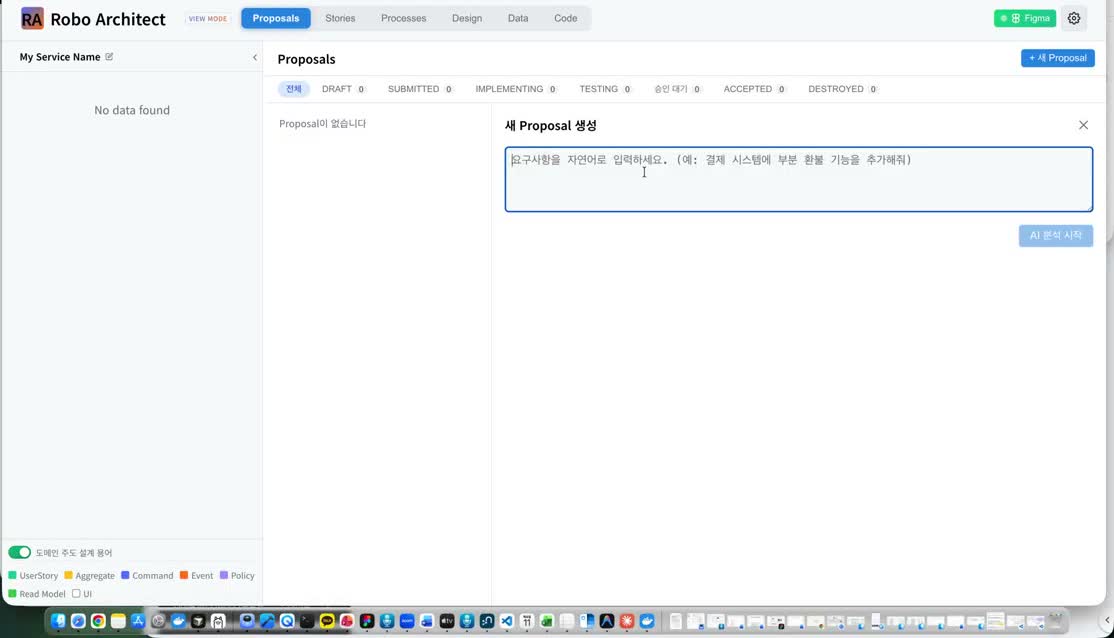
Natural-language requirements input

Start with natural-language requirements

A product owner enters a requirement in plain language, such as "Customers order food and manage menus in a food delivery app," and the AI begins its analysis. Everything starts from the requirements spec, not from code.

Natural-language requirements input
Start from a document upload, too
AI analysis starts automatically
Strategic and Tactical Diff

Proposal-based change management

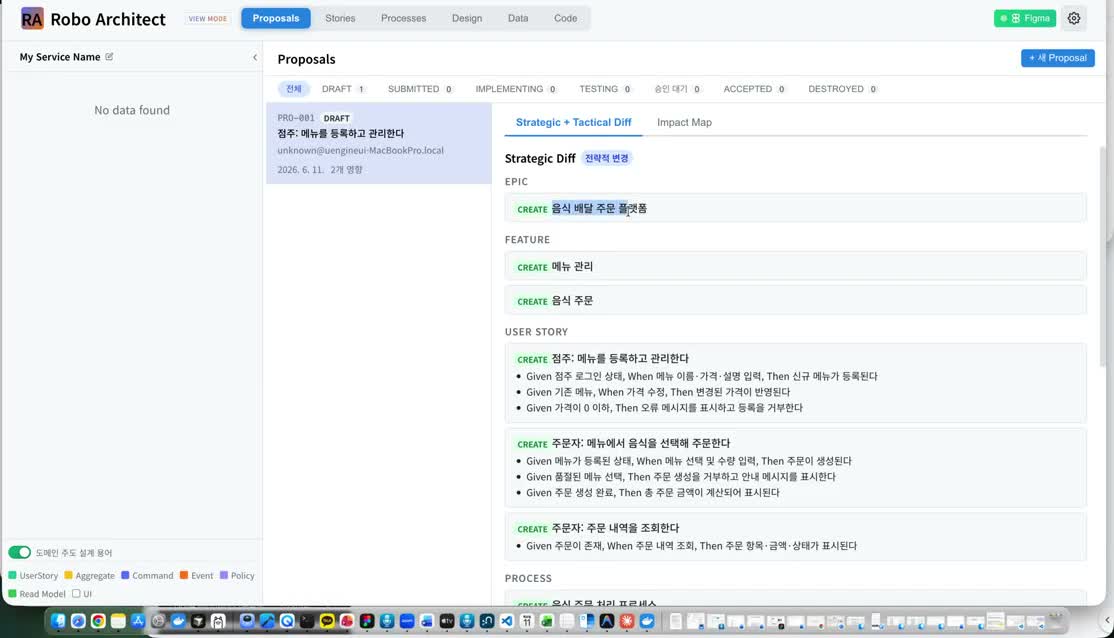
From the requirements you enter, Epics, Features, and User Stories (strategic changes) and Aggregates, Commands, and Events (tactical changes) are derived automatically. Every change is managed as a single Proposal with full history tracking.

Automatic strategic and tactical Diff generation
Automatic Epic/Feature/Story derivation
Change history tracking and management
Change Impact Map

Change impact analysis (Impact Map)

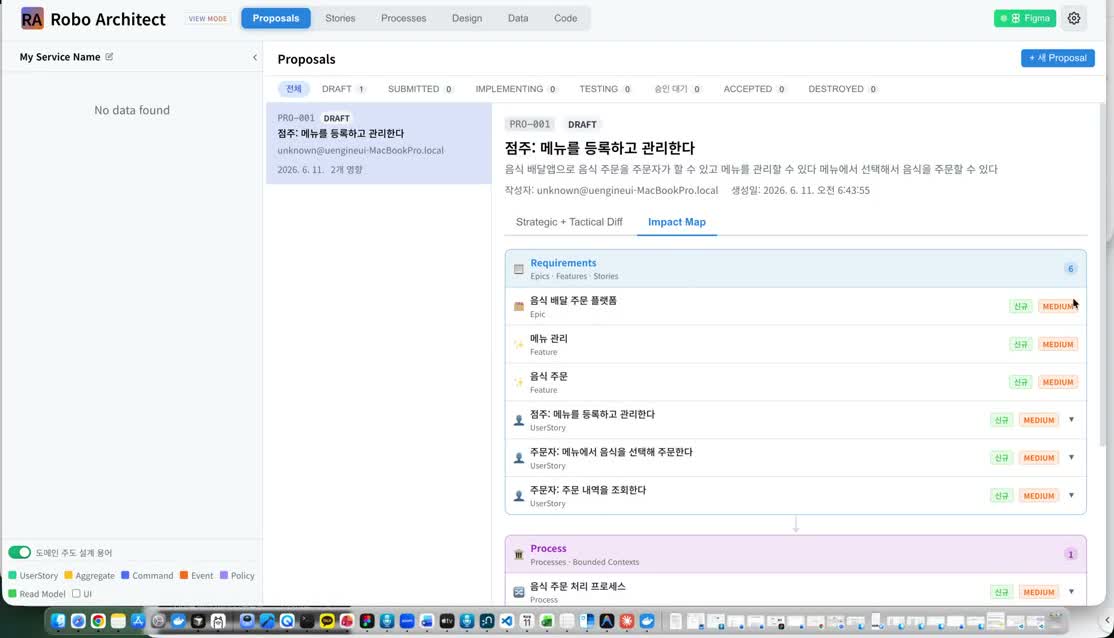
The impact of a new requirement on the existing design is analyzed automatically from the Requirements, Process, and Design perspectives. See at a glance what is new and what changes on the Impact Map.

Requirements, Process, and Design impact analysis
Automatic identification of new/changed elements
Impact Map visualization
BDD acceptance criteria

Specs based on BDD acceptance criteria

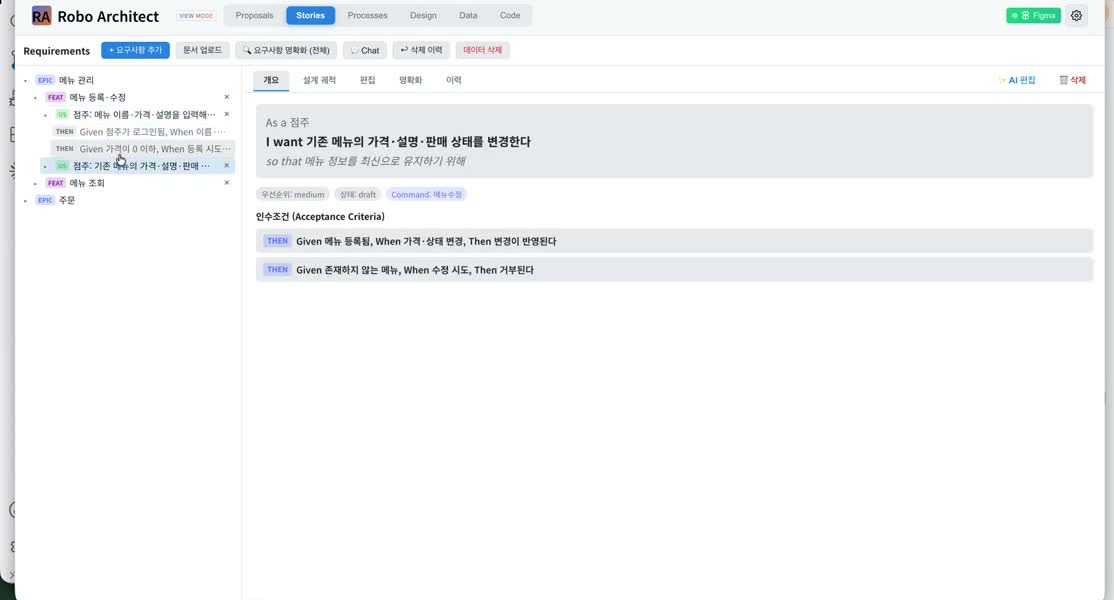
Each User Story is refined into Given-When-Then acceptance criteria. The BDD spec becomes the verification standard itself, guaranteeing that requirements and implementation match.

Given-When-Then acceptance criteria
The spec is an executable test
Guaranteed requirements-to-implementation match
Process and User Journey

Process and User Journey design

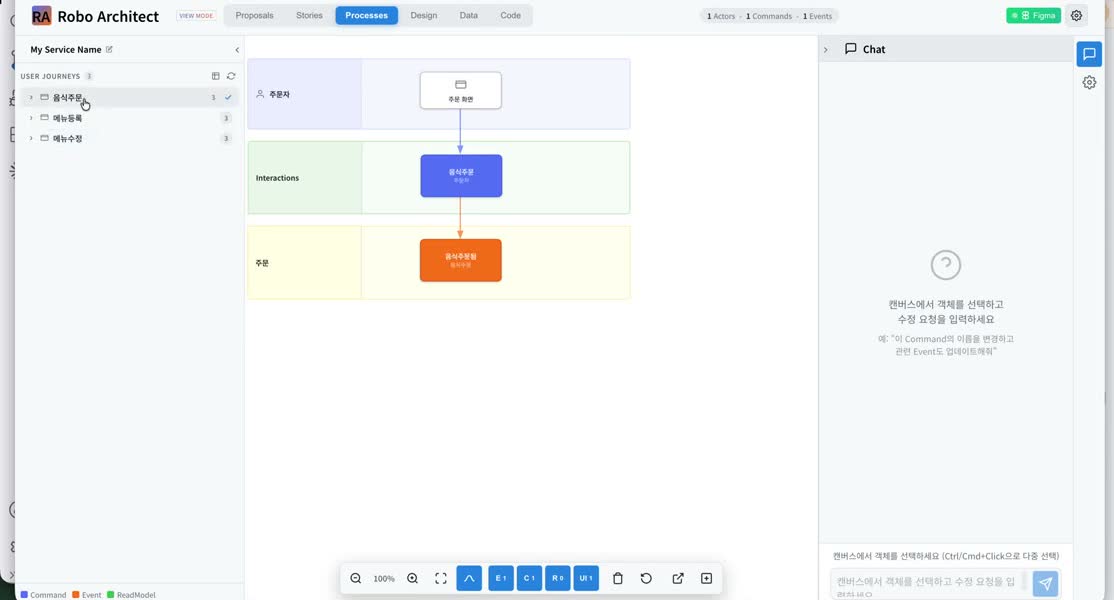
User Journeys and the interactions among actors, commands, and events are visualized as processes. Business flows are expressed clearly from the perspective of domain events.

User Journey visualization
Actor, command, and event flows
Business process modeling
Aggregate EventStorming design

Aggregate and EventStorming design

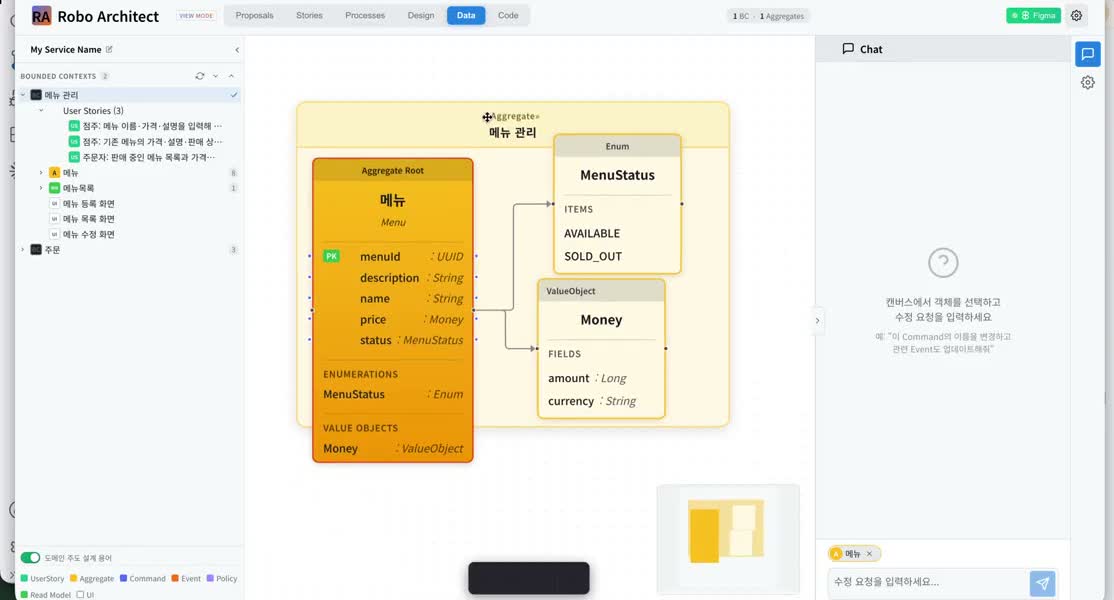
Aggregate, Entity, Value Object, and Enum designs grounded in DDD, along with the EventStorming model, are composed automatically. Domains are cleanly separated by Bounded Context to keep complexity under control.

Aggregate, VO, and Enum design views
EventStorming modeling
Bounded Context separation
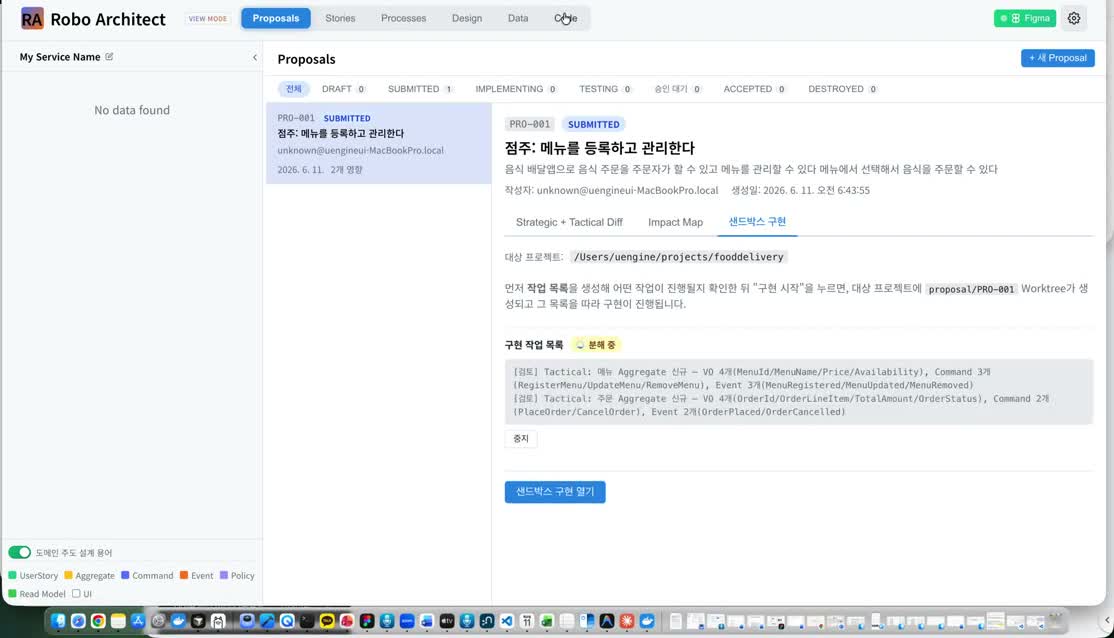
Sandbox task list

Isolated sandbox worktree implementation

Each Proposal gets its own Git Worktree (local branch) sandbox, so implementation is safe and never affects the main project. The implementation task list is broken down automatically in tasks.md.

Git Worktree sandbox per Proposal
Safe implementation with zero impact on the main project
Automatic task breakdown in tasks.md
Claude Code skill engine

Engine built on Claude Code skills

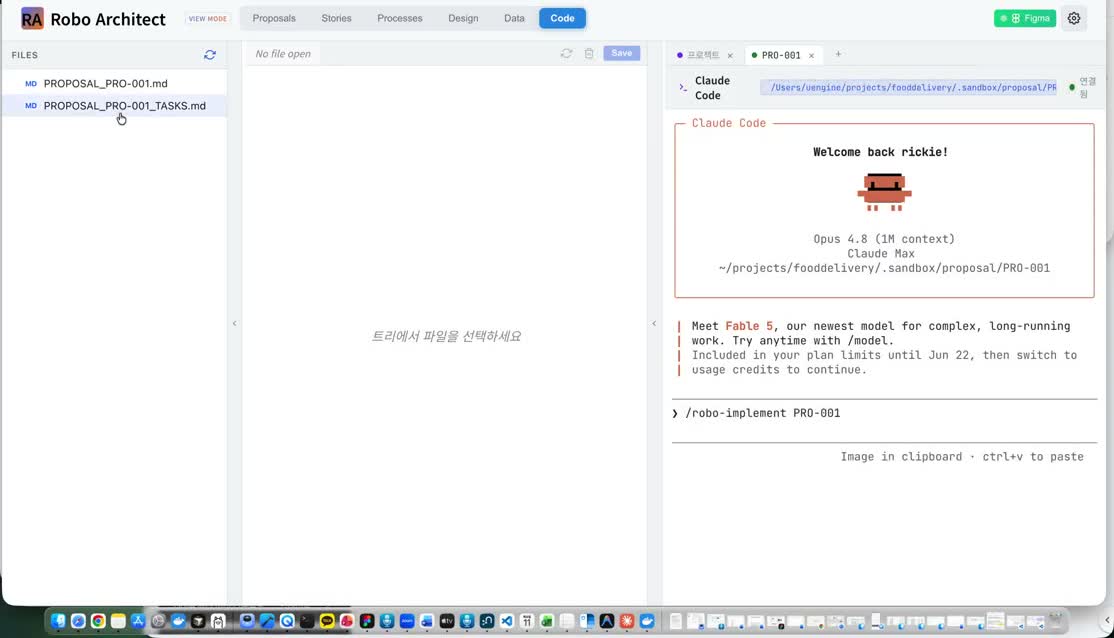
Instead of a proprietary LangChain/LangGraph stack, it runs by invoking Claude Code Skills. It works just as well from the Claude Code terminal without a UI, so you are never locked into the tool.

Claude Code Skill invocation engine
Runs in the terminal without a UI
Reuse of standard agents
Open skill files

Open skill file customization

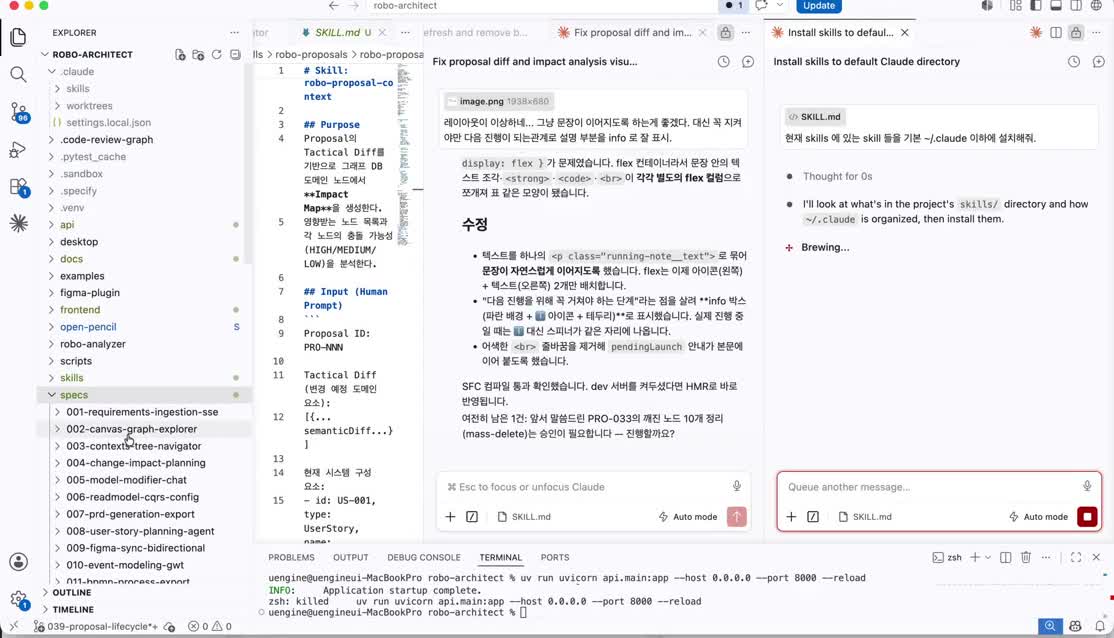
Every engine behavior is defined in editable skill files (SKILL.md). Change a skill and you change the Robo Architect engine itself, drawing on proven patterns from spec-kit and OpenSpec.

Editable SKILL.md engine
Swap skills to change behavior
References spec-kit and OpenSpec patterns
Automatic DDD code generation

Automatic DDD-based code and test generation

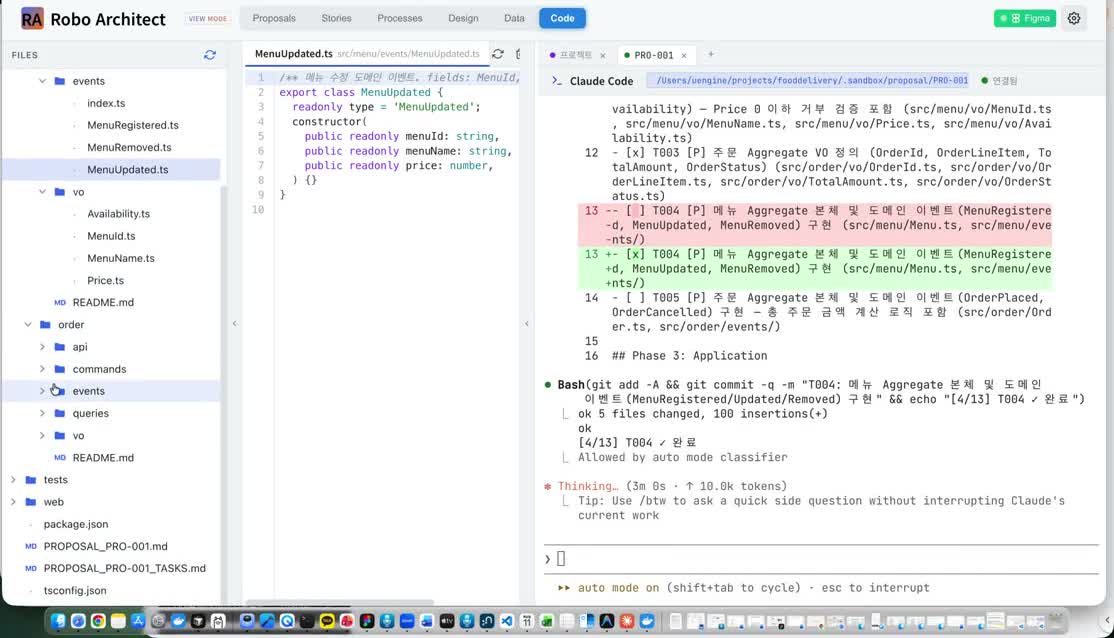
Value Objects, Commands, Events, and Aggregates are implemented as real source code following DDD principles, complete with tests. Work is committed task by task and progress is monitored in real time.

VO, Command, Event, and Aggregate implementation
Automatic test code generation
Per-task commits and real-time monitoring
Implementation deliverables report

Implementation deliverables report

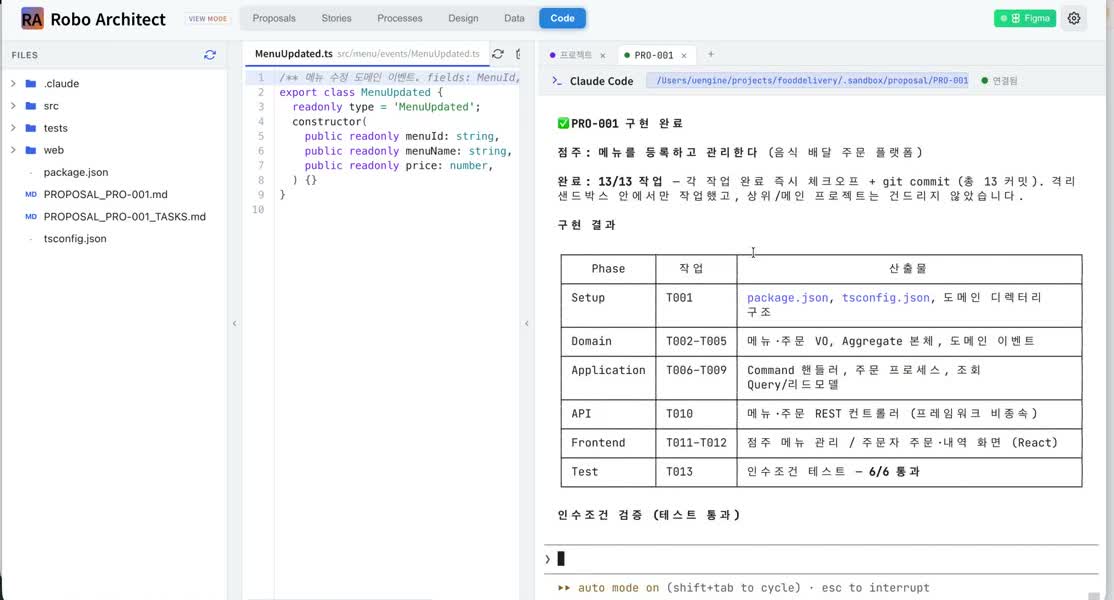
Tasks and deliverables are summarized in a report by stage: Setup, Domain, Application, API, Frontend, and Test. See clearly which files were created or changed and how many acceptance-criteria tests passed.

Per-stage task and deliverables report
List of created/changed files
Aggregated acceptance-criteria test results
Verify and Accept

Verify & Accept with two-way sync

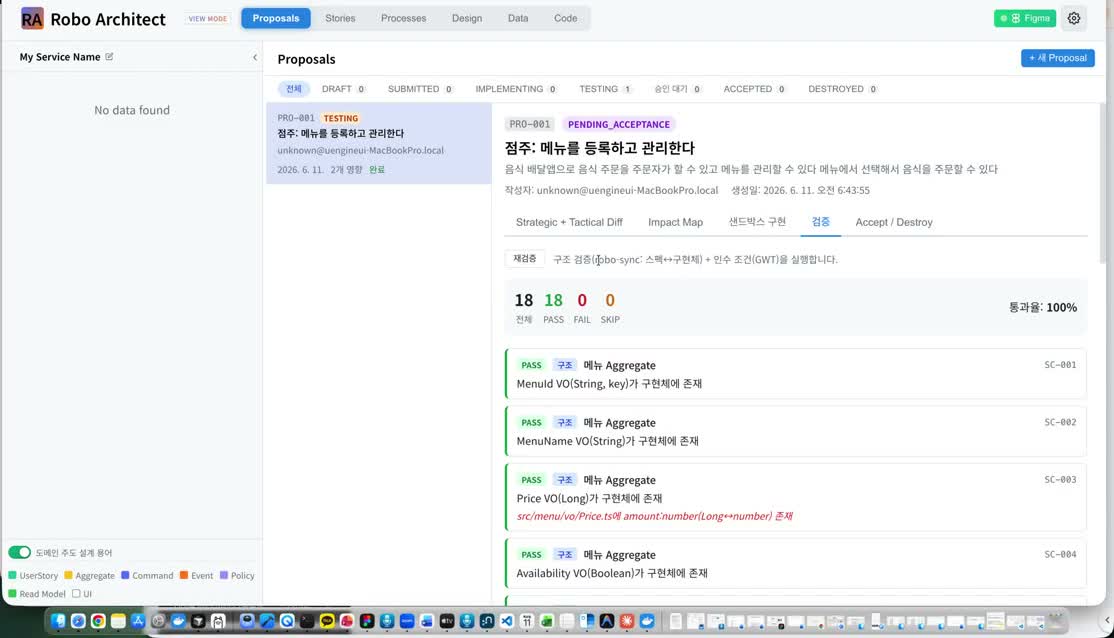
The Robo Sync skill runs structural verification (spec vs. implementation) and acceptance criteria (GWT) to confirm the implementation matches the spec. On Accept, the code is merged into main and reflected back into the design in both directions at the same time.

Robo Sync structural and acceptance-criteria verification
Two-way code-to-design sync
Automatic merge to main on Accept

Ontology Studio knowledge graph

Ontology Studio integration

It flows into the agents' knowledge graph

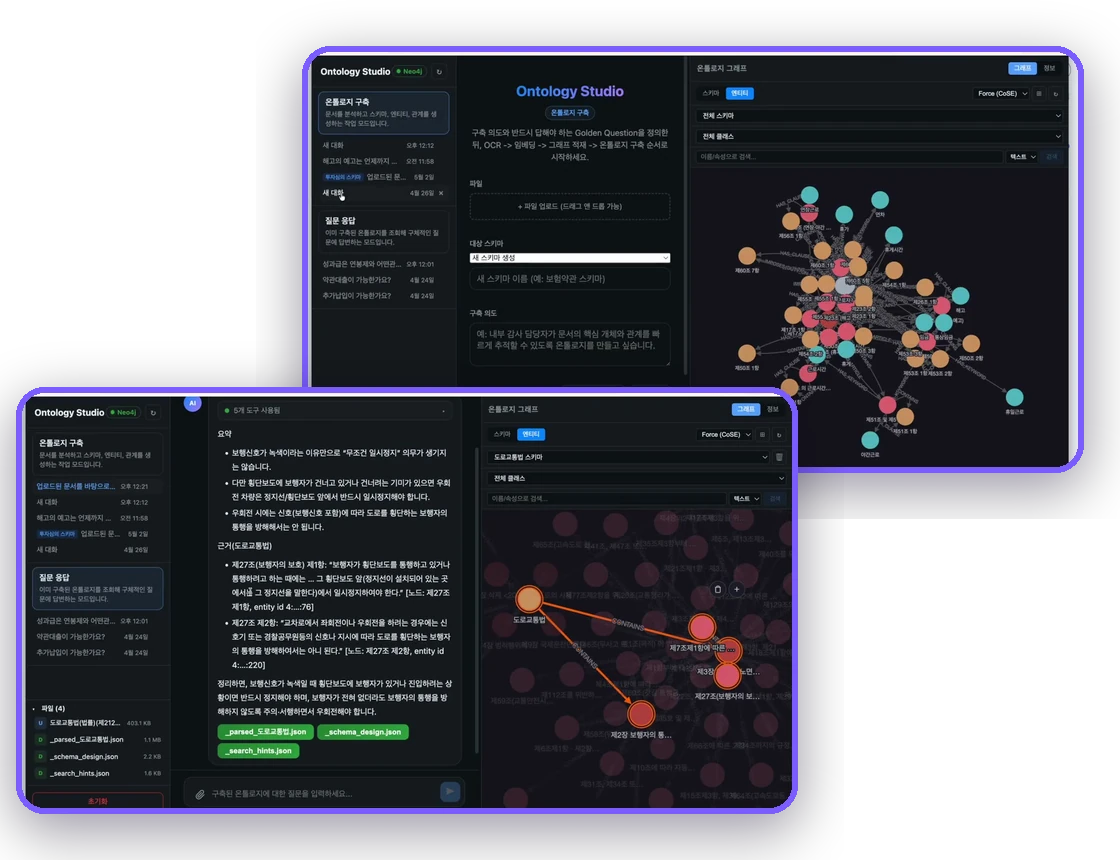
The domain models Robo Architect designs (Aggregates, domain events, ubiquitous language) accumulate as a knowledge graph in Ontology Studio. As design and implementation build up, the entire system becomes a single ontology (knowledge graph), which AI agents consult to understand the domain and make more accurate changes.

The two products move freely back and forth — explore Robo Architect's designs as a graph in Ontology Studio, and reference the domain knowledge Ontology Studio extracts from documents back into the design as supporting evidence. Spec and knowledge circulate in a single orbit.

Design domain models → accumulated as a knowledge graph (ontology)
AI agents consult the knowledge graph to understand the domain and change it accurately
Document-derived domain knowledge referenced back as design evidence (Neo4j, MCP)

Proposal lifecycle

From a single line of requirements to verified code, Robo Architect works through the following flow

1. Write a Proposal

A product owner enters requirements in natural language, and Epics, Features, and User Stories are derived automatically.

2. Impact analysis & task breakdown

The impact on the existing design is analyzed and the implementation task list is composed automatically in tasks.md.

3. Sandbox implementation

In a Git Worktree sandbox, Claude Code skills automatically implement DDD code and tests.

4. Verify & Accept

After verification with Robo Sync, Accept reflects the result into both code and design in both directions.

Why Robo Architect

Robo Architect is not another trendy AI code generator; it is a Spec-Driven Development platform built on proven software engineering principles. With the spec as the Single Source of Truth, it models the problem with Domain-Driven Design (DDD) and verifies it with Behavior-Driven Development (BDD).

DDD · Domain-Driven Design

Business complexity is given clear boundaries through Aggregates and domain events. Even as AI pours out code, the domain model holds the center, so the structure stays sound as the system grows.

BDD · Behavior-Driven Development

Requirements are expressed as Given-When-Then acceptance criteria, so the spec itself becomes an executable test. ‘What should we build’ and ‘Did we build it right’ are linked into one, automatically verifying the accuracy of AI implementation.

SDD · Spec-Driven Development

The spec, not the code, is the source. Because spec and implementation always match through the Proposal lifecycle and two-way sync, change history, impact, and design are managed in one place instead of scattering.

The result: fast AI productivity and enterprise-grade maintainability at the same time — the core domains of large cloud-native systems can evolve safely, with no vendor lock-in.


Comparison Summary

Attribute Robo Architect Typical AI coding tools
Development approachSpec-Driven (the spec is the single source of truth)Prompt-Driven (the code is the output)
Change managementPer-Proposal history and impact analysisOne-off prompts, no history management
Work isolationGit Worktree sandbox (no impact on the main project)Edits the workspace directly
Design integrationTwo-way code-to-design syncGenerates code only; design not updated
Engine architectureClaude Code skills (swappable)Fixed internal pipeline
Design methodologyBased on DDD and EventStormingBased on unstructured prompts
VerificationStructural verification + automatic acceptance-criteria (GWT) executionMostly manual checks

Get started today!

Manage everything from requirements to verified code in one flow with the Robo Architect Proposal lifecycle.
It is 100% browser-based, so you can start right away with nothing to install.


Have more questions?

Want to learn more about Robo Architect or have a question? Reach out anytime.