Cloud Native Architecture
CNA/MSA Consulting
uEngine's services for transitioning to a microservices architecture on the e-Government Standard Framework (eGovFrame) rest on two pillars — consulting that transforms your organization's systems together with you, and training that grows your organization's people.
8,390+
CNA (Cloud-Native Architecture) training graduates
2,800+
Members in the DDD and EventStorming community we run
325+
Corporate and public-sector training and consulting engagements
eGovFrame Standard
Practical standards based on the standard framework
Hands-on consulting & training from uEngine, the team behind MSA School
uEngine Solutions runs MSA School, a dedicated learning center for cloud-native applications (CNA), and delivers the entire journey as consulting and training: from domain-driven design (DDD)·EventStorming to microservices implementation patterns and deployment/operations.
Led by CEO Jinyoung Jang, a SAFe certified consultant and technical advisory member of the Digital Platform Government, our team of hands-on experts draws on MSA prototyping consulting experience across many industries to go beyond theory and build real architecture transformation in your organization together with you.
① Consulting Services — We Transform Systems
The engagement proceeds in four stages — legacy assessment → service boundary design → pilot implementation → operational stabilization — with the Robo Analyzer (assessment) and Robo Architect (implementation) tools integrated at each stage.
② Training Services — We Grow People
Using the Cloud Native Maturity Model (CNMM) as the benchmark, we internalize team capability through public seminars (Parts 1–3) covering design·implementation·deployment and a roughly six-month regular Professional program (Levels 1–3·capstone).
Consulting Service
Consulting Process
From assessment to operational stabilization, people (experts) and tools (Robo Analyzer and Robo Architect) work side by side
1. Assessment
2. Service Boundary Design
3. Pilot Implementation
4. Operational Stabilization
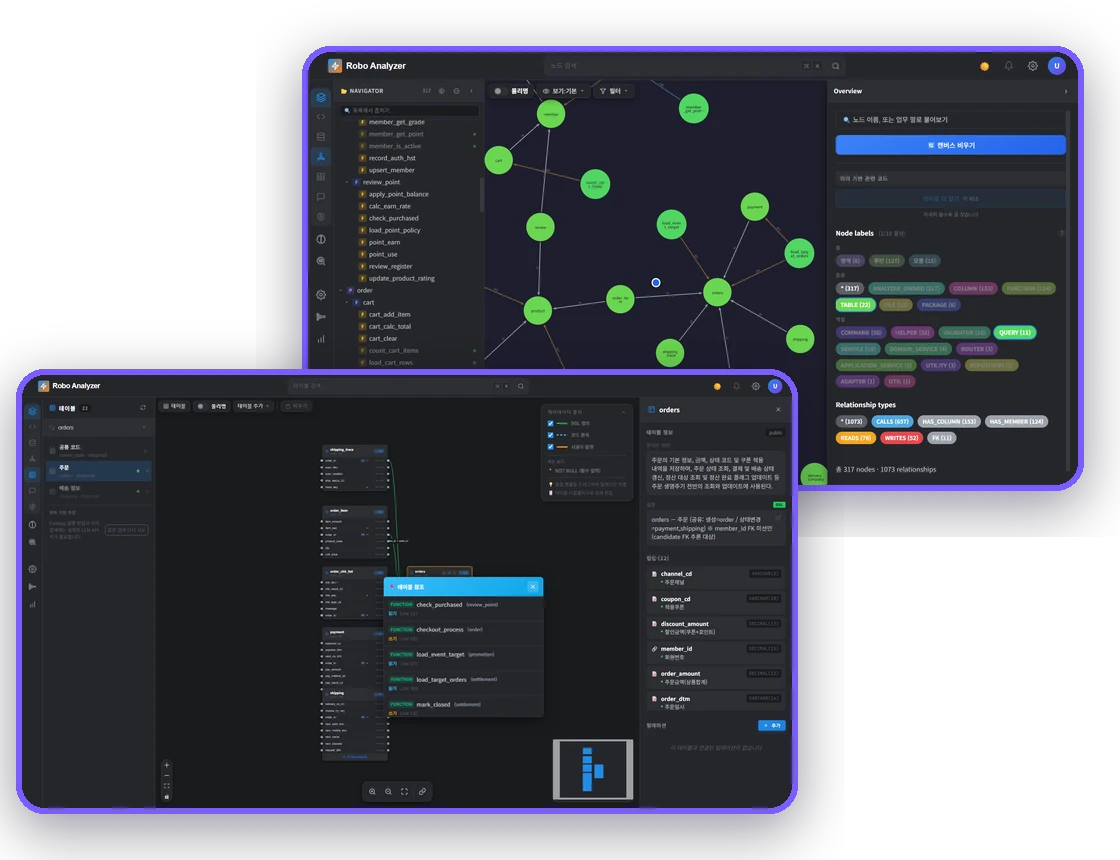
Consulting Tool ① Assessment
Robo Analyzer — Consulting That Starts with Assessment
The first step of any engagement is always an ‘as-is assessment’. Robo Analyzer automatically analyzes the existing legacy system to identify tight-coupling points, service decomposition candidates and migration priorities, which are then applied directly to the service boundary design of the real system.
Rather than relying on gut feel to analyze legacy systems, we design DDD-based service boundaries together with you on the quantitative evidence our tools produce.
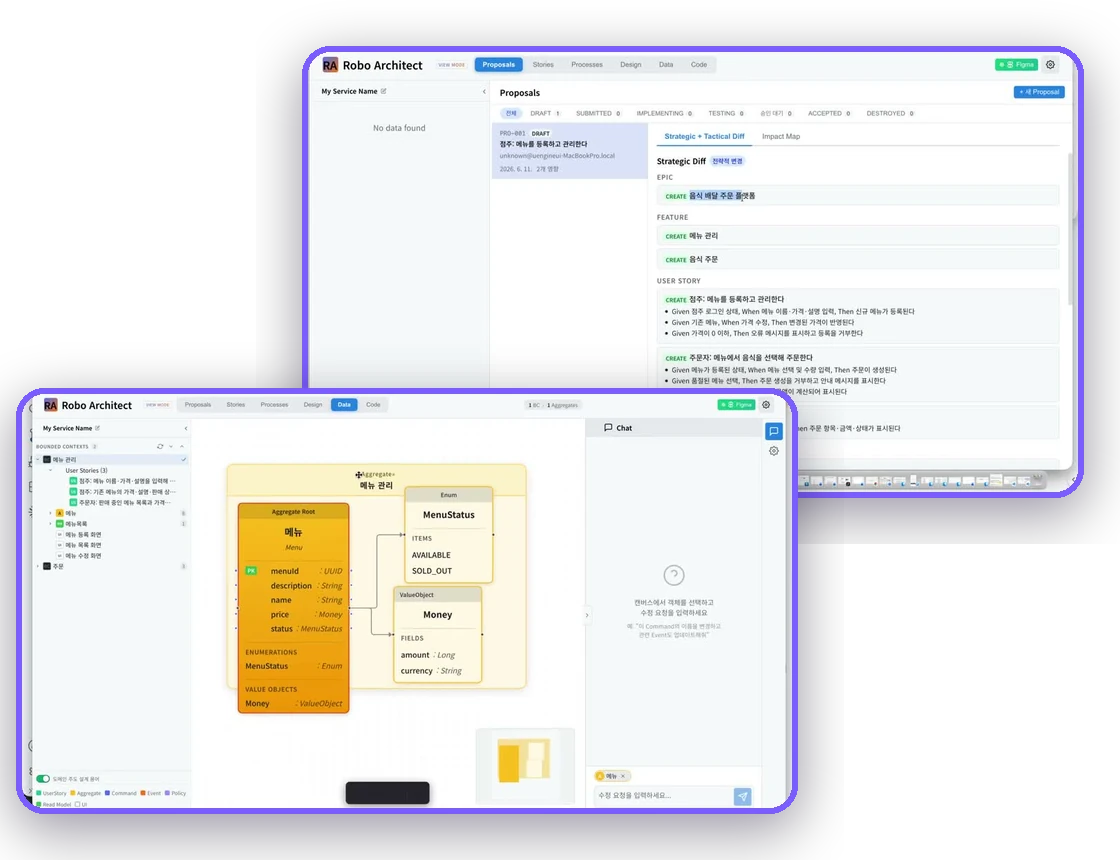
Consulting Tool ② Implementation
Robo Architect — From Design to Automated Implementation
The Aggregate·EventStorming models and microservice implementation patterns derived during consulting are automatically turned into working code through the Spec-Driven Development engine of Robo Architect. Training embeds design capability in your team while tooling secures implementation speed, and the two levers move together.
The domain model and service boundaries derived during consulting carry straight into Robo Architect proposals, so specification and implementation never drift apart.
Education Program
Talent Maturity Model (CNMM)
A cloud-native maturity model we developed in-house by integrating CNCF and the Scaled Agile Framework. Every course and assessment is designed on the model's level-by-level learning objectives (LOs), and each individual's achievement is plotted on the model to become a capability development roadmap.
| Perspective | Lv1 Early | Lv2 Inception | Lv3 Expanding | Lv4 Mature |
|---|---|---|---|---|
| Functional Decomposition | Separation by function·use case | Interface definition per service | Domain context separation (Anti-corruption Layer) | Domain events·CQRS model |
| Data | Single DB·ACID (2PC) | Schema per Service | DBMS per Service (polyglot persistence) | Event-based management·event sourcing |
| SW Architecture | Server-side rendering·session security | MSA-oriented framework (Spring Boot) | Client-side rendering·token security (OAuth2) | Polyglot + Service Mesh |
| Infrastructure·Deployment | Continuous build·manual installation | Continuous deployment·one service per VM | Containers·Kubernetes, Blue/Green deployment | PaaS·multi-cloud |
| Team Structure | Functional teams with separate Dev·QA·Ops | Collaboration on a shared service model | Product team per service | Fully accountable team per domain (“You build it, you run it”) |
Talent development targets — Architects: 80% reach Lv3·50% reach Lv4 / Developers: 100% reach Lv2·50% reach Lv3
Training ① Public Seminars
Design·Implementation·Deployment Seminar Series (Parts 1·2·3)
Using a public-service civil-complaint handling exercise and the Korea Workers' Compensation and Welfare Service ‘industrial accident claim’ case as running examples, we apply patterns to real requirements instead of stopping at theory. The complete lecture materials are available as PDFs right away.
Training ② Regular Program
Cloud Native Professional Program (approx. 6 months)
An intensive development program targeting progression from maturity model Lv2→Lv4. From AI-based orientation to the capstone project, every stage is validated with a mini project.
| Stage | Duration | Goal | Key Content |
|---|---|---|---|
| Orientation | Week 1 | Understanding the AI-driven development process | Hands-on with Cursor IDE·GPT-Engineer, trying AIOps tools such as Kubectl AI·K8sGPT, forming teams·missions |
| Lv1 Fundamental | 1 month | VM-based app development skills (CNMM Lv2) | Java·object orientation·design patterns·UML, Spring Boot·JPA·REST, React.js·MUI front end, mini project |
| Lv2 Intermediate | 1.8 months | Cloud-native app implementation (CNMM Lv3) | DDD·EventStorming, microservice implementation, Kafka·Saga (Axon), API gateway·authentication/authorization, GraphQL·CQRS, contract testing, mini project |
| Lv3 Advanced | 1.3 months | Competitive cloud app design (CNMM Lv4) | Agile planning·analysis (SAFe·BDD), Docker packaging, AWS·Azure Kubernetes, service mesh, GitOps·CI/CD, LLM app development |
| Capstone Project | 3 weeks | Mastering real-world project delivery | Two iterations of project planning (Biz) → implementation (Dev) → operations (Ops) → improvement, with a final presentation evaluated by a review panel |

Runs on the MSA School platform
The regular program runs on MSA School (msaschool.io), the cloud-native learning platform operated directly by uEngine. Practice in a browser-based cloud IDE with nothing to install, while instructors join your screen directly and guide you through pair coding.
Training ③ Program Operations
From Selection to Follow-up
We go beyond attendance tracking to systematically manage the entire cycle of selection·operations·projects·evaluation
1. Selection
2. Operations
3. Projects
4. Follow-up
Training ④ Instructors
Mentors & Coaches
The program is led not by theory lecturers but by hands-on experts who have personally driven MSA transformations in enterprise settings.
Jinyoung Jang
CEO, uEngine Solutions · Lead Instructor, MSA School
Yongju Park
Director, uEngine Solutions · Lead Instructor, MSA School
Seongyeol Yoon
CEO, DreamFlow · Lead Instructor, MSA School
Youngsoo Son
CPO, Onycom · Lead Instructor, MSA School
They are joined by a team of hands-on coaches who have co-delivered numerous corporate programs for SDS·Doosan·LG·SK and others.
Training ⑤ Student Reviews
Student Reviews
Voices of real students who have completed the MSA School Cloud Native Professional program.
4.7/5.0
Average satisfaction rating
257 sessions
Total Sessions
7,410 trainees
Total Trainees
9,840 hours
Total Training Hours
Course Content
“The course materials were rich and varied, which really helped my understanding, and I liked being able to go hands-on from cloud environment setup all the way to deployment in a short time.”
“There were plenty of examples and exercises, and it was a valuable course for seeing how DDD translates into real code and how the tools link together along the way.”
Lab Environment
“Using the MSAEZ tool and GitPod, I could jump straight into hands-on work without any tedious installation or environment setup.”
“I liked how the whole flow, from EventStorming to code generation and development, was connected right inside the web browser.”
Instructor Reviews
“Learning so many new concepts can be hard to keep up with, but the instructor delivered an excellent course, pacing both theory and practice well with deep professional knowledge.”
“Both the instructor and the assistant instructor answered every question kindly and explained things simply and in detail so that no one was left behind.”
Why uEngine for CNA/MSA Consulting
This is not a theory lecture from a typical training provider. It is a program that combines the hands-on consulting experience we have built by running MSA School ourselves with automation tools.
Maturity-Model-Based Framework
eGovernment Standard Framework
Robo Architect·Analyzer Integration
The result: training leaves your organization with design capability, and tooling secures implementation speed — completing a sustainable microservices transformation.
Comparison Summary
| Attribute | uEngine CNA/MSA Consulting | Typical MSA Training/Consulting |
|---|---|---|
| Curriculum Framework | Level-by-level design based on the CNMM maturity model | Fragmented list of topics |
| Scope | Full lifecycle: design→implementation→deployment/operations (Parts 1∼3, Lv1∼3) | Mostly one-off theory lectures |
| Standard | Grounded in eGovFrame real-world practice | Arbitrary criteria that vary by vendor |
| Diagnostic Tooling | Automated analysis with Robo Analyzer | Relies on manual interviews |
| Implementation Link | Design→code auto-implemented with Robo Architect | Separate implementation needed after training ends |
| Program Operations | Full-cycle management: selection→operations→projects→comprehensive evaluation | Attendance-focused operations |
| Instructors | Hands-on experts including SAFe certified consultants | Theory-focused lecturers |
| Post-Program Support | Continues through Radar Chart skills analysis·operational stabilization | Ends when the training ends |
Get in touch today!
From design training to implementation consulting, make your microservices architecture transformation with uEngine.
Consulting combined with Robo Architect·Robo Analyzer ensures training outcomes take root in the field.
Have more questions?
If you would like to learn more about CNA/MSA Consulting or have any questions, please contact us anytime.