AI-Driven Development
Robo Analyzer
The connection between code and data, as a graph you can read.
Analyzes legacy source code together with database schemas to show function calls and table read·write relationships in a single graph. From any point, you can drill down to the original source code.
About 4 min 47 sec · Narration is a synthetic voice (OpenAI TTS). Turn on the sound to hear each screen explained.
What you can't learn from reading code alone
In an aging system, reading the code alone rarely reveals the real call flow. Documentation and code disagree about where tables are read and written.
Robo Analyzer focuses on understanding the current system from code and data evidence. Automating the specification, design, and implementation that follow analysis is the job of a separate product.
Legacy always leaves the same questions
If I change this function,
how far does the impact reach?
Who reads this table today,
and who writes to it?
When the docs and the code disagree,
which one do I trust?
The person who knows the answer has usually left the company — or is still there, but not certain.
What sets Robo Analyzer apart
Structure computed without an LLM
Analyzes broken code too
Progress in real time
Search in business language
Proven by the source
Production DB is read-only
Opening the code isn't enough to know
| Question | Until now | Robo Analyzer |
|---|---|---|
| Call impact scope | Guess names and search repeatedly | Calls and reads·writes in one graph |
| Data origin | Investigate SQL and code separately | Jump straight from the table to the function and line of code |
| Business boundaries | Rely on staff memory and outdated documents | Compare modules and business units from analysis results |
| Progress status | No results until it finishes | Stage·console·graph counts visible in real time |
| Re-checking | Start from scratch every time | Analyze once, keep exploring |
It doesn't stop at showing structure
Ever been handed code that doesn't even compile?
It's normal for legacy source to include files with broken syntax. Valid files are processed as-is; only the failed parts get a grammar-rule-based recovery attempt. If that still fails, only that part is left behind and processing moves on to the next file.
By default, original source files are never modified.
Down to business rules and risk points
Extracts the decision conditions scattered through the code as rules — for example, “allow withdrawal if the balance is greater than 0.” They are organized into rules, examples, and questions needing confirmation, and linked to the related tables.
For each function, it computes how often it is called, how many calls it makes, code length, circular references, and table coupling, then assigns a Low·Medium·High grade.
FEATURES
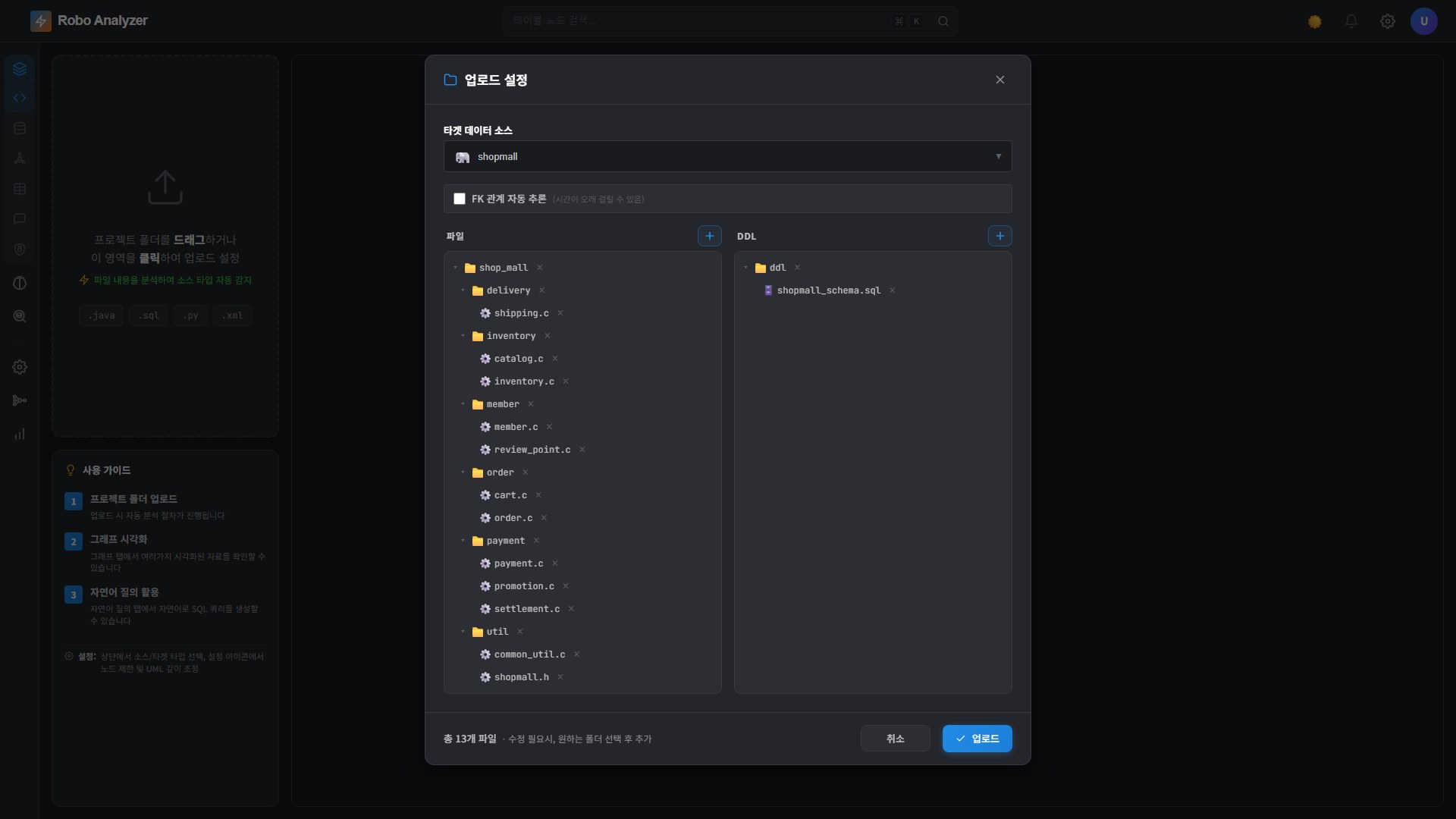
Drop files in any way you like,
and they're handled automatically
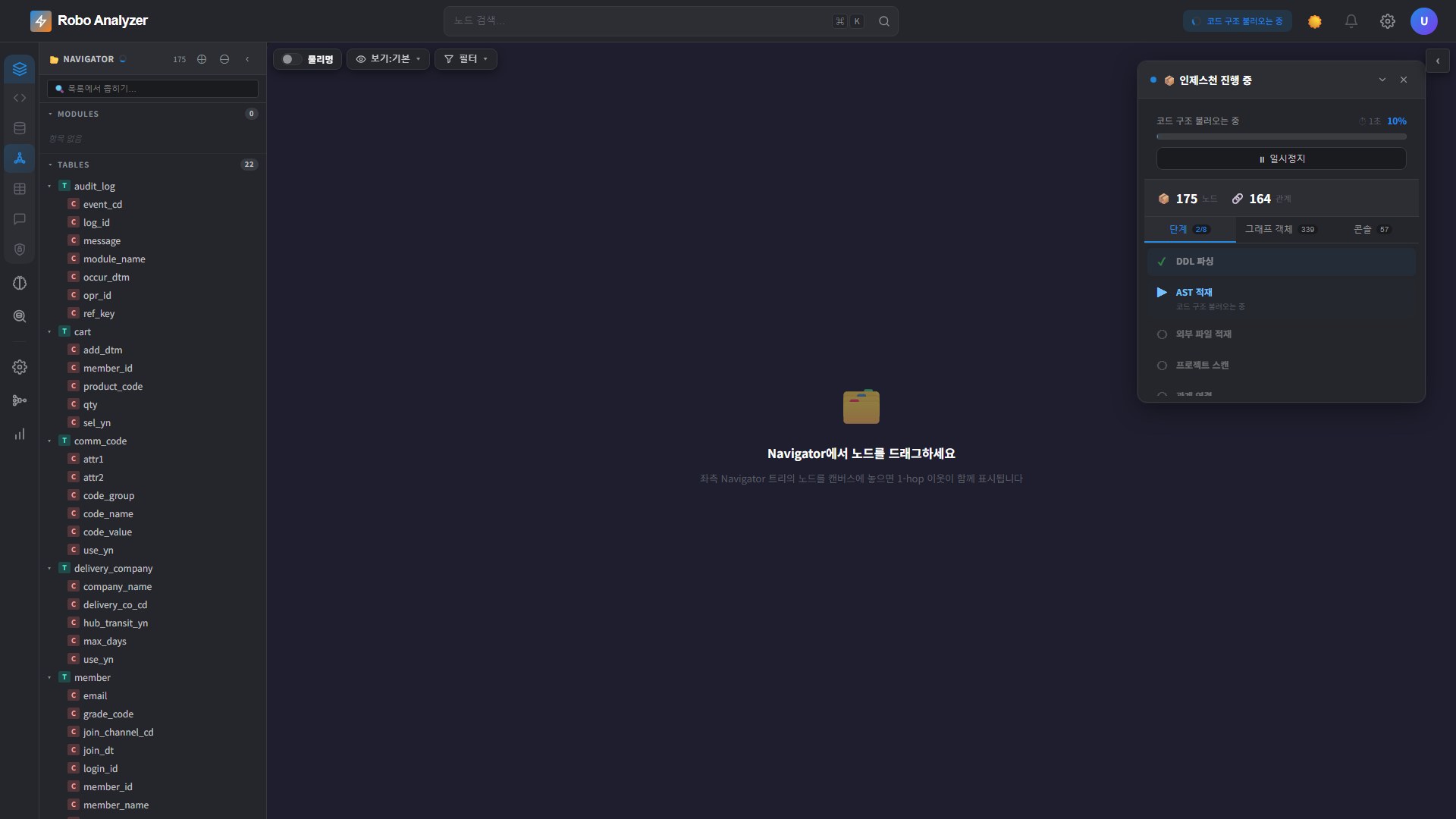
You can watch progress
in real time
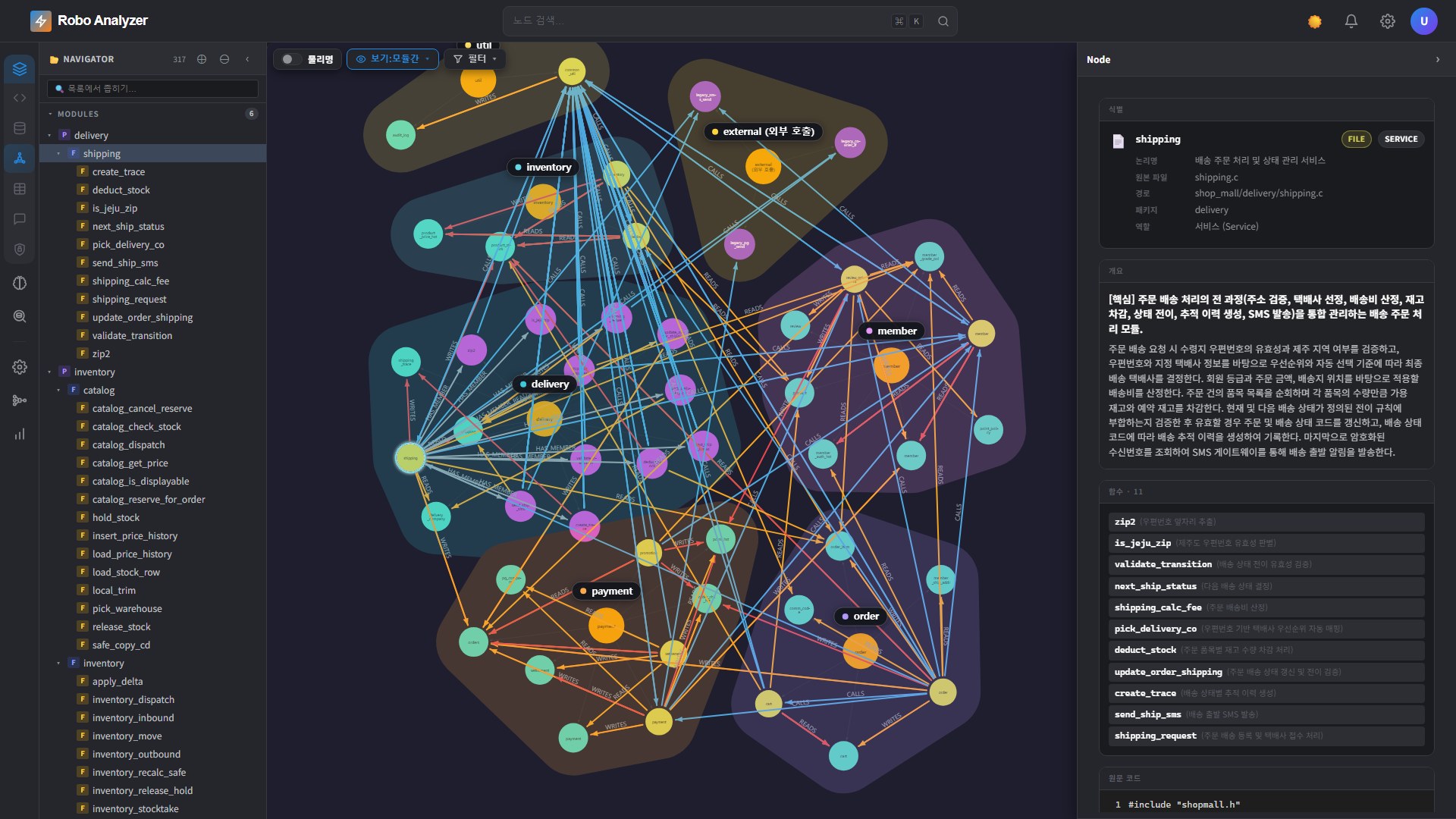
Click a node,
and its meaning appears with it
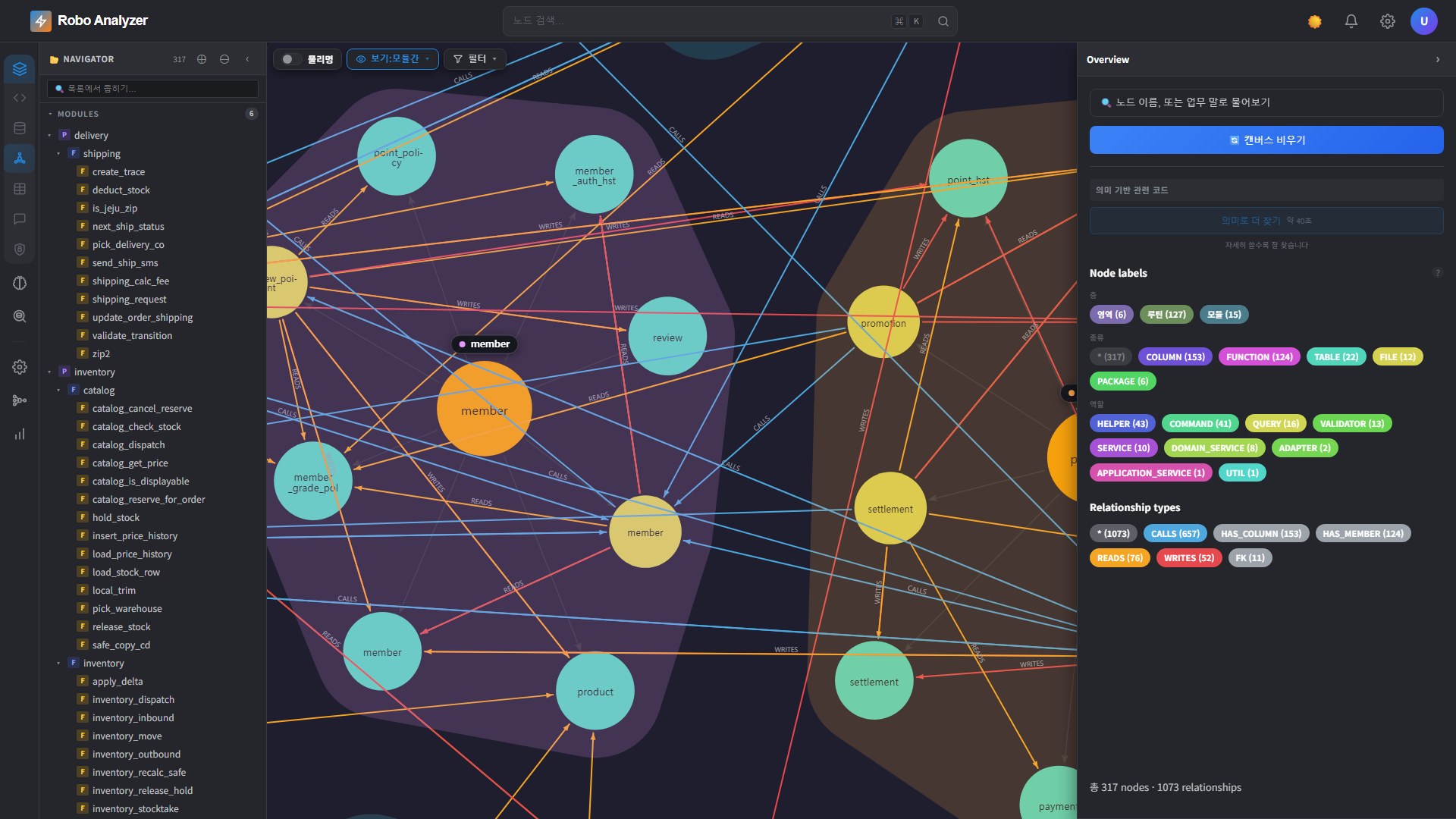
Cohesion and coupling
become visible
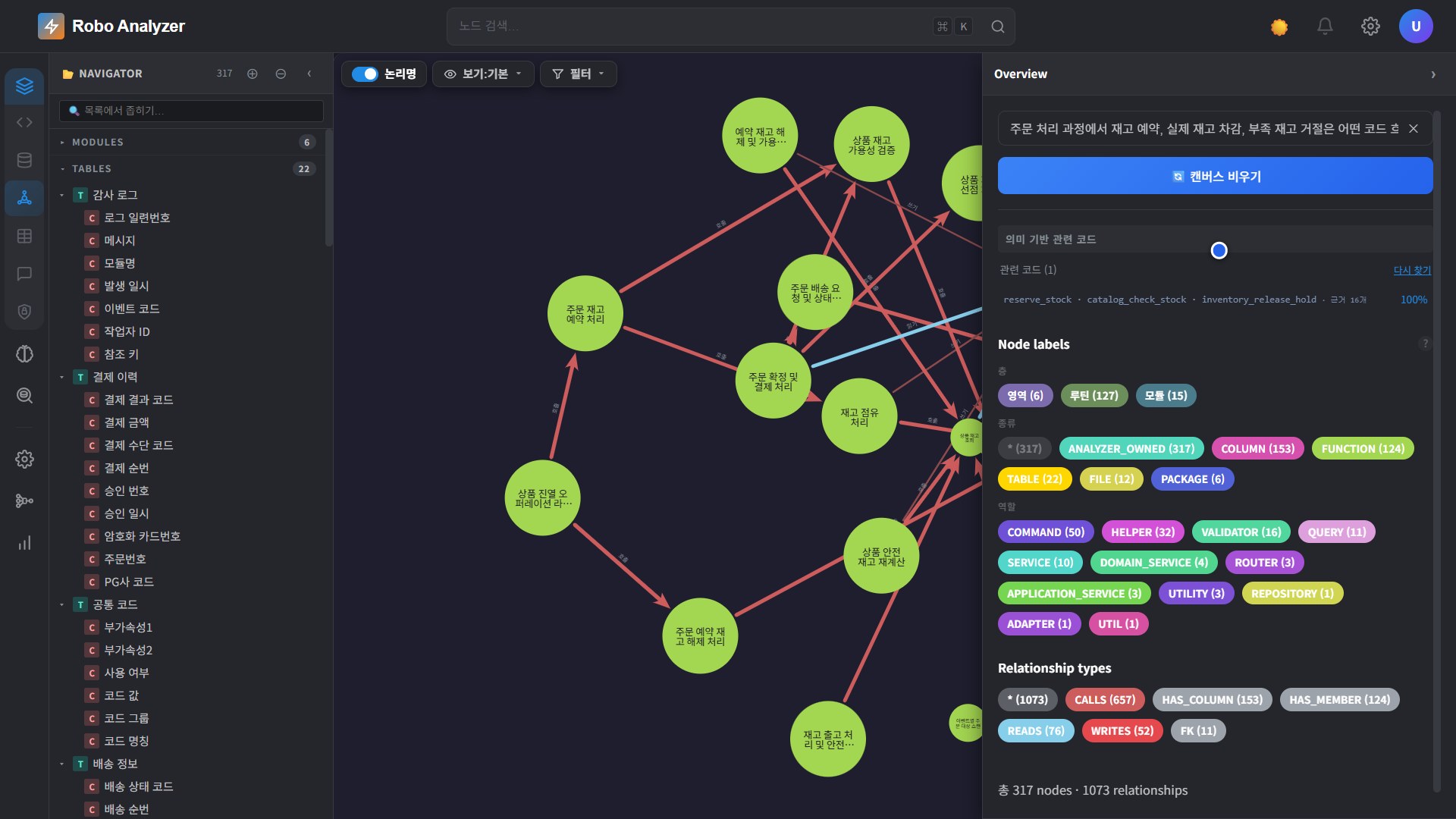
Search with a business sentence,
and the right nodes really light up
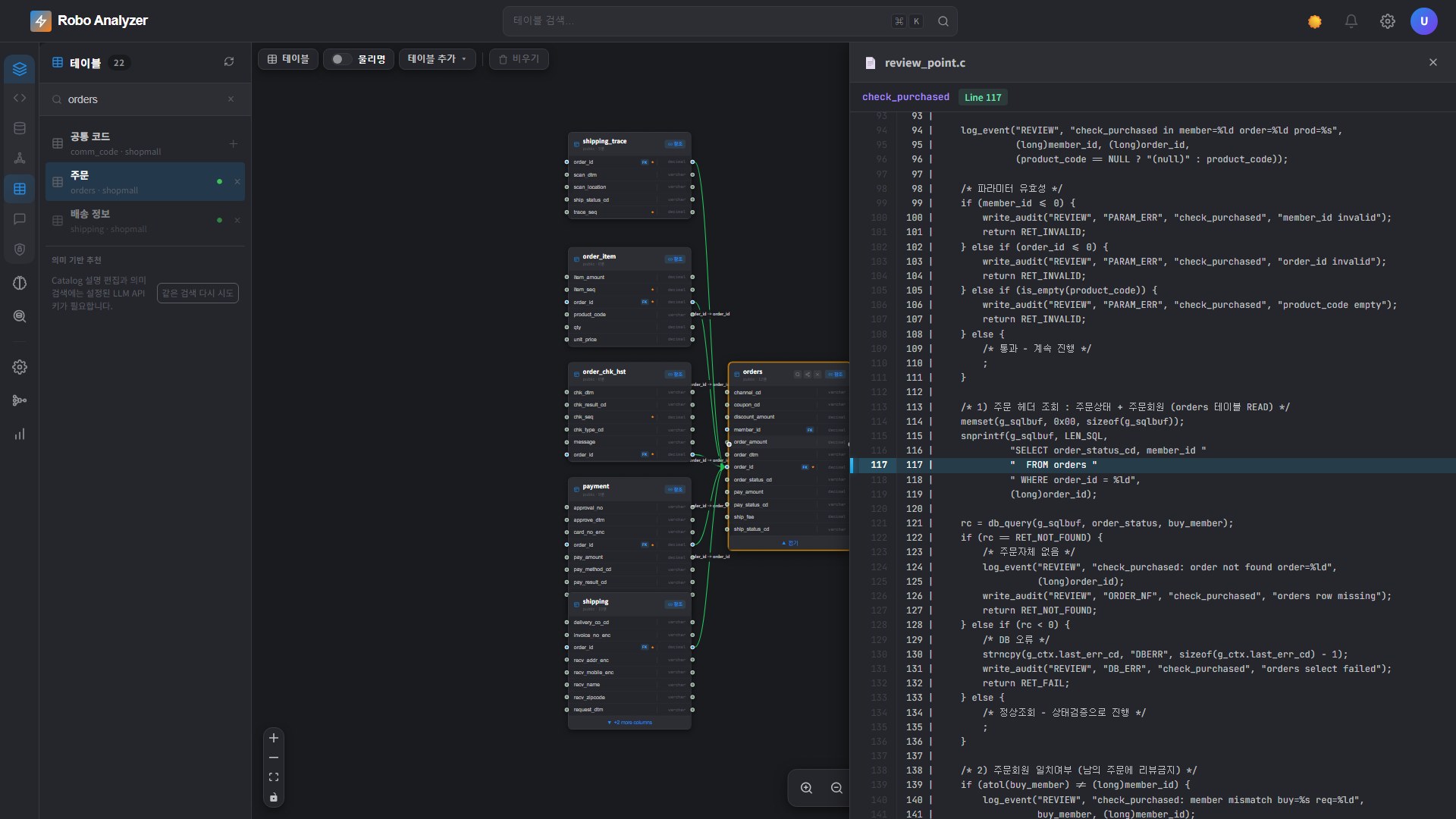
Pick an origin, and the actual
line of code is highlighted
Eight stages, and determinism
Structure · relationships · clusters · risk levels are computed without an LLM
AI is used only to attach meaning, such as “what does this function do?”
Architecture
File sharing exists only between the code parser and the analysis engine.
Analysis request flow
System composition
Environment
Related products
After analysis, the next step is Robo Architect
Robo Analyzer focuses on understanding the current system from code and data evidence. For the requirements specification, design, and implementation automation that follow analysis, see our separate product, Robo Architect.
Frequently Asked Questions
Which source languages can be analyzed?
Java, C, Python, Oracle PL/SQL, and PostgreSQL are detected automatically from file contents. Users never need to specify the target language.
Can I start without connecting a production DB?
Yes. Analysis can begin with source code and DDL alone. If you also register a production DB, table accesses found in the code can be checked against the actual schema.
Is it safe to connect to a production DB?
Only query statements are allowed; writes, changes, and deletes are blocked. The server caps the number of rows fetched, and connection passwords never appear in storage, responses, or logs.
What happens if some files have broken syntax?
It retries only the failed portion; if that still fails, it leaves just that part behind and moves on to the next file. The analysis as a whole never stops, and the original source files are never modified.
Are the analysis results made up by the AI?
Structure, relationships, clusters, and risk scores are computed without an LLM. AI is used only to attach meaning, such as summarizing functions or phrasing rules in plain language.
Try it on your own system
Let's see together what Robo Analyzer uncovers in your source code and databases.
Request a demo consultation and a representative will get in touch.
Have more questions?
Want to learn more about Robo Analyzer or have a question? Reach out anytime.