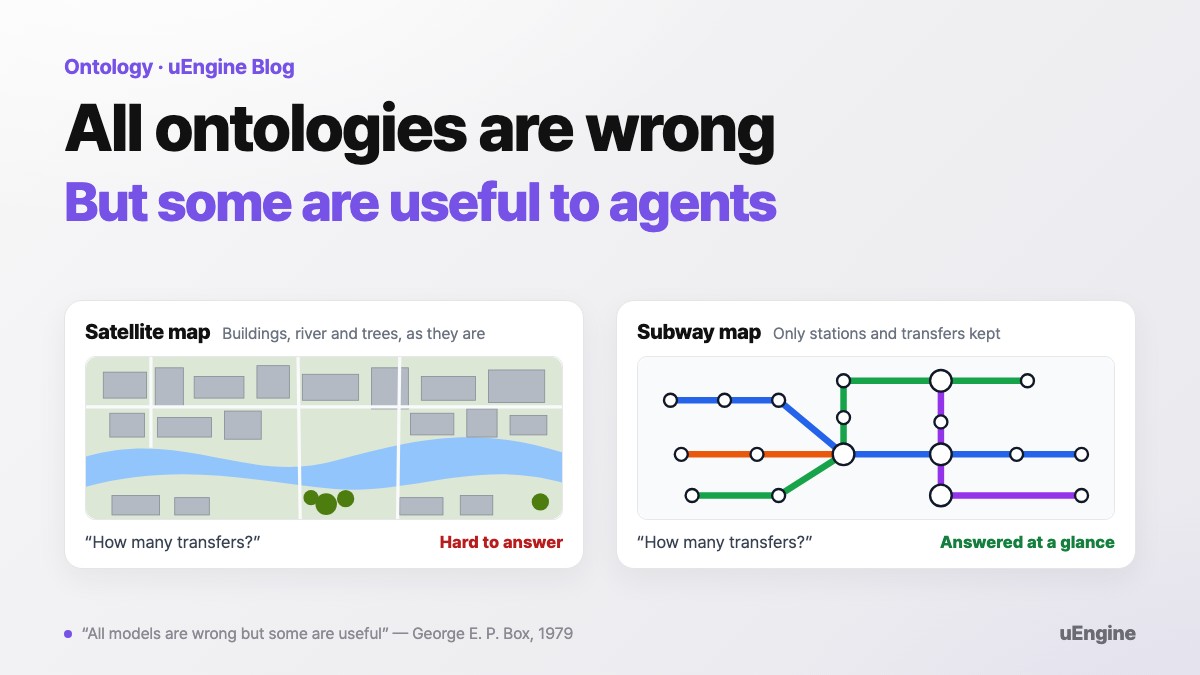
All ontologies are wrong — but some are useful to agents
1. When a wrong map is the more useful one
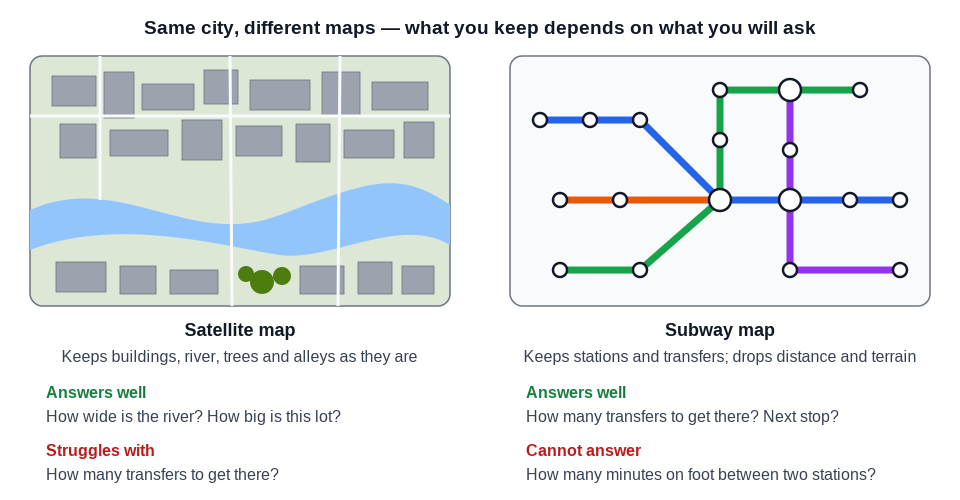
A satellite map and a subway map
On the way to a meeting place, we don’t open a satellite map. We look at the subway map. The subway map gets the distances between stations, the directions and even the shape of the river wrong. As a map, it is wrong. Yet it answers “How many times do I have to change trains?” far faster than a satellite map does.
Harry Beck of the London Underground, who first drew this kind of picture, “didn’t bother with making his map geographically accurate”[1]. He kept only what passengers needed to answer their question, the order of the stations and the interchanges, and left out the rest.
2. All models are wrong
The statistician George Box put it in one line: “All models are wrong but some are useful”[2]. A model is a reduced drawing of the world, so it can never be identical to the world. The question to ask, then, is not “Is this model right?” but “What is this model useful for?”
Ontologies are models too. Carry Box’s words straight over, and you get this:
All ontologies are wrong. But some are useful to agents.
There is no “ontology that correctly represents our company.” There is only “an ontology that is useful to the agent doing this job.”
3. What it means to be useful to an agent
Every time an AI agent gets a question, it reads the ontology’s schema, chooses which path to follow through it, and finds the answer. That is why a bigger ontology is not automatically a better one.
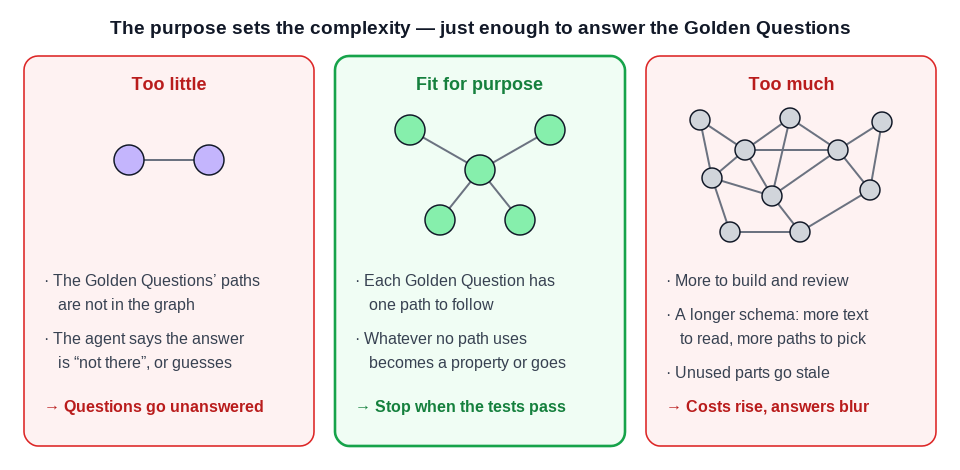
Too little · fit for purpose · too much
We checked this ourselves by loading nine law PDFs into a graph[3]. The schema was small, with only 11 node types and 15 relationship types, yet it made up 18% of the text the agent read for each question. Had we copied hundreds of the company’s tables as they are, the agent would have to read that much more before answering, and pick one path out of many more. Anthropic, too, advises giving an agent “the smallest possible set of high-signal tokens”[4].
Leaving out what is needed does not work either. In the same exercise, an article the schema had no path to was an article the agent could not find. A useful ontology holds only as much as the agent’s job needs.
4. The questions decide what “as much as needed” means
Deciding that “how much” is simple. Write down first what the agent has to do.
- Golden Question: a question this ontology must be able to answer
- Golden Command: an instruction this ontology must be able to carry out
These questions and instructions become the tests. Once the ontology is built, you actually ask the questions; if an answer does not come back, you fix the ontology, and when everything passes, you stop.
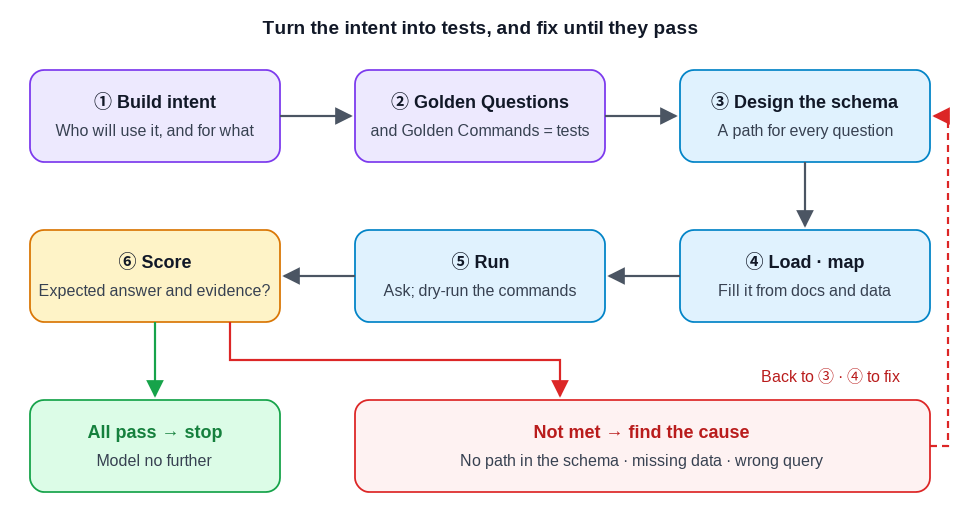
Intent → Golden Questions and Commands → design → load → run → score, as a loop
That may sound abstract, so let’s follow one real case.
5. Case: an ontology for “late inbound shipments”
This is the “Supply Chain Operations” sample that ships with Ontological Studio. The company runs a purchasing ERP, a logistics WMS and a customer CRM. We do not start by moving every table of the three systems into the ontology.
① Write down in one sentence who wants to do what.
② Write down the questions and instructions that person will actually give.
| Category | Example |
|---|---|
| Golden Question | Which inbound shipments are more than 3 days late, and which supplier and purchase order are they for? |
| Golden Question | Which customer’s order did the PCB soldering defect claim come from? |
| Golden Command | Expedite the inbound shipments that are more than 3 days late (reason: risk of production disruption) |
| Golden Command | Cancel what you just did |
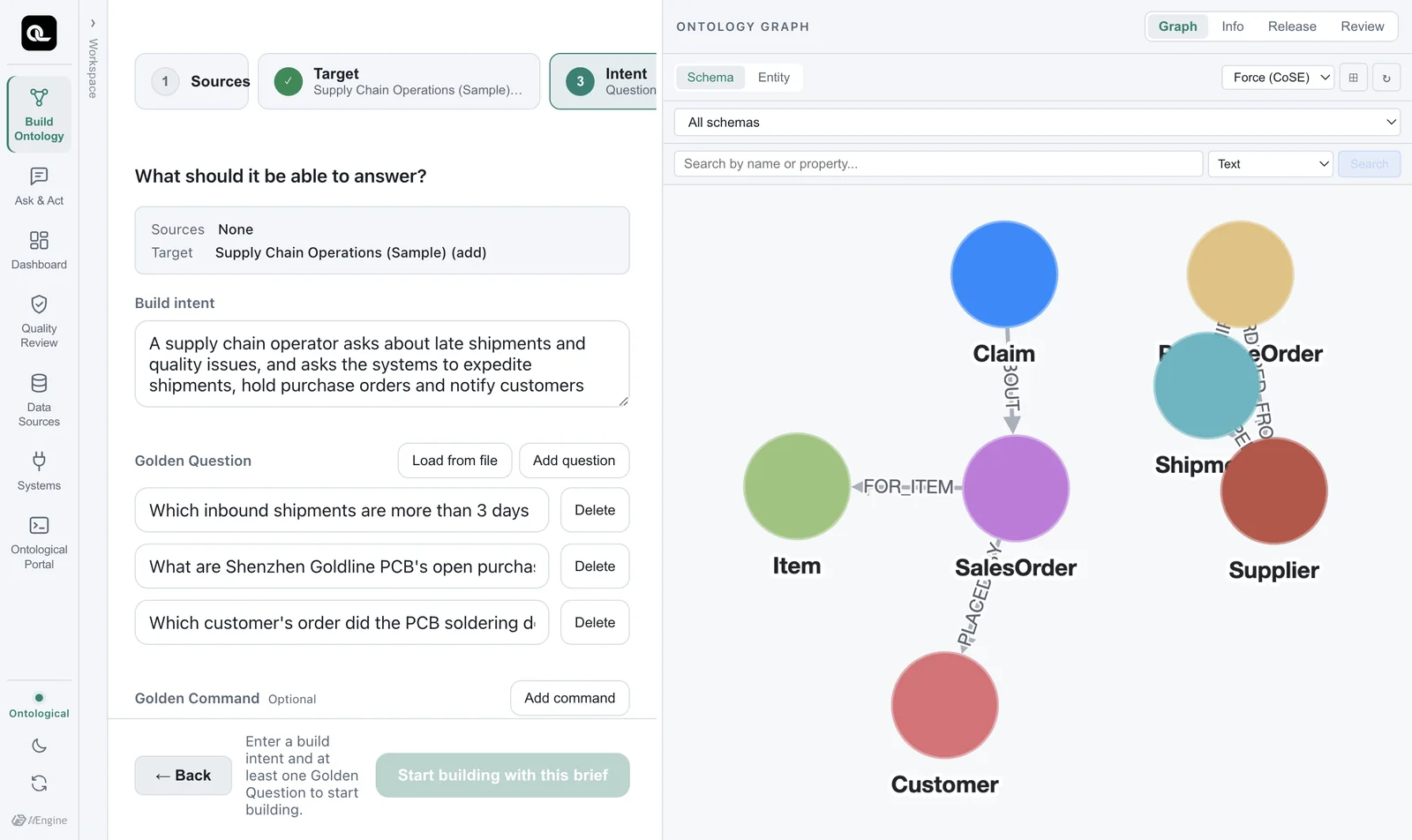
The build brief: the build intent, 3 Golden Questions and 4 Golden Commands
③ The ontology comes out of the questions.
From the words “inbound shipments,” “supplier” and “purchase order” in the first question, you can tell that you need Shipment, PurchaseOrder and Supplier, and the relationships that connect them. The second question brings in claims, sales orders and customers. The ontology in this example has 7 classes and 6 relationships. Things like unit prices, payment terms and accounting accounts stay out. That is not because the company is simple; it is because this job does not need them.
④ Test it by asking a question.
You ask it as is, without telling the agent what to look for or in what order.
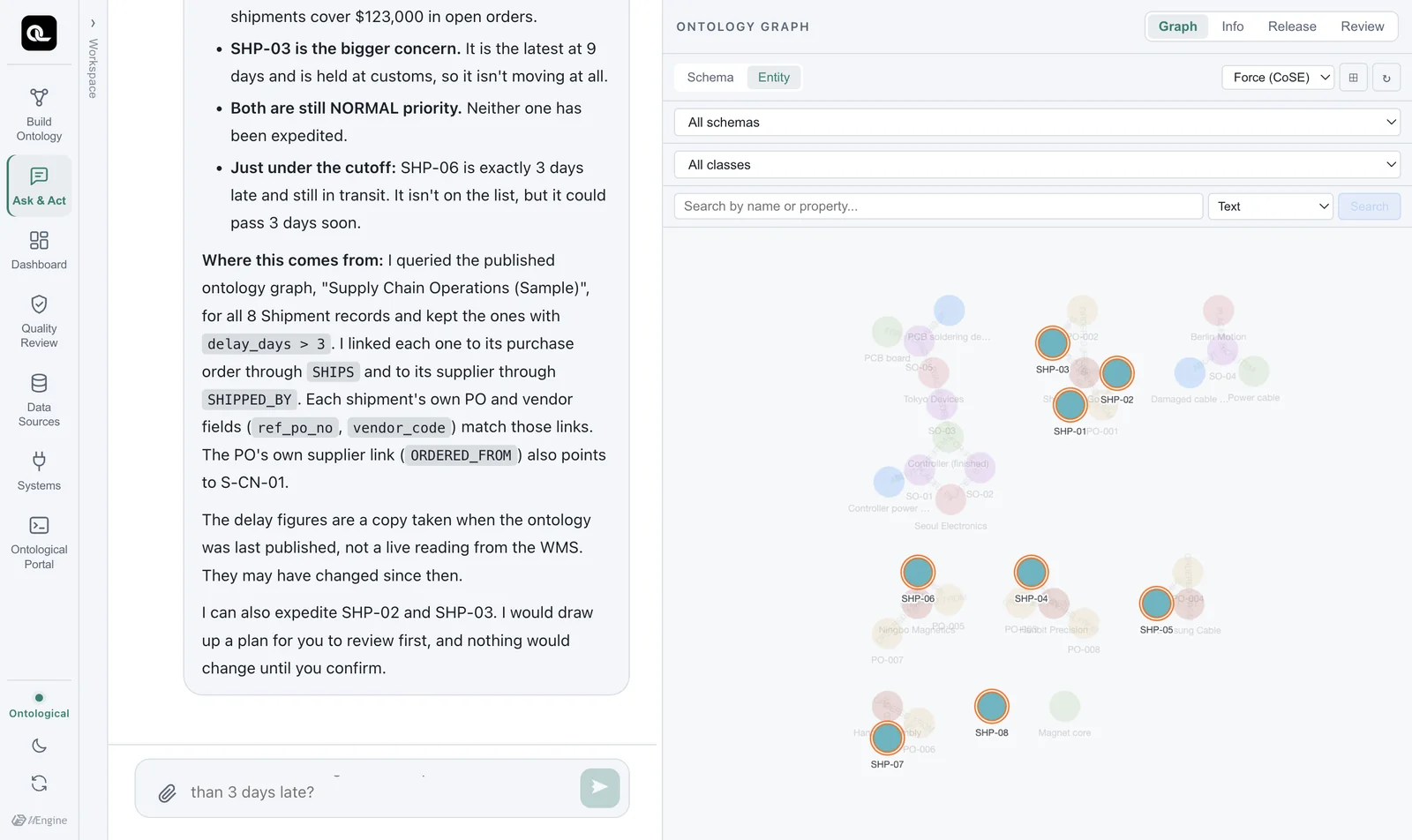
The answer: SHP-03 (9 days) and SHP-02 (7 days), supplier Shenzhen Goldline PCB. The evidence is written below, and the two shipments are highlighted in the graph on the right
The agent reads the schema and answers by following the relationships from shipment to supplier and from shipment to purchase order. The answer holds more than a conclusion. Along with the evidence that 2 of the 8 shipments met the condition, it states its criterion too: SHP-06 is exactly 3 days late, so it was left out under “more than 3 days.” With the evidence in hand, a person can check the answer directly.
⑤ Test it by giving an instruction.
This time it is a Golden Command.
The agent does not run it right away; it makes a plan first. The targets are the two shipments found earlier, and the work is to set their WMS priority to urgent and send the supplier an expedite request through the ERP. The plan runs only after a person approves it. Say “Cancel what you just did” and the executed steps are undone in reverse order.
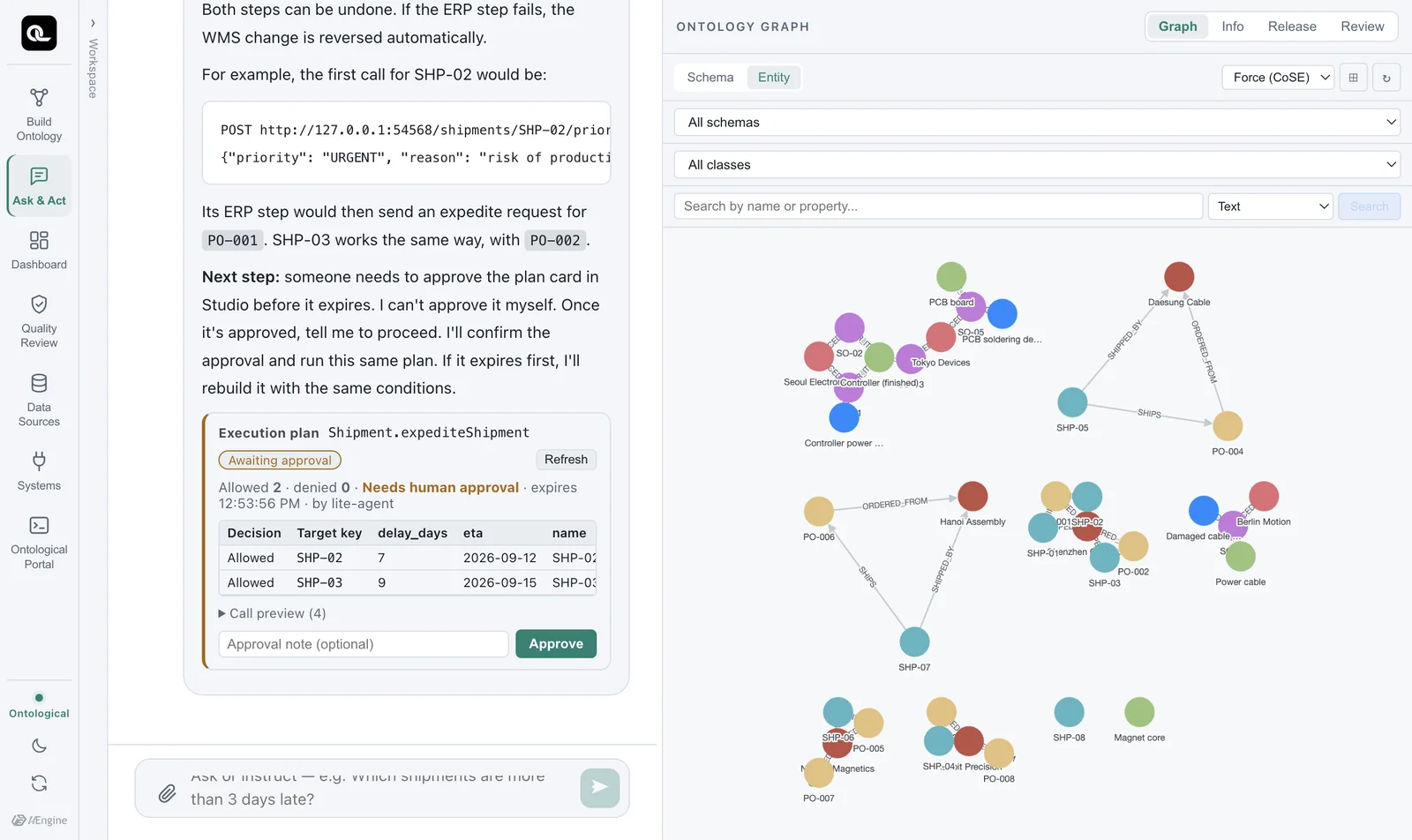
The plan card: Allowed 2 (SHP-02, SHP-03), needs human approval. Nothing has changed yet
⑥ Ask for something the ontology does not have, and it says so.
Ask the same ontology “What was our advertising spend last quarter?” and the agent does not make up an answer; it tells you this ontology cannot answer that yet. Advertising spend was not a question this job had to answer. That is not a failure; it is the next thing to do. If advertising spend really becomes necessary, add the question to the Golden Questions, connect the data, and run the same process once more.
This one case holds the whole argument of this post. The ontology is “wrong,” because it does not hold everything about the company. But to an agent that asks about and handles late inbound shipments, it is “useful.” What counts as useful was decided by the four lines of questions written at the start.
6. A design principle shared across fields
Starting from the questions and modelling only what is needed is a principle other fields have arrived at as well.
| Field | In one line |
|---|---|
| Domain-driven design | “Total unification of the domain model for a large system will not be feasible or cost-effective”[5] |
| Data warehousing | The first step of the design process is “Select the business process.”[6] |
| Ontology engineering | “There is no one correct way to model a domain— there are always viable alternatives.” Write down the questions the ontology must answer first, and evaluate it against them[7] |
| AI agents | Write evaluations first, each one “a test for an AI system,” and you get a baseline and regression tests along with them[8] |
Two questions we often hear:
“You can’t write down every question up front, can you?” Right. That is why the work is not done in one pass; the same process repeats. When a new question comes up, like advertising spend in the case above, add it and run the same process once more.
“If you build one for each job, won’t they drift apart?” They can. That is why the order matters. Rather than drawing the enterprise model first and then looking for uses, start from the uses, and once overlapping concepts show up, put them into a shared model. Palantir’s design guidance says the same: “A slightly imperfect Ontology that is in use and generating value is better than a theoretically perfect one”[9].
7. Try it in Ontological Studio
Each step of the case above maps to an Ontological Studio feature.
| Step in the case | Ontological Studio feature |
|---|---|
| ① ② Write the intent and the questions first | When you start a build, you write down the build intent and the Golden Questions. The agent proposes a first draft ↗ See it on the product page |
| ③ ④ Design from the questions, test with the questions | The agent designs the concepts and relationships, loads the facts as instances, then asks the Golden Questions itself to check that answers come back. A person decides whether to publish ↗ See it on the product page |
| ④ Answers that keep their evidence | It answers by following relationships, and leaves the nodes and relationships each answer rests on visible on screen ↗ See it on the product page |
| ⑤ Instructions as plan, approve, execute, cancel | Once you write a Golden Command, the agent studies the business systems’ APIs, creates the actions, compensations and policies, and checks them with a dry run. Execution always goes through human approval ↗ See it on the product page |
| ⑥ Say so when something isn’t there | Before answering, the query agent checks whether the published ontology can answer the question. If the data it needs is missing, it does not make up an answer; it tells you what is missing ↗ See it on the product page |
| Don’t copy everything | Source databases are not replicated. They are connected with just their connection details, and their tables appear as virtual nodes ↗ See it on the product page |
You can follow along yourself.
- See the case above on real screens in the Ontological Studio tutorial: chapter 11, “Golden Questions and Golden Commands”, chapter 13, “Asking Questions” and chapter 16, “Running Actions”.
- Build the same idea yourself with open source (Neo4j and Claude Code) in AX School’s “Law GraphRAG Hands-On” (Korean)
- See the product on the Ontological Studio page, and request a consultation through Contact Us.
When you start an ontology, don’t ask “What does our company have?” Write down first “What must the agent answer, and what must it do?” All ontologies are wrong. Useful ones start with questions.
References
- [1] London Museum, "Harry Beck: The man who revolutionised the Tube map"
- [2] G. E. P. Box (1979), "Robustness in the Strategy of Scientific Model Building", in Robustness in Statistics, Academic Press, pp. 201–236
- [3] uEngine AX School, “Law GraphRAG Hands-On: Neo4j × Claude Code” (Korean)
- [4] Anthropic (2025), "Effective context engineering for AI agents"
- [5] Martin Fowler (2014), "BoundedContext"
- [6] Kimball Group, "Four-Step Dimensional Design Process"
- [7] N. F. Noy, D. L. McGuinness (2001), "Ontology Development 101: A Guide to Creating Your First Ontology"
- [8] Anthropic (2026), "Demystifying evals for AI agents"
- [9] Palantir, "Ontology design: Best practices"