An Open-Source Survival Strategy for Solo Founders in the AI Era
This article summarizes the slides from the special lecture "Beyond Simply Publishing Code: The Evolution Toward Spec-Driven Development and an Agentic LLM OS (feat. uEngine's 20-Year Answer)" delivered by uEngine Solutions CEO Jinyoung Jang at the 2026 Open Source Developer Contest orientation (online via Zoom, for contest participants) on July 23, 2026. It covers the story of entering the contest and winning repeatedly, the growth of an open-source company that started from an award-winning entry, and the AI technology trends that practitioners need most right now.
1. Open source is not a hobby: 23 years that began with a contest award
uEngine's story began in 2003, when it opened Korea's first open-source BPM community on SourceForge.net. That work led to the Grand Prize at the Korea Software Contest, and the award became the key that opened the door to large-enterprise projects such as SK Telecom (T-Interactive) and Hyundai/Kia Motors (new-vehicle quality management).
- 🏆 2003–2008: First on SourceForge.net, Grand Prize at the Korea Software Contest; adopted by SK Telecom and Hyundai/Kia Motors
- ☁️ 2013–2015: Cloud transition, chair company of the Open Cloud Engine; long-term subscription for IBK Industrial Bank of Korea's post-next-generation BPM
- 🧩 2018–2024: Expanded cloud-native and microservices (MSA) tooling; LG CNS, POSCO DX, Hanwha Life
- 🤖 2025–2026: Process GPT and the leap into agentic AI
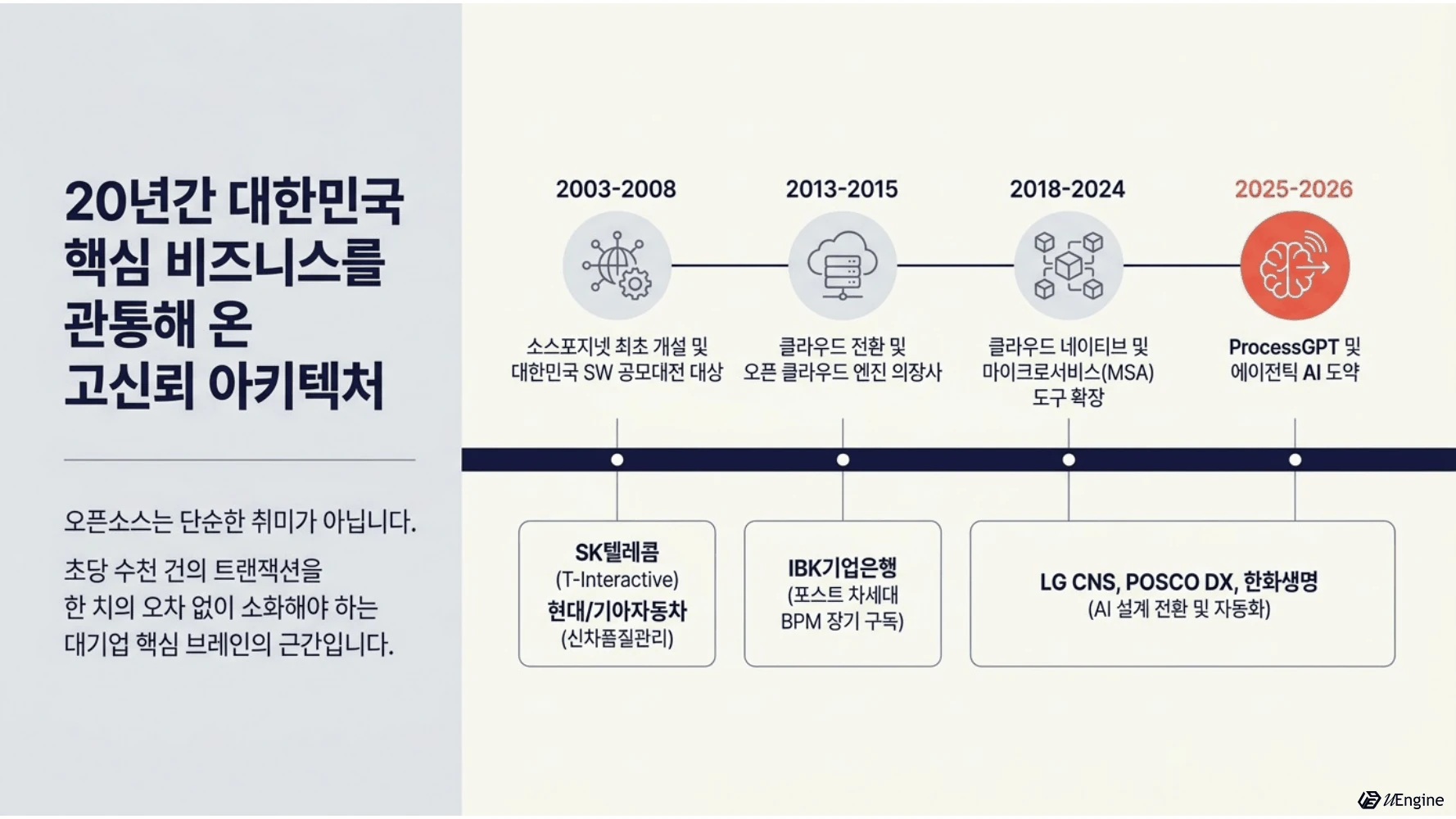
Open source was never a hobby; it was the foundation of the core brains of large enterprises handling thousands of transactions per second.
The only way an unknown startup could win over giant enterprise customers was not to monopolize the source code, but to give customers unlimited control and freedom and thereby dispel the primal fear of vendor lock-in. Open source is the most powerful distribution channel for earning trust and 'monetizing the customer's operational risk.'
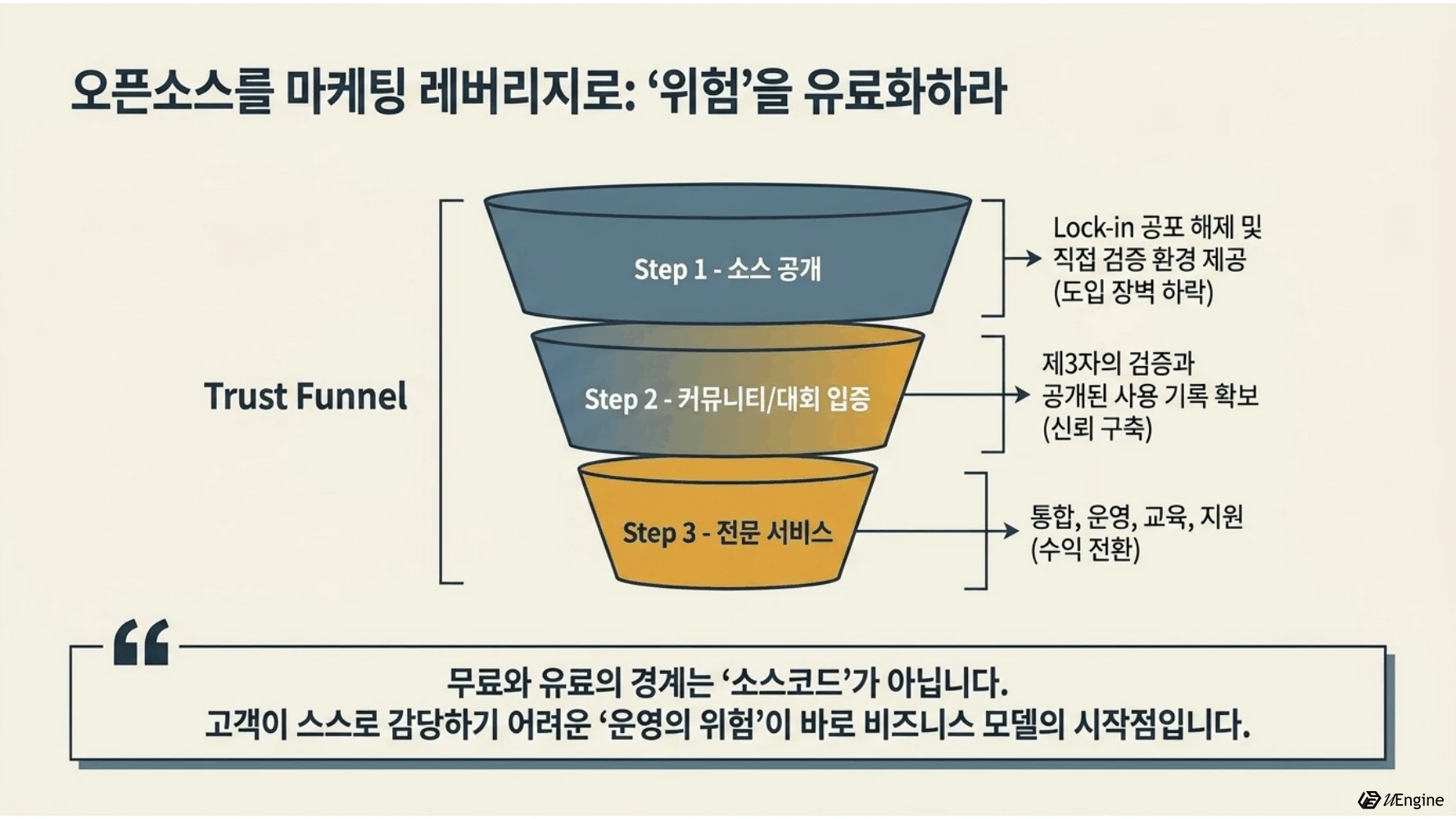
Trust Funnel: publish the source (lower the adoption barrier) → community and contest validation (build trust) → professional services (convert to revenue). The line between free and paid is not the 'source code' but the 'operational risk' customers cannot easily bear on their own.
This is where the first message for contest participants comes in. The entry you are building right now is not merely a contest submission; it is the second stage of the trust funnel, where you secure third-party validation and a public record of use. An award history becomes your most powerful reference in front of enterprise customers.
2. The Open Source 2.0 era, triggered by AI
If Open Source 1.0 was the era of code, the exclusive domain of engineering developers who reused and validated engines and tools, Open Source 2.0 is the era of specs and knowledge. The center of gravity of open source is shifting toward co-developing business rules, domain specs, and organizational knowledge, and accumulating the execution records of agents (Operating Learning).
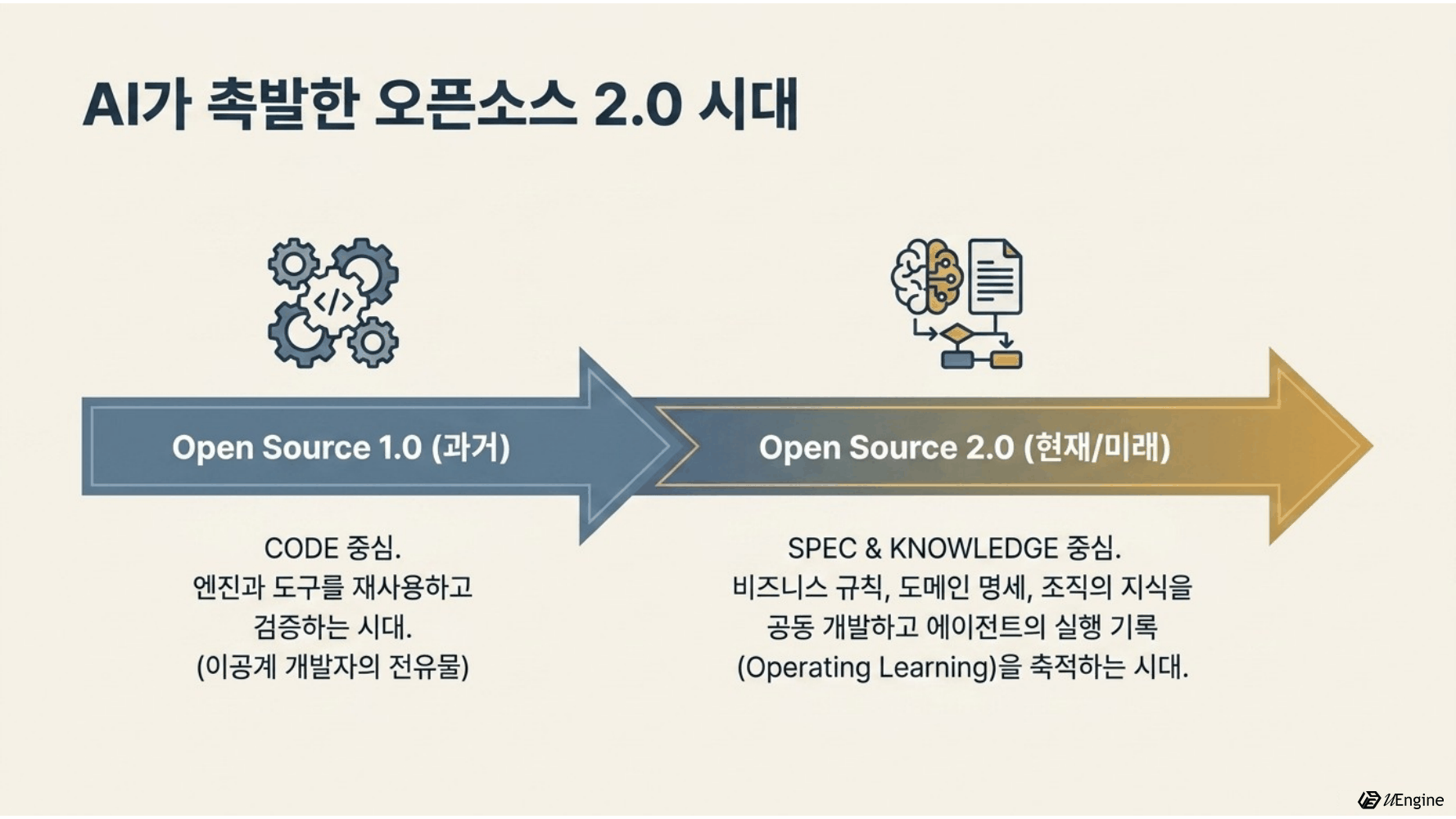
Open Source 2.0, triggered by AI: from CODE-centric to SPEC & KNOWLEDGE-centric.
3. Trend ① The end of coding, the reign of the 'Spec'
AI coding removes the implementation bottleneck and instead exposes the 'intent bottleneck.' Problem definitions, domain concepts, normal and exception flows, roles and permissions: domain knowledge structured in natural language becomes the top layer of the source code. This is the shift from Vibe Coding to Spec-Driven Development.
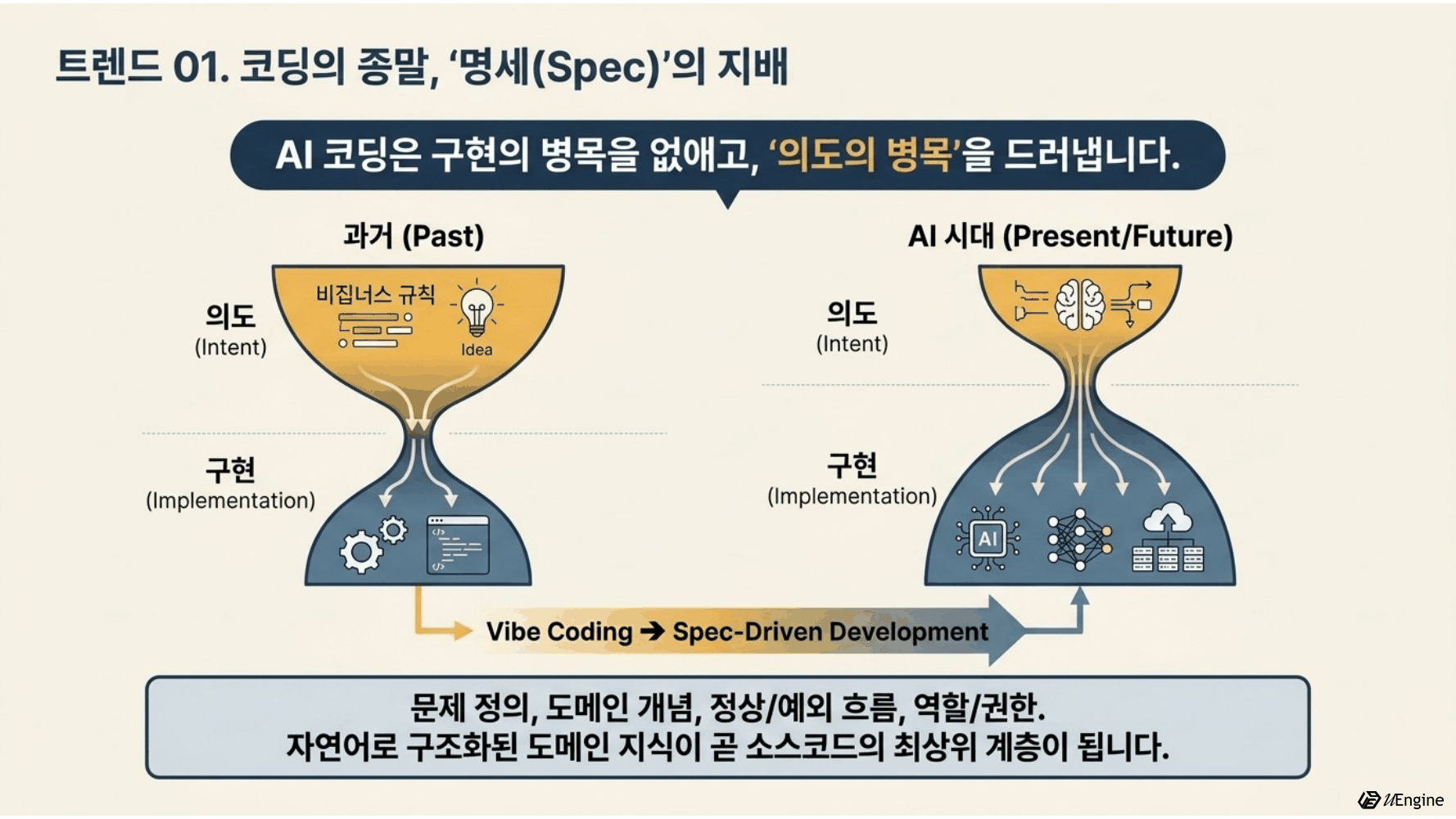
In the past, intent was wide and implementation was the narrow bottleneck; in the AI era, implementation widens and intent becomes the bottleneck.
The speed of this transition is beyond imagination. Semiconductors get faster every two years, but AI coding capability doubles every 70 days.
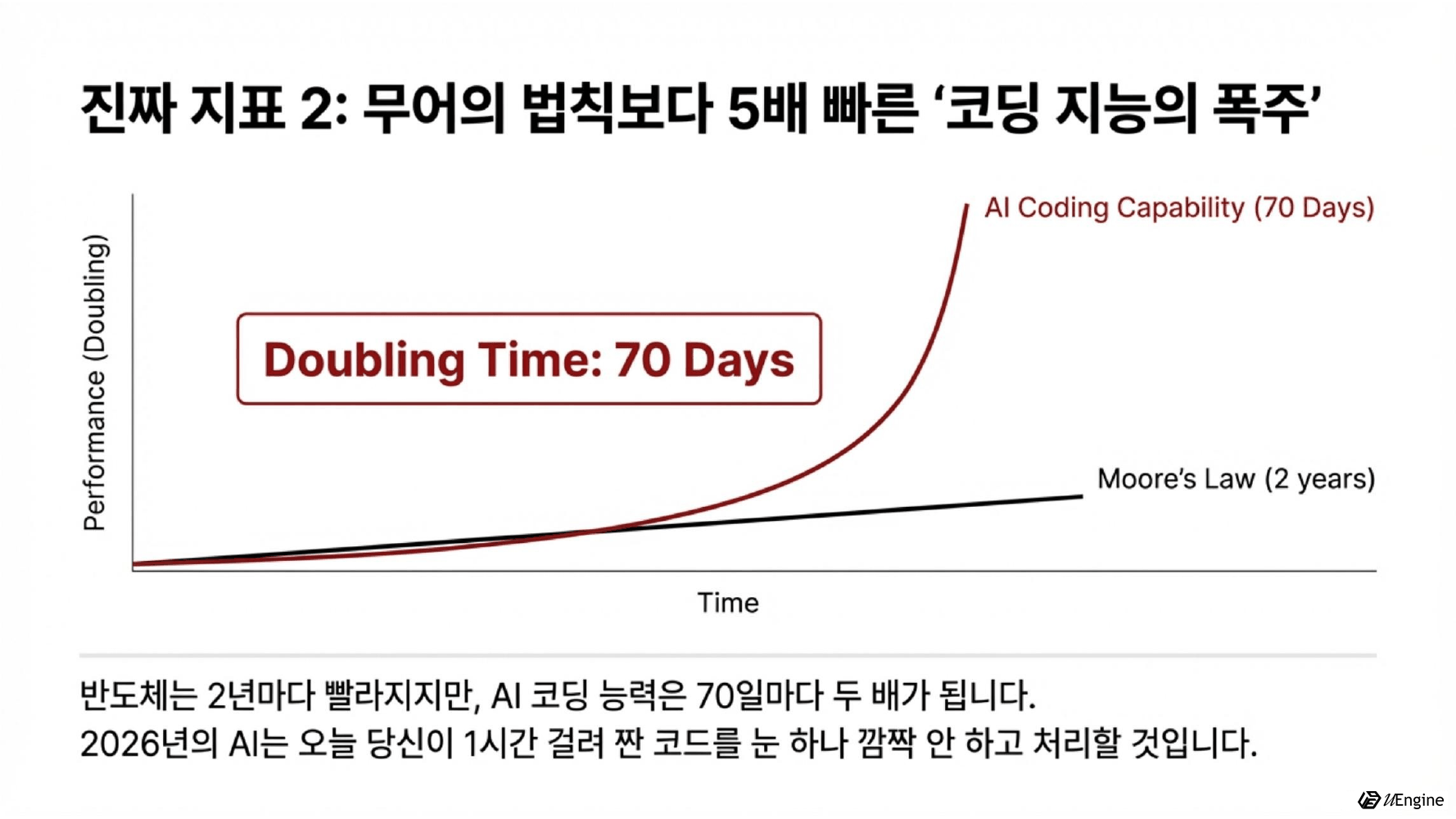
The AI of 2026 handles the code that takes you an hour to write today without batting an eye.
As implementation cost converges to zero, the battleground has shifted entirely from 'how to build it (How)' to 'what to build (What).' The new bottleneck is not the technical implementation that dozens of engineers once poured days into, but the decision of "what to build."
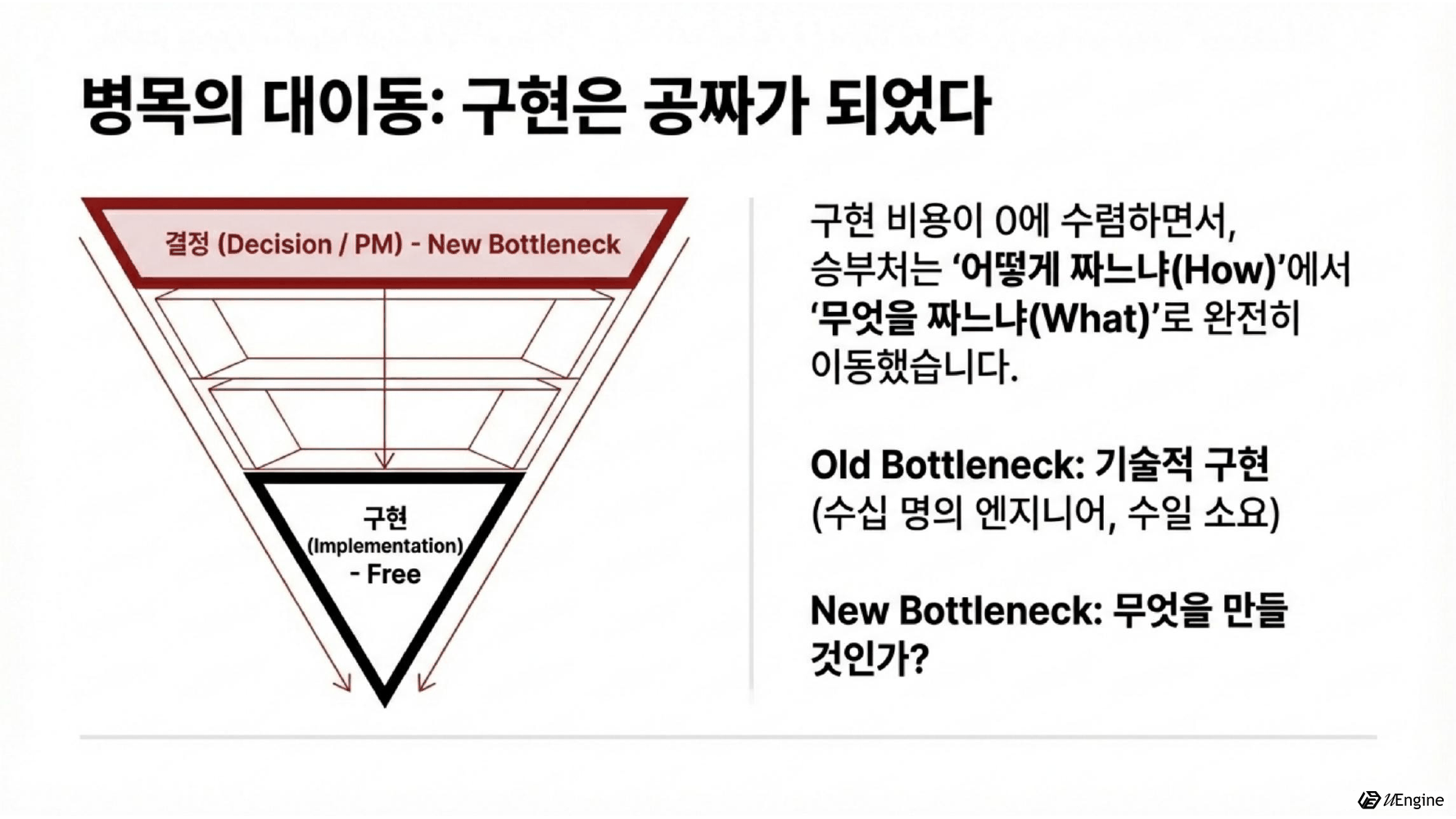
Old Bottleneck: technical implementation → New Bottleneck: what to build?
Organizational structure collapses along with it. The 1:8 golden ratio of one PM to eight engineers is over. Thanks to AI, engineers now move at spaceship speed while human judgment (the PM) still moves at bicycle speed, so the engineer and the planner ultimately merge into a single person.
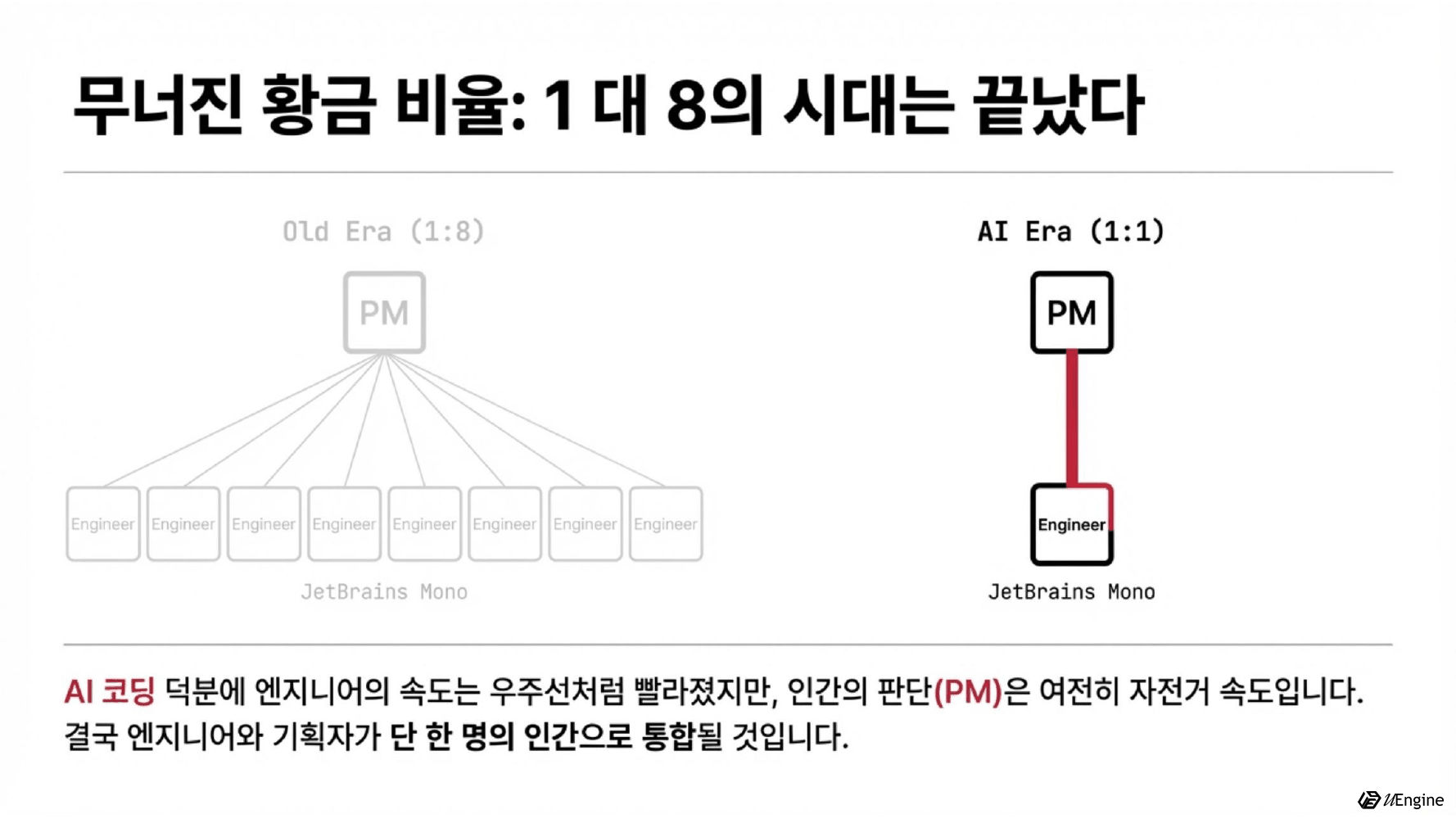
From the Old Era (1:8) to the AI Era (1:1): the integration of planning and implementation.
4. The new survivor: the product engineer, not the coder
So which developers will survive? The product engineer, who stands at the intersection of coding skill, empathy, and product thinking. If the developer of the past was a bricklayer waiting for a spec, the developer of the future is a site manager who revises the blueprints and rebuilds.
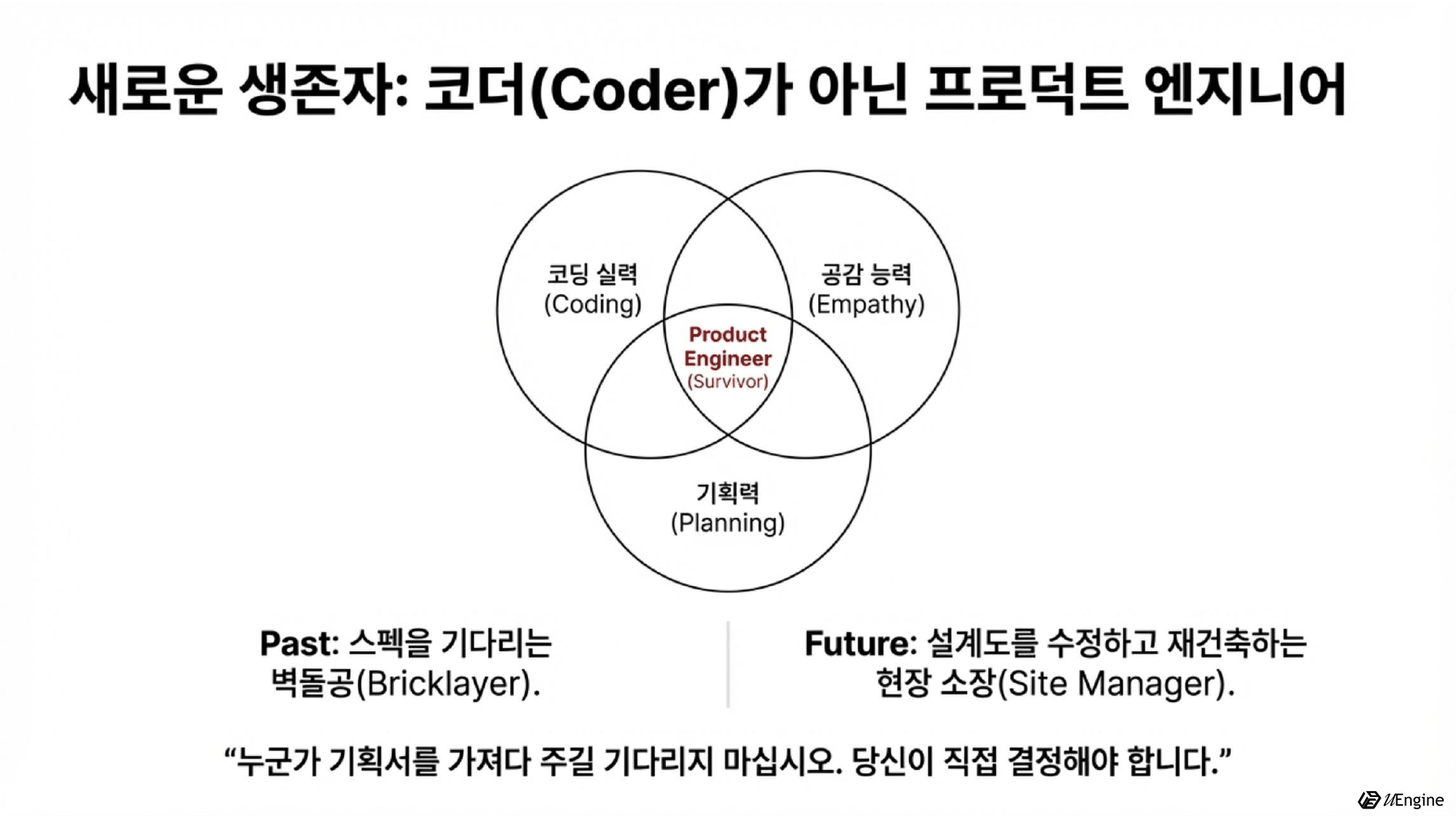
"Don't wait for someone to hand you a plan. You have to make the decisions yourself."
A shift in thinking: use AI like a teammate
"AI drives the detailed thinking; I set the direction." The developer's role shifts from writing every line of code by hand to directing the AI, verifying its output, and making the strategic decisions.
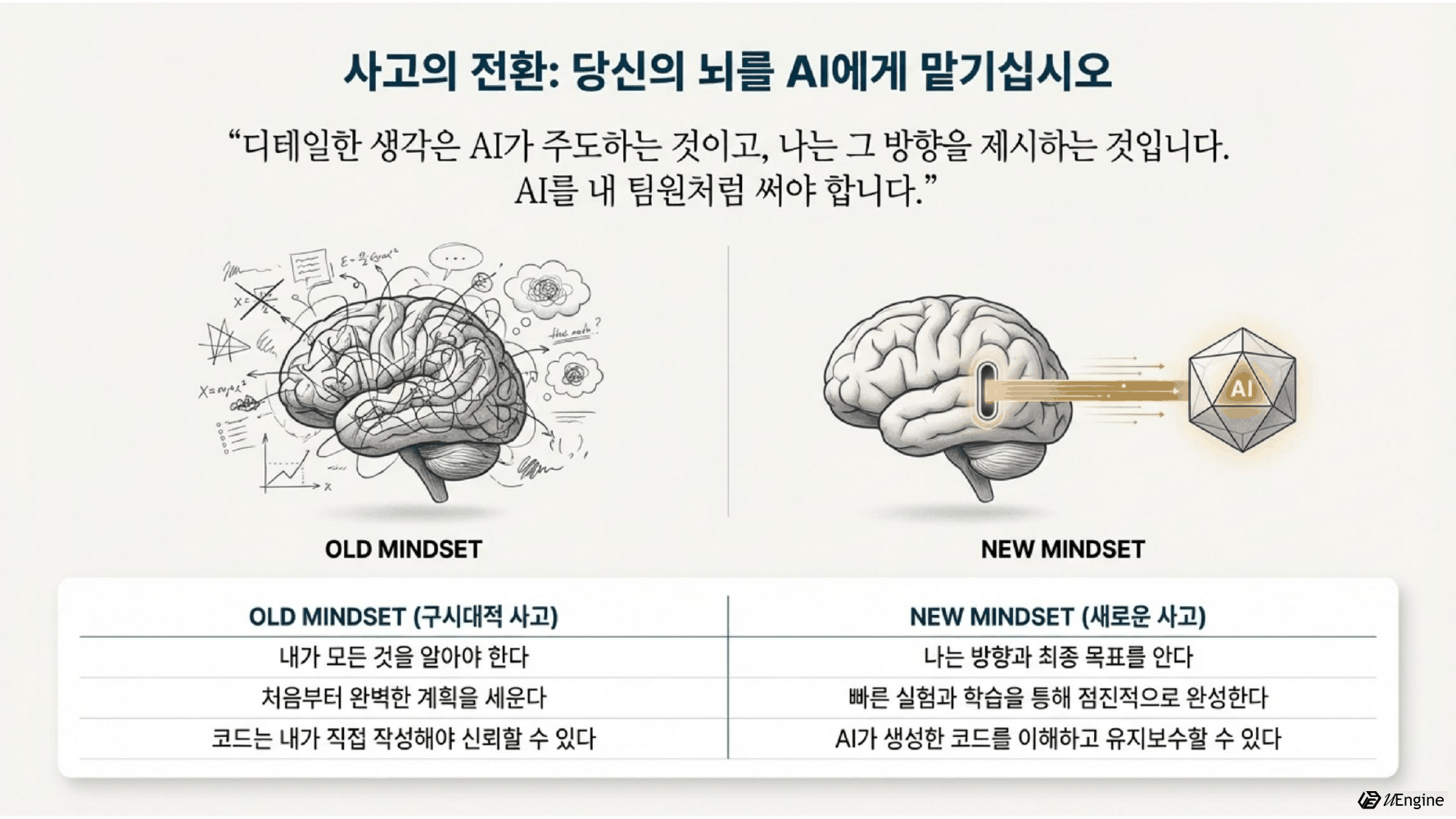
Fast experimentation and learning instead of a perfect plan; the ability to understand and maintain AI-written code instead of trusting only code you wrote yourself.
The rhythm of execution changes too. A 30-minute rapid iteration cycle of PRD generation → model-first implementation → UI-less testing → feedback and refinement becomes the basic unit of the new way of developing. Key insight: assume the output of the first cycle will be thrown away. The goal is learning and concretization through fast execution.
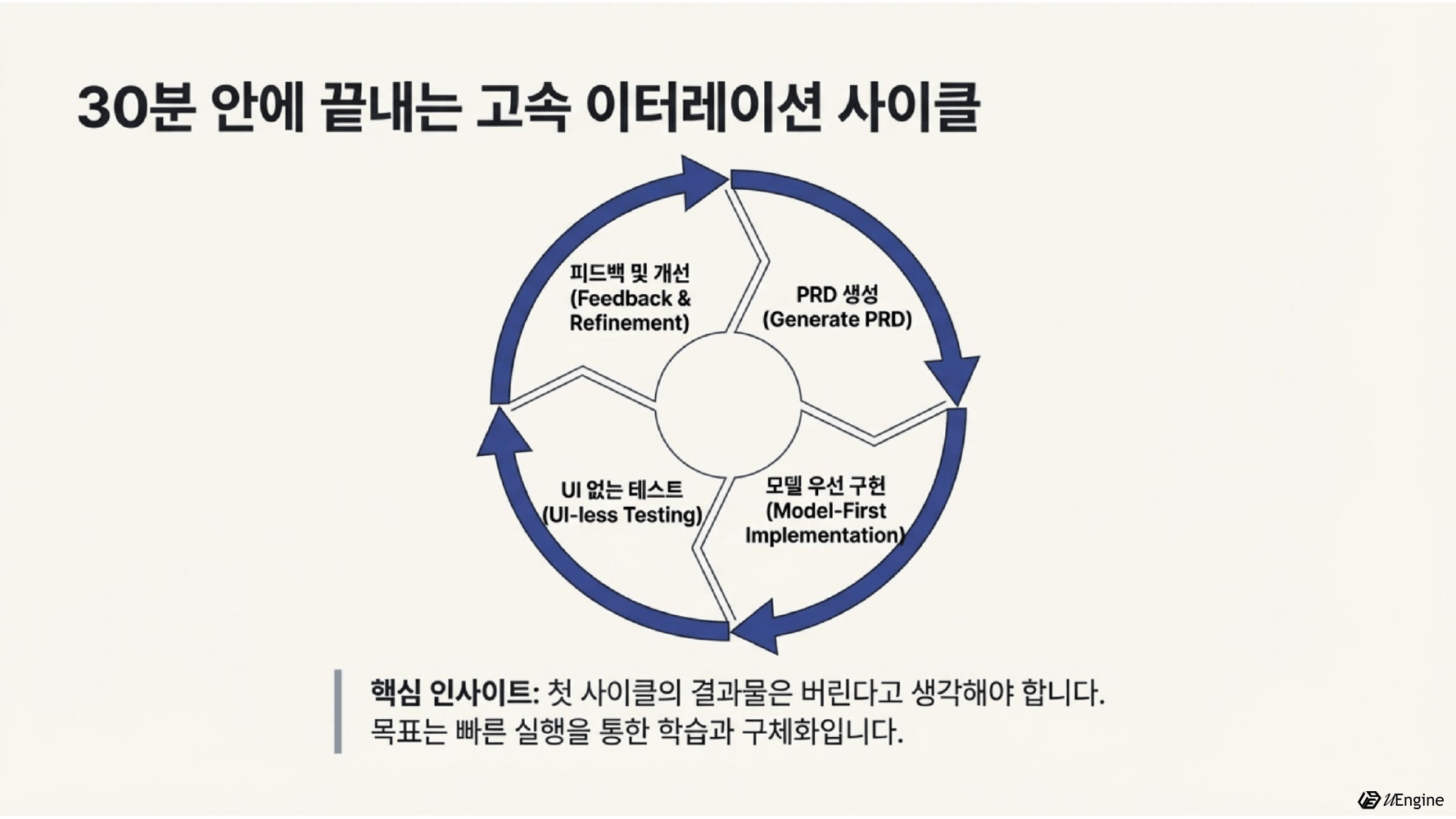
Generate PRD → Model-First Implementation → UI-less Testing → Feedback & Refinement.
Architecture, too, must evolve with the business. Market validation comes before technical perfection. Start with a single-database monolith to ship an MVP fast; once the product starts selling, lower coupling with an event bus; and only when large-scale traffic is proven, move to event-driven microservices.
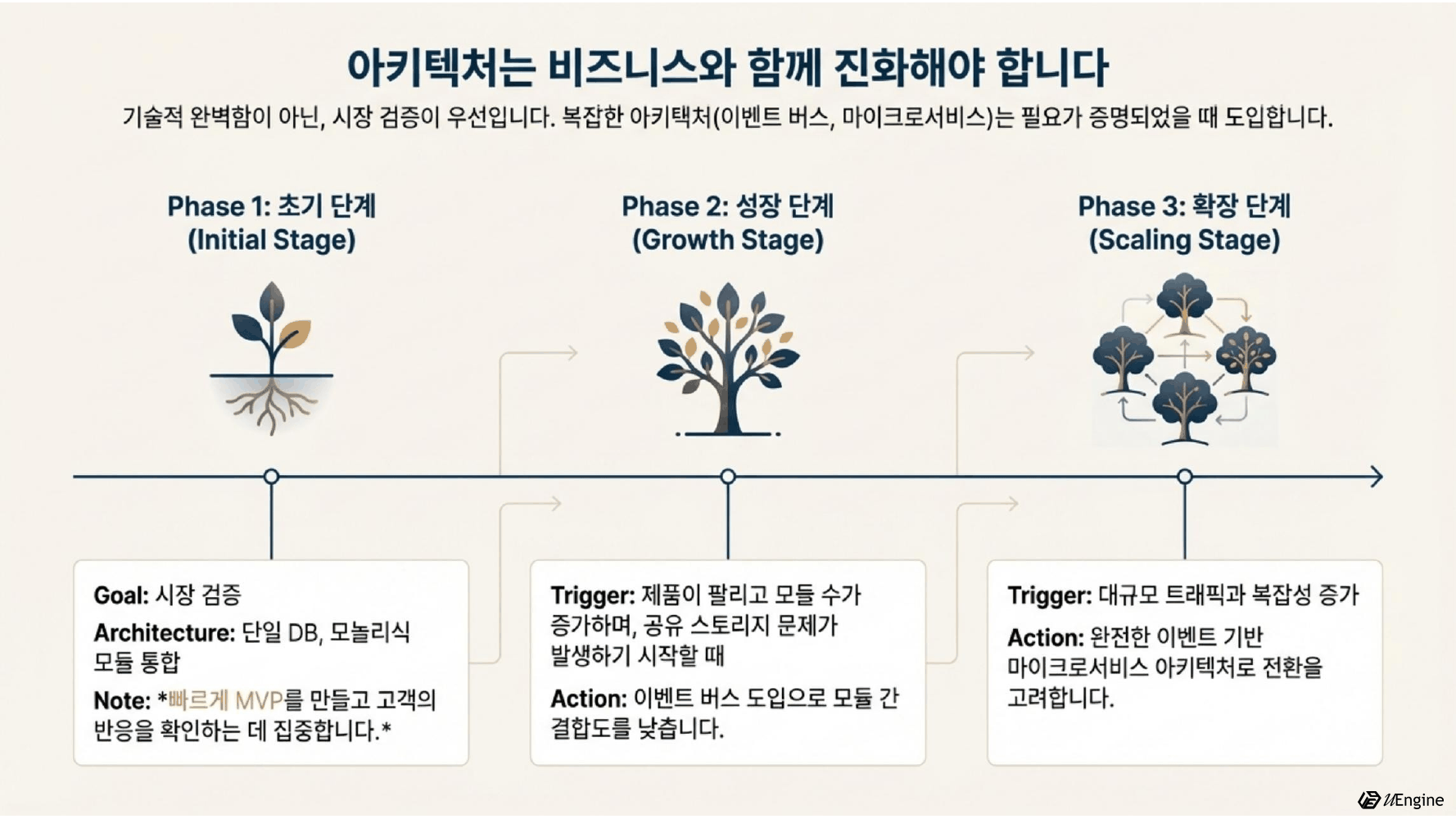
Complex architecture (event bus, microservices) is introduced only once the need has been proven.
The way we hand work to AI must evolve as well. Fine-grained step-by-step instructions (micro-prompting) strip AI of its autonomy and degrade performance. The AI-native way is to delegate one to four days' worth of work in a single large chunk through high-level instructions centered on business purpose and intent.
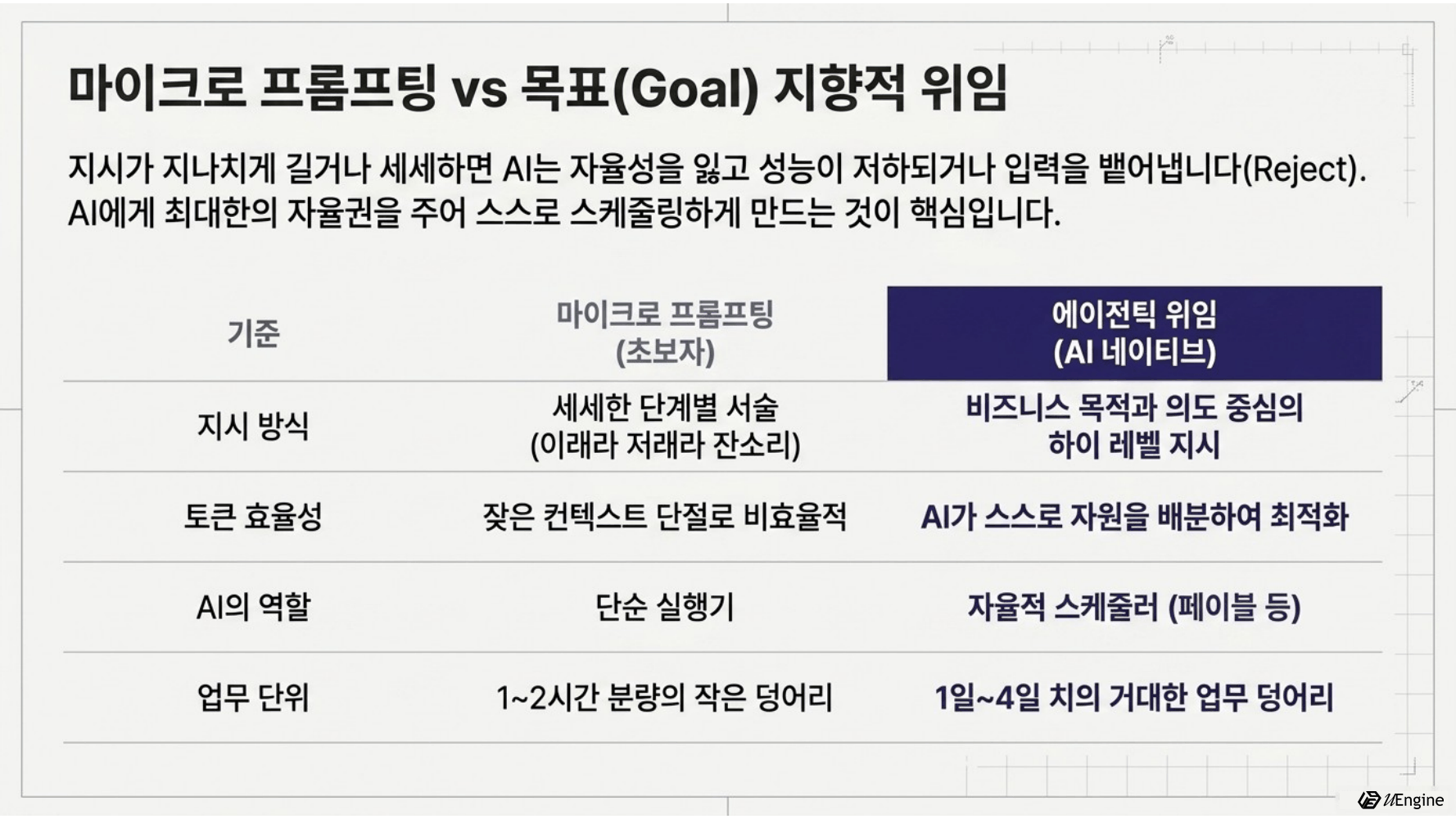
The key is to give AI maximum autonomy so it can schedule the work itself.
5. Three Survival Rules for Solo Founders in the AI Era
- 📢 Marketing leverage: 'Don't mistake code for product.' Use open source as a powerful distribution channel for earning trust and 'monetizing the customer's operational risk.'
- 📐 Specs as assets: 'Break free from code labor.' Become an architect who owns the customer's recurring problems through structured domain specs and evaluation sets — not through coding skill.
- ⚙️ Own the process: 'Drop the lightweight chatbot.' Instead of fragmented AI demos, control an end-to-end value chain that runs to completion — however narrow it is.
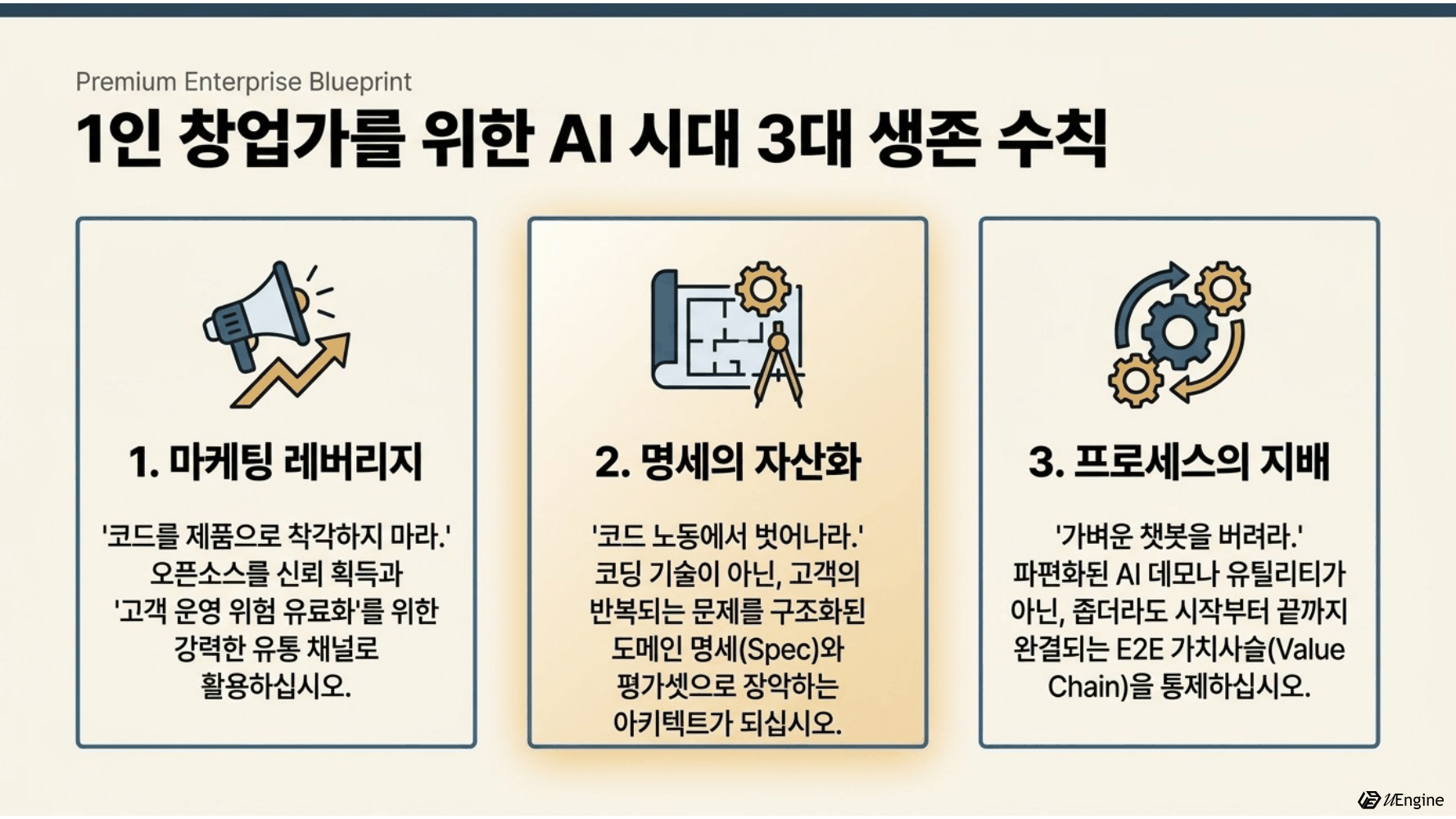
The three survival rules that formed the backbone of the talk.
6. Trend 2: From Personal Assistant (Co-pilot) to E2E Process AI
No matter how many copilots you roll out to help with personal tasks like summaries, email, and search, enterprise E2E outcomes do not follow automatically. Isolated chat windows, broken context between departments, and the absence of process KPIs are why enterprise ROI fails. Enterprise results come from handoffs and collaboration among people, agents, and systems — in other words, from completing the value chain.
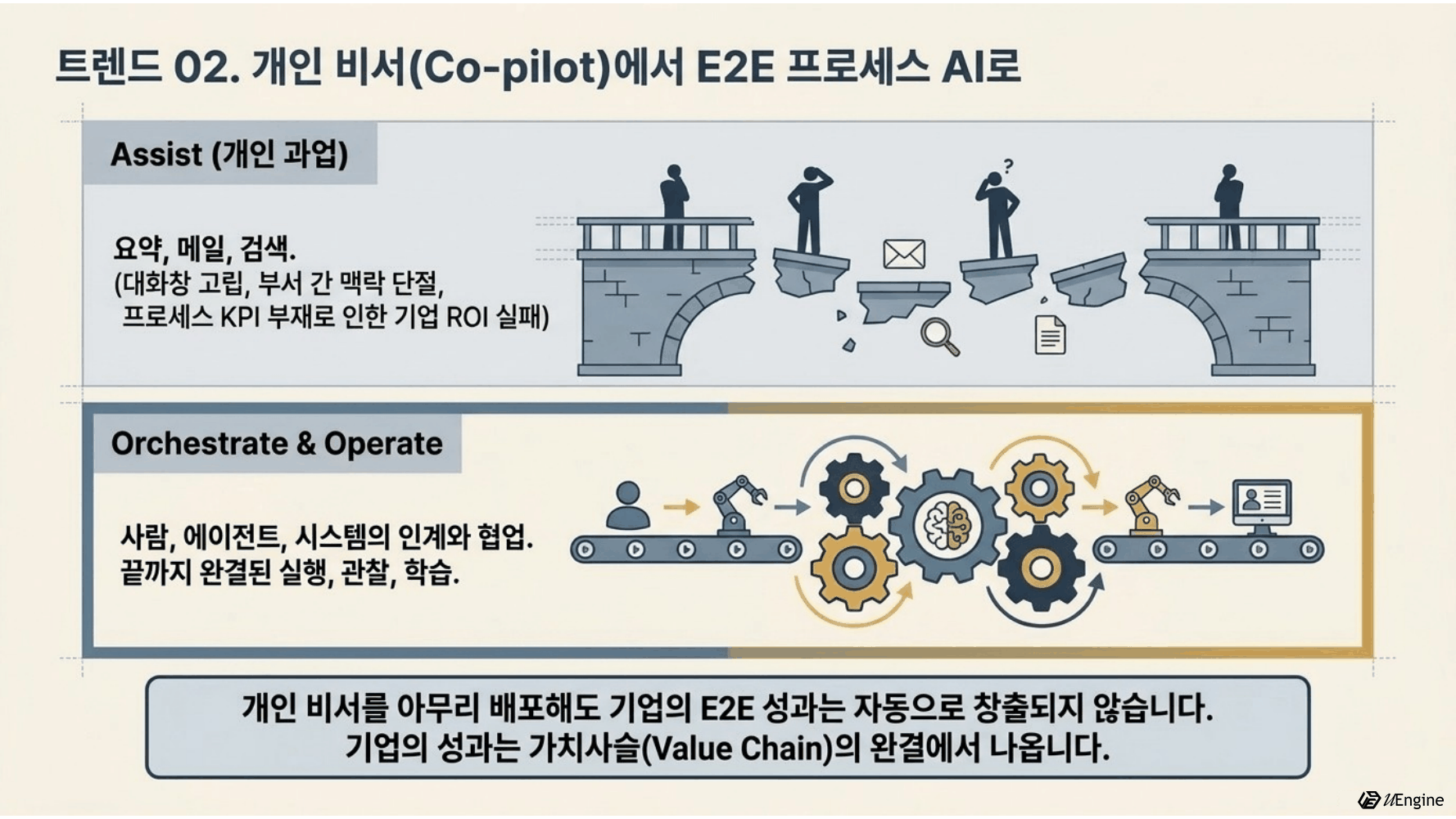
From Assist (personal tasks) to Orchestrate & Operate (execution, observation, and learning carried through to completion).
uEngine's Process GPT unifies fragmented AI into a business execution engine. Design in natural language and it is converted into standard BPMN/DMN models; AI agents are deployed automatically over the A2A protocol; and after human intervention and approval (Human-in-the-Loop), systems execute and are monitored over the MCP protocol. In Process GPT, BPMN is the perfect 'Operating Contract' that balances agent autonomy with enterprise control.
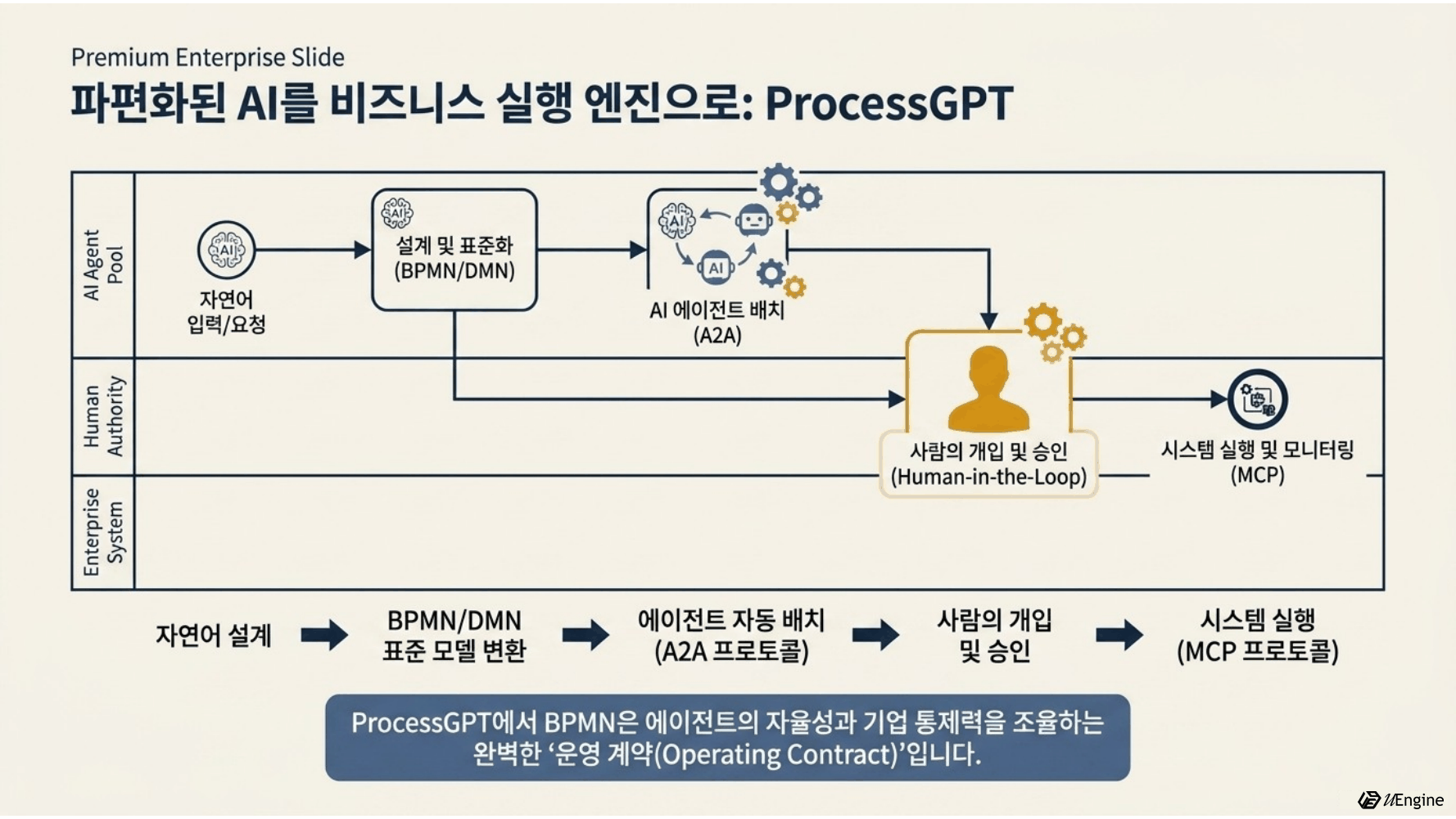
Natural-language design → BPMN/DMN conversion → automatic agent deployment (A2A) → human intervention and approval → system execution (MCP).
7. uEngine's 20-Year Answer — From BPM to Agentic AI
The names of the technologies have changed, but uEngine's direction over 23 years has been a single one: "Execute the intent the business expresses, more directly." It is a staircase from BPM (2003–), which pulled workflows out of code, to DDD/MSA (2018–), which reached agreement in domain language and drew boundaries, to Agentic AI (2025–), where agents execute natural language directly, grounded in knowledge and specifications.
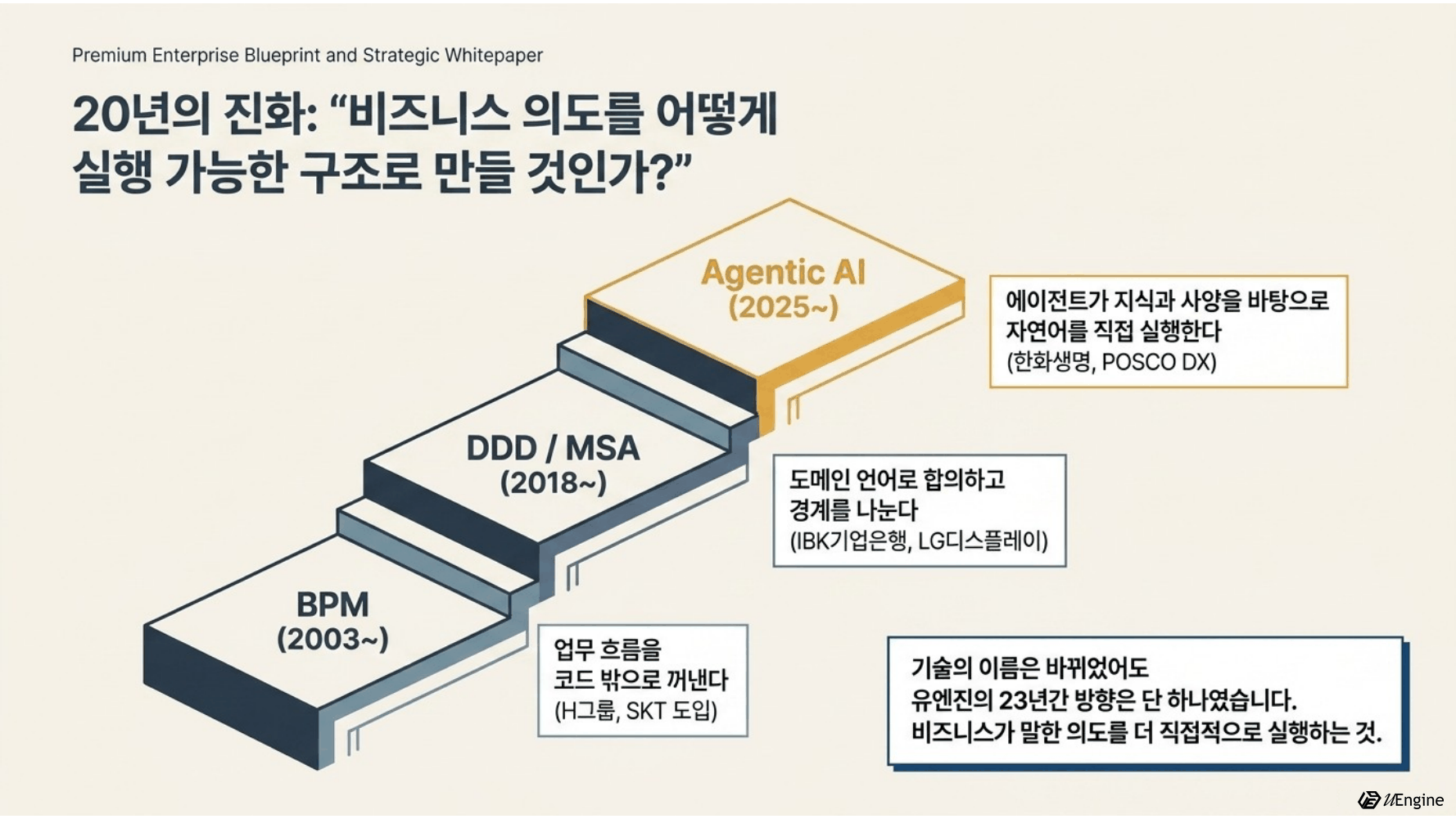
"How do we turn business intent into an executable structure?" — one question, 23 years.
Robo Architect is the culmination of spec-driven development. Whereas off-the-shelf LCNC (low-code/no-code) tools generate proprietary runtime scripts with very high vendor lock-in, Robo Architect generates pure, standard, general-purpose code in Java, Python, and more that you are free to modify, and supports large-scale Cloud Native / MSA architectures aligned with DDD and Aggregate boundaries.
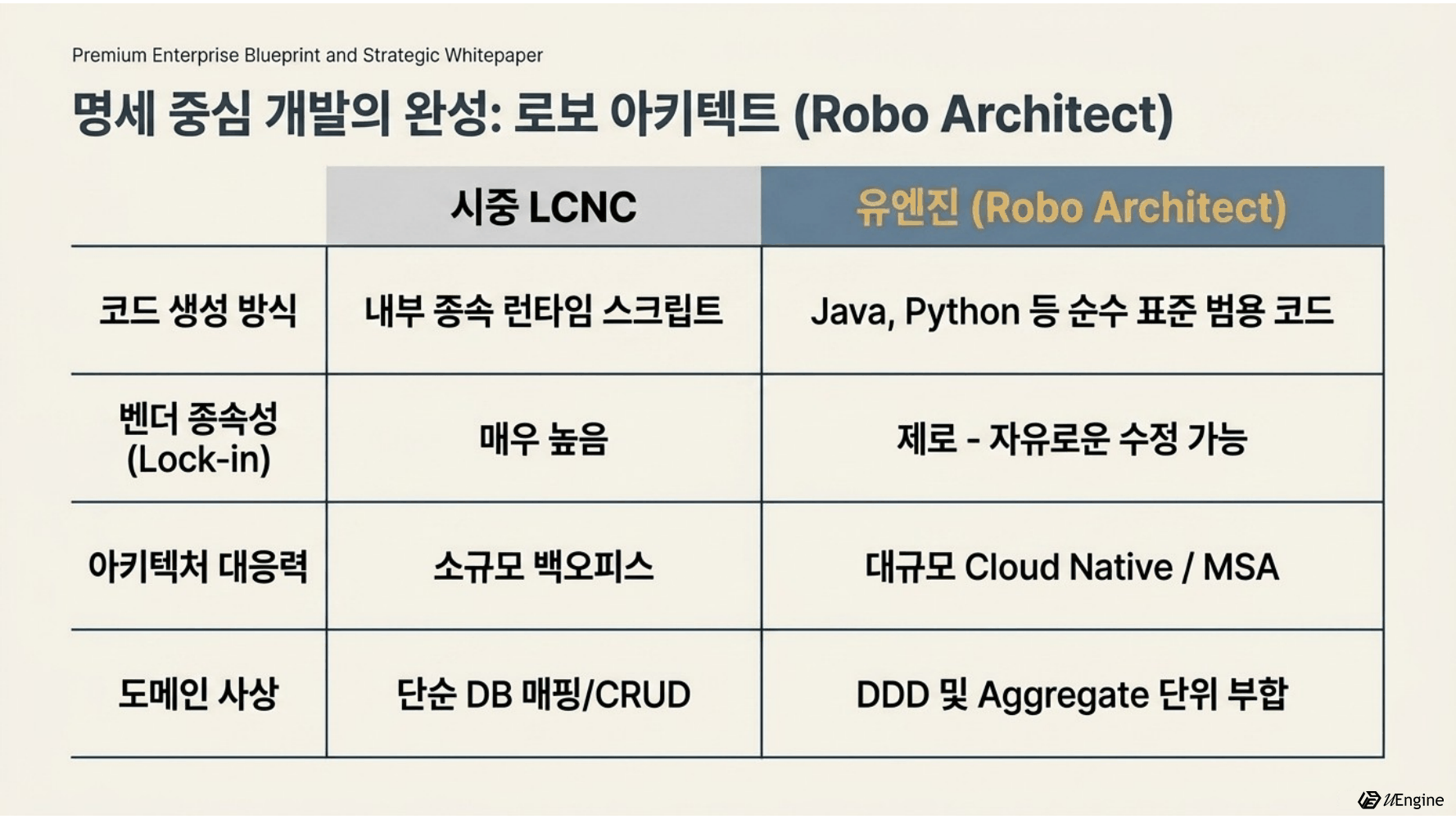
The culmination of spec-driven development: Robo Architect.
8. Blueprint for Autonomy — Agents That Work Overnight and the Economics of AI-Native
Development, QA, marketing asset creation, and deployment that used to take three to four days are folded into a single cohesive workflow that runs autonomously overnight. The team lead delegates a 'Goal' at 5 p.m. and reviews the results the next morning. From source code intake to deriving the architecture and manuals, install validation, E2E regression tests, demo video generation, website deployment, and agent skill creation — the entire pipeline belongs to AI agents.
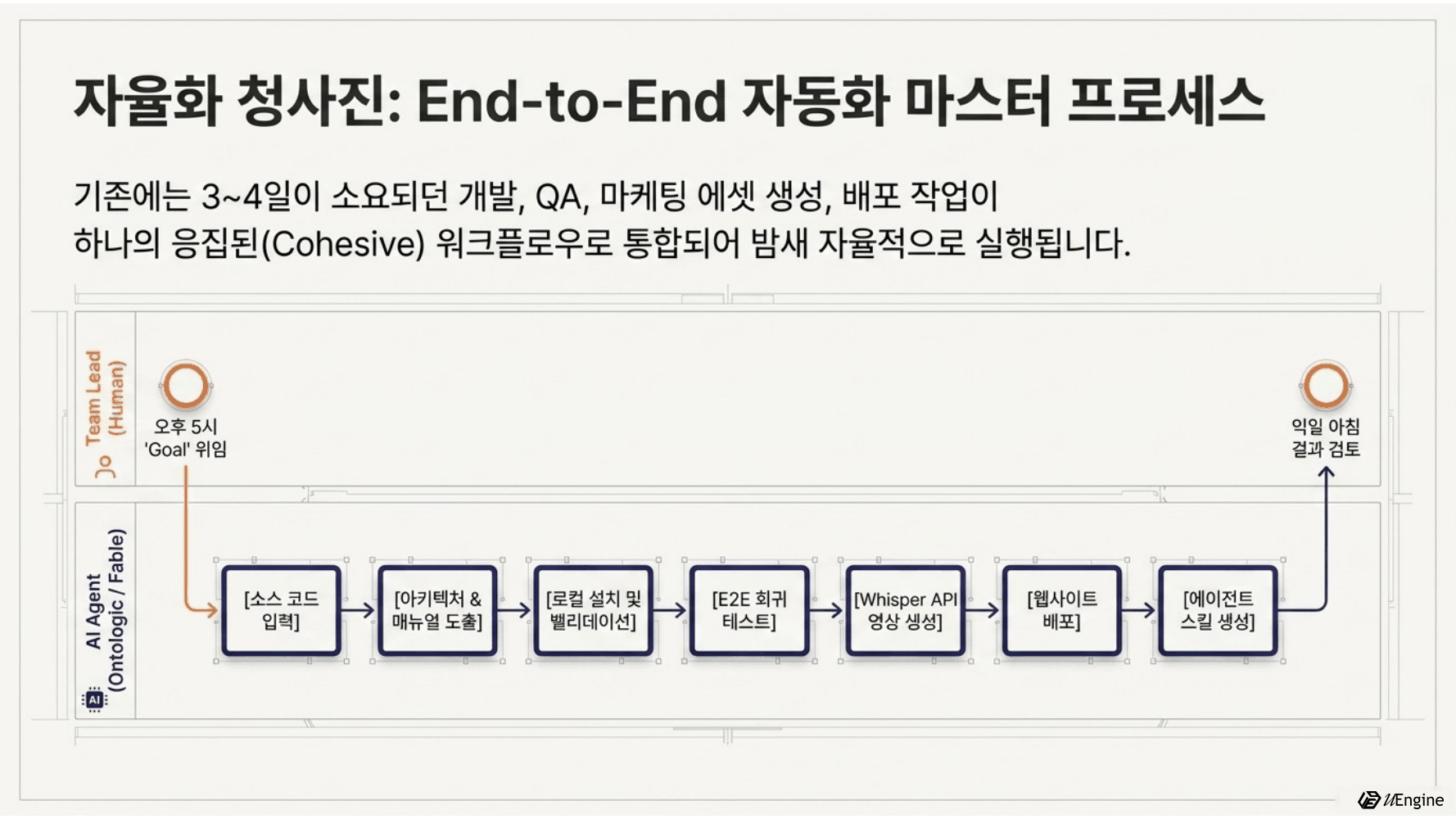
People delegate goals and review results. Agents carry out the execution overnight, to completion.
This is a matter of economics, not technical curiosity. Companies that have aggressively adopted AI tools are creating unicorn-scale value with only a few dozen people. Telegram generates roughly KRW 48.3 billion per employee with a staff of 30; Midjourney creates about KRW 18.1 billion per employee with 40.
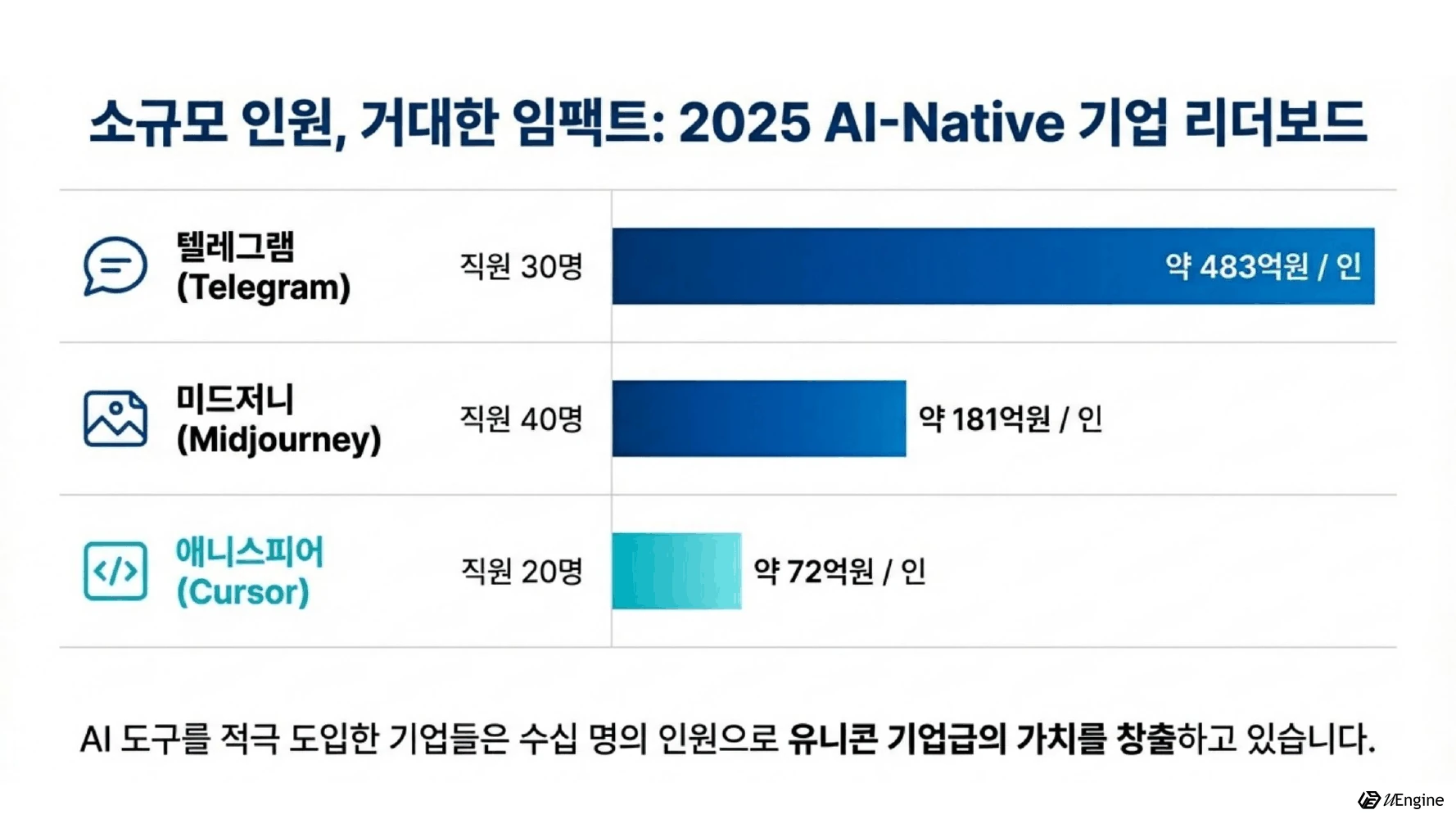
Small teams, massive impact: the 2025 AI-Native company leaderboard.
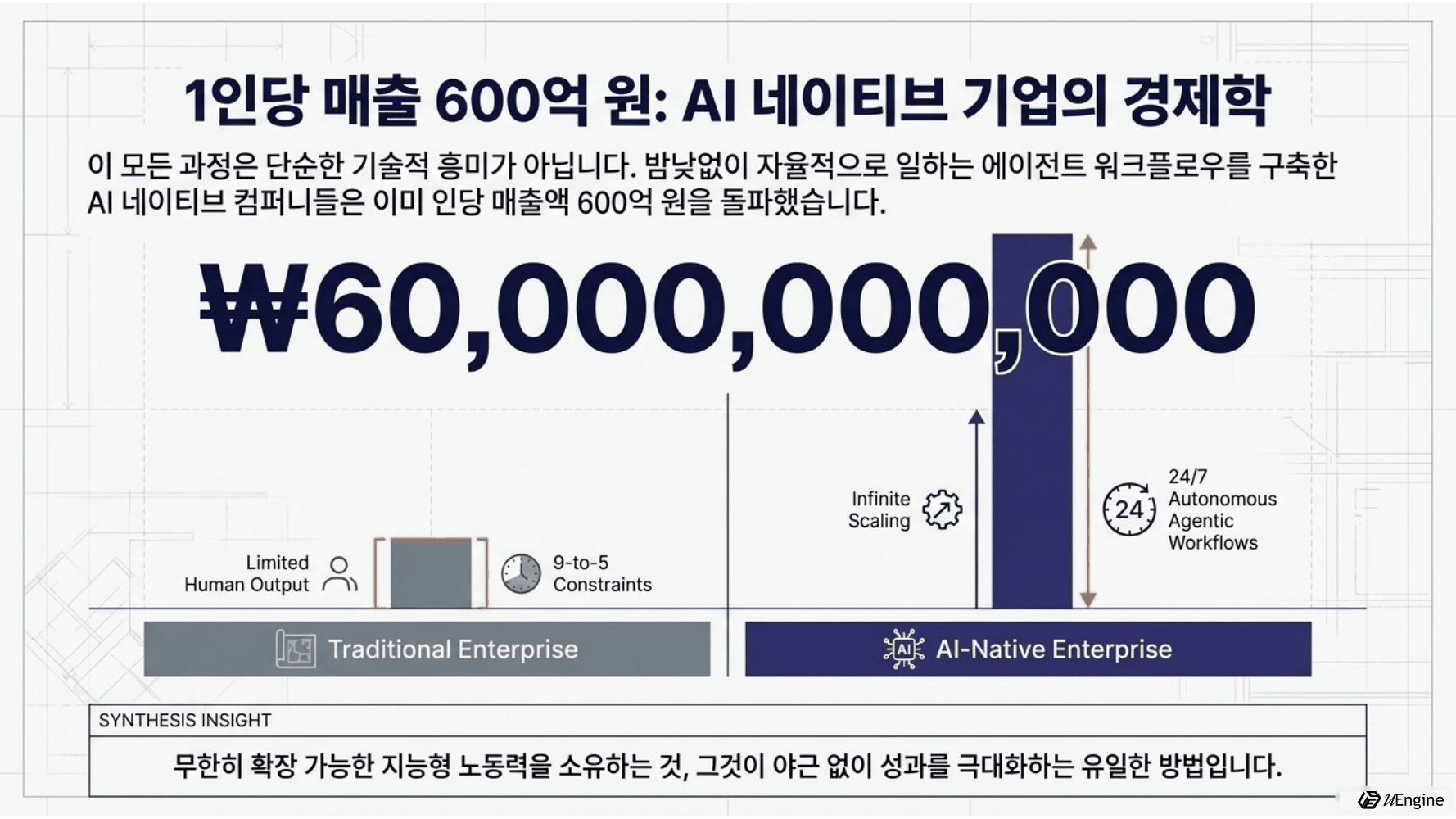
AI-native companies that have built agent workflows running autonomously around the clock have already surpassed KRW 60 billion in revenue per employee.
9. A Developer Manifesto for the AI Era
- 🪄 We are conductors, not coders. We create value by conducting AI.
- ⏱️ Speed over perfection. We execute and learn fast in 30-minute cycles.
- 💎 The model always comes first. We validate core logic before the UI.
- ⚙️ Integration is automated. We leave repetitive integration work to AI.
- 🔀 Architecture evolves. We advance the system in step with business growth.
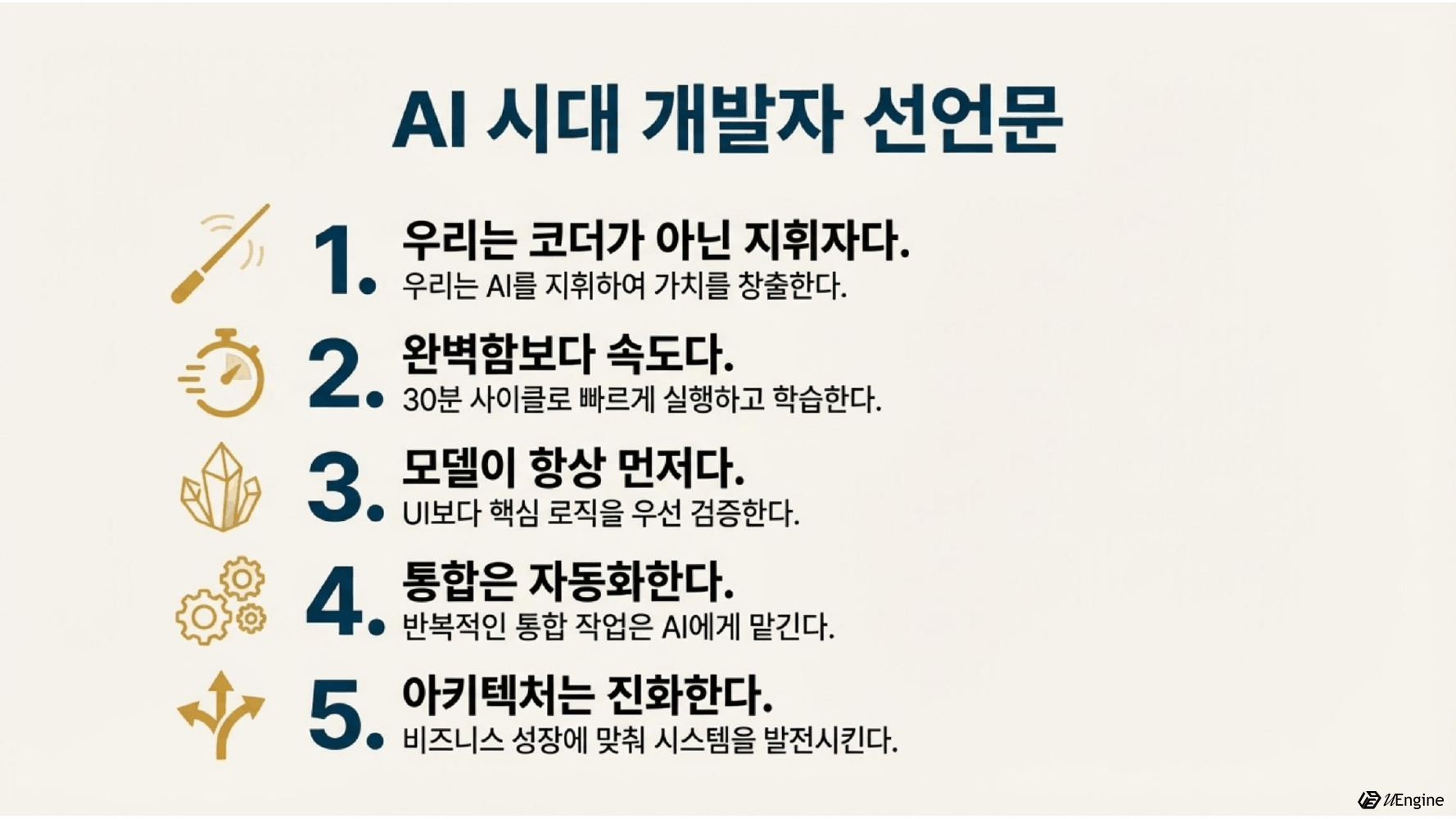
The developer manifesto for the AI era, shared with the contest participants.
The entry you submit to the Open Source Developer Contest may well be the core brain of some company 20 years from now — just as uEngine started with the grand prize at the 2003 contest and grew into today's agentic AI platform. We are rooting for you to become developers who own specs beyond code, and processes beyond demos.
The full slide deck from the talk can be downloaded below, and the product journey introduced in the talk continues on the Process GPT, Robo Architect, and Ontologic Platform pages.